Loading...
Done
Caoimhe Cooburn-Gray poses for a picture on St. Patrick's day in Dublin, Ireland March 17, 2016. (Photo by Clodagh Kilcoyne/Reuters)

Caoimhe Cooburn-Gray poses for a picture on St. Patrick's day in Dublin, Ireland March 17, 2016. Saint Patrick's Day is a cultural and religious celebration held on 17 March, the traditional death date of Saint Patrick (c. AD 385–461), the foremost patron saint of Ireland. Celebrations generally involve public parades and festivals, céilithe, and the wearing of shamrocks, as well as green or orange attire. (Photo by Clodagh Kilcoyne/Reuters)
Details
18 Mar 2016 12:39:00
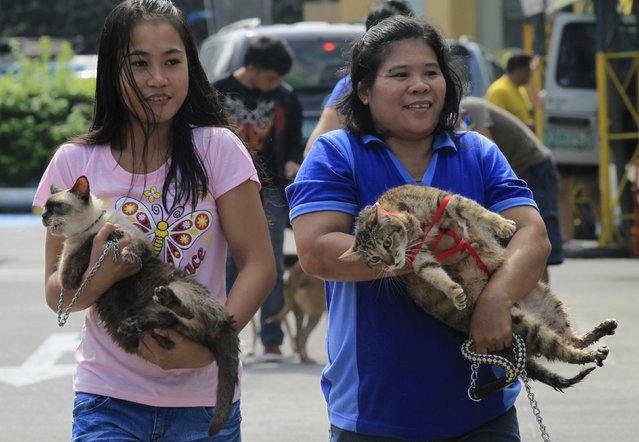
People carry their pets before the start of a pet blessing at Greenhills shopping mall in Manila October 3, 2015. (Photo by Romeo Ranoco/Reuters)

People carry their pets before the start of a pet blessing at Greenhills shopping mall in Manila October 3, 2015. Pets were blessed on Saturday in a celebration honouring the patron saint of animals Saint Francis of Assisi. (Photo by Romeo Ranoco/Reuters)
Details
05 Oct 2015 08:07:00
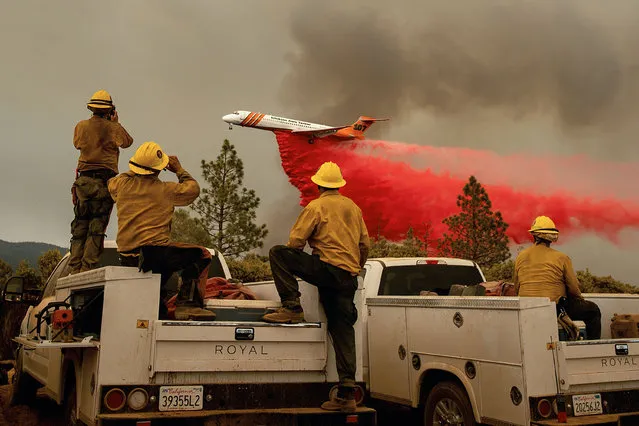
Firefighters watch as an air tanker drops retardant while battling the Ferguson fire in the Stanislaus National Forest, near Yosemite National Park, California on July 21, 2018. A fire that claimed the life of one firefighter and injured two others near California's Yosemite national park has almost doubled in size in three days, authorities said Friday. The US Department of Agriculture (USDA) said the so-called Ferguson fire had spread to an area of 22,892 acres (92.6 square kilometers), and is so far only 7 percent contained. (Photo by Noah Berger/AFP Photo)

Firefighters watch as an air tanker drops retardant while battling the Ferguson fire in the Stanislaus National Forest, near Yosemite National Park, California on July 21, 2018. A fire that claimed the life of one firefighter and injured two others near California's Yosemite national park has almost doubled in size in three days, authorities said Friday. (Photo by Noah Berger/AFP Photo)
Details
30 Jul 2018 00:01:00
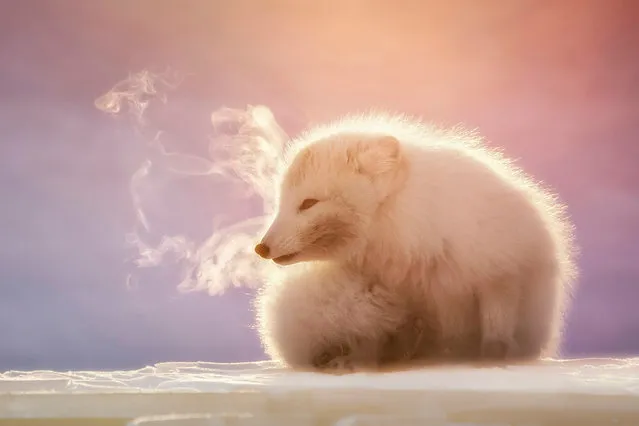
Breath of an Arctic fox by Marco Gaiotti, Italy. Marco was watching this little Arctic fox as it incessantly called another nearby. Gradually he noticed the fox’s wet breath was quickly freezing in the air after each call. It was late winter in Spitsbergen, Svalbard, and the air was -35C (-31F). Photographing Arctic foxes is often frustrating, as they are normally running around fast in search of food, but this one was very relaxed and let Marco get close enough to focus on it, with the light glowing perfectly in the background. (Photo by Marco Gaiotti/Wildlife Photographer of the Year 2021)

Breath of an Arctic fox by Marco Gaiotti, Italy. Marco was watching this little Arctic fox as it incessantly called another nearby. Gradually he noticed the fox’s wet breath was quickly freezing in the air after each call. It was late winter in Spitsbergen, Svalbard, and the air was -35C (-31F). Photographing Arctic foxes is often frustrating, as they are normally running around fast in search of food, but this one was very relaxed and let Marco get close enough to focus on it, with the light glowing perfectly in the background. (Photo by Marco Gaiotti/Wildlife Photographer of the Year 2021)
Details
05 Dec 2021 06:36:00
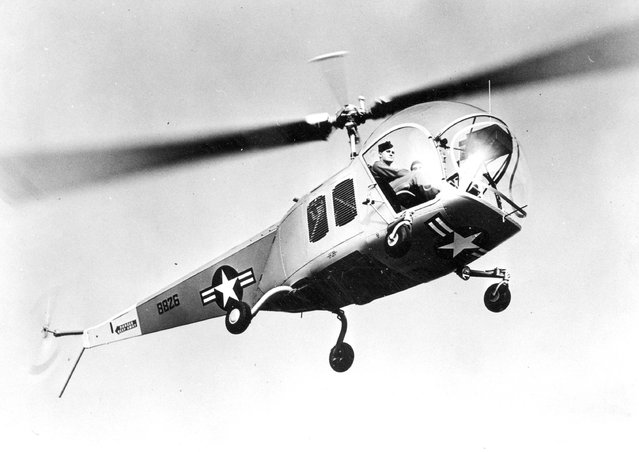
Number 10. BELL H-13 SIOUX was a two-bladed, single engine, light helicopter built by Bell Helicopter. Westland Aircraft manufactured the Sioux under license for the British military as the Sioux AH.1 and HT. (Photo by AP Photo)

Number 10. BELL H-13 SIOUX was a two-bladed, single engine, light helicopter built by Bell Helicopter. Westland Aircraft manufactured the Sioux under license for the British military as the Sioux AH.1 and HT. In 1947, the United States Air Force ordered the improved Bell Model 47A. Most were designated YR-13 and three winterized versions were designated YR-13A. The United States Army first ordered Bell 47s in 1948 under the designation H-13. These would later receive the name Sioux. The Bell-built H-13 B is seen airborne in this April 29, 1951 photo. The helicopter is equipped with a 173 horsepower engine, cruises at 85 miles per hour, climbs 900 feet in a minute and has a service ceiling of 11,500 feet. (Photo by AP Photo)
Details
08 Aug 2014 11:59:00
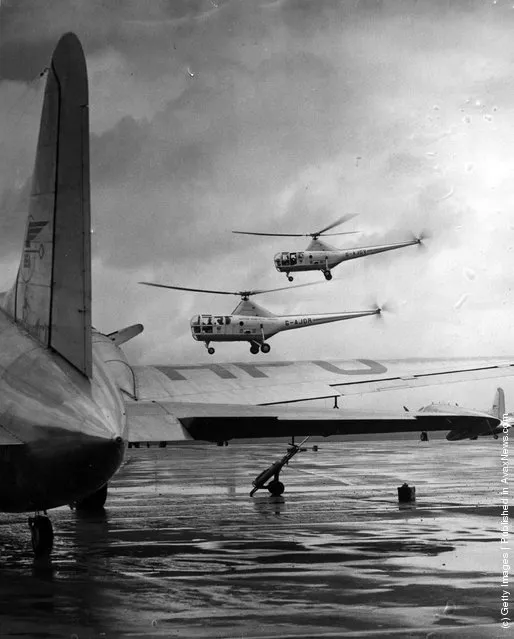
Sikorsky H-5 helicopters

“Igor Sikorsky (May 25, 1889 – October 26, 1972), born Igor Ivanovich Sikorsky was a Russian American pioneer of aviation in both helicopters and fixed-wing aircraft. He designed and flew the world's first multi-engine fixed-wing aircraft, the Russky Vityaz in 1913, and the first airliner, Ilya Muromets, in 1914. After immigrating to the United States in 1919, Sikorsky founded the Sikorsky Aircraft Corporation in 1923, and developed the first of Pan American Airways' ocean-conquering flying boats in the 1930s. In 1939 Sikorsky designed and flew the Vought-Sikorsky VS-300, the first viable American helicopter, which pioneered the rotor configuration used by most helicopters today. Sikorsky would modify the design into the Sikorsky R-4, which became the world's first mass-produced helicopter in 1942”. – Wikipedia

Photo: Westland Sikorsky H-5's, used by British European Airways Helicopters, which fly between London and Birmingham. The Sikorsky H-5, (aka R-5, S-51, HO3S-1, or Horse) (R-5 until 1948; company designation VS-327) is a helicopter built by Sikorsky Aircraft Corporation, formerly used by the United States Air Force, and its predecessor, the United States Army Air Forces, as well as the United States Navy and United States Coast Guard (with the designations HO2S and HO3S). (Photo by Harrison /Topical Press Agency/Getty Images). 22nd May 1951

Details
06 Sep 2011 10:18:00
Photography by Lyubomir Sergeev Part 2

Lyubomir Sergeev Bulgarian photographer Lyubomir Sergeev combines creepy contradictions in his masterfully composed shots.
Details
11 Nov 2013 09:45:00
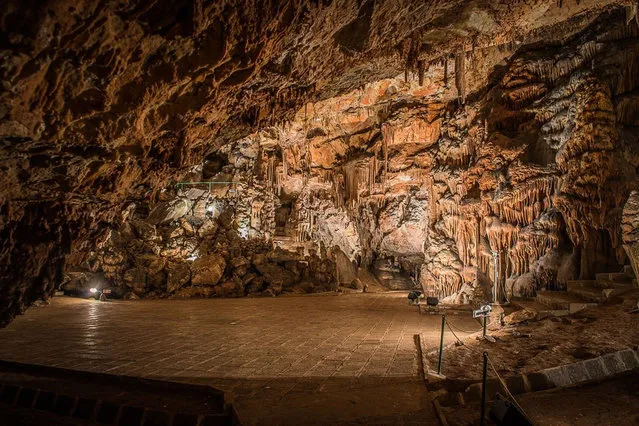
Saeva Dupka Cave

Saeva dupka (Bulgarian: Съева дупка) is a cave in Northern Bulgaria near the village of Brestnitsa, Lovech Province (43°2′N 24°11′E). Its five halls and 400 metres of corridors offer some of the most beautiful cave formations in the country. Besides that the cave has hosted many Choral music performances, thanks to the excellent acoustic conditions. Saeva dupka was named after two brothers Seyu and Sae who used it as a hiding place during the Ottoman occupation of Bulgaria. Recent excavations have showed the cave was inhabited since Roman times. Currently Saeva dupka is one of the 100 Tourist Sites of Bulgaria.
Details
20 Feb 2013 11:30:00