Loading...
Done
Jeff Byrd 500

David Reutimann, driver of the #00 Aaron's Dream Machine Toyota, Brian Vickers, driver of the #83 Red Bull Toyota, and Denny Hamlin, driver of the #11 FedEx Express Toyota, collide after an incident in the NASCAR Sprint Cup Series Jeff Byrd 500 Presented By Food City at Bristol Motor Speedway on March 20, 2011 in Bristol, Tennessee.
Details
20 Mar 2011 20:55:00
Brazil Soccer Calendar By Tim Tadder

A 2014 Soccer Calendar, inspired by the World Cup, and commissioned by a beer company (we can't provide client info) featuring women doing the 12 most famous moves in soccer.
Tim Tadder traveled around Brazil shooting the backgrounds and collaborated with the talented Mike Campau to blend the scenes together to create a truely unique set of images.
Details
24 Jun 2014 09:38:00
Police dog

Police dog handlers wait outside the Loftus Road stadium after FA Cup Fourth Round between Queens Park Rangers and Chelsea on January 28, 2012 in London, England. Security has been stepped up after QPR player Anton Ferdinand recieved a package containing a bullet. (Photo by Dan Kitwood/Getty Images)
Details
29 Jan 2012 12:25:00
An environmental activist performs during a protest in front of the headquarters of Brazilian mining company Vale SA in downtown Rio de Janeiro, Brazil, November 16, 2015. (Photo by Sergio Moraes/Reuters)

An environmental activist performs during a protest in front of the headquarters of Brazilian mining company Vale SA in downtown Rio de Janeiro, Brazil, November 16, 2015. The collapse of two dams at a Brazilian mine, owned by Vale SA and BHP Billiton Ltd, has cut off drinking water for quarter of a million people and saturated waterways downstream with dense orange sediment that could wreck the ecosystem for years to come. Nine people were killed, 19 are still listed as missing and 500 people were displaced from their homes when the dams burst at an iron ore mine in southeastern Brazil on November 5. (Photo by Sergio Moraes/Reuters)
Details
18 Nov 2015 08:00:00


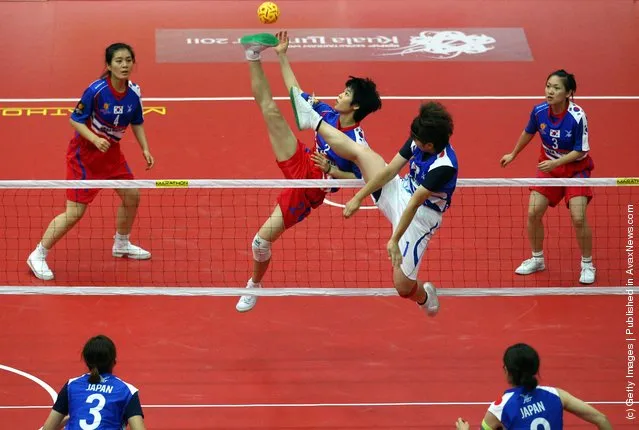
“Sepak takraw or kick volleyball, is a sport native to the Malay-Thai Peninsula. Sepak takraw differs from the similar sport of volleyball in its use of a rattan ball and only allowing players to use their feet, knee, chest and head to touch the ball. It is a popular sport in Indonesia, Malaysia, Thailand, Singapore, Myanmar, Vietnam, Cambodia, Laos, and Philippines”. – Wikipedia

Photo: Hyun Ju Kim of Korea kicks over the net against Yukie Sato of Japan during the round robin match between Korea and Japan during day one of the ISTAF Sepaktakraw World Cup at Titiwangsa Stadium on July 21, 2011 in Kuala Lumpur, Malaysia. (Photo by Ryan Pierse/Getty Images for UFA Sports)
Details
23 Jul 2011 11:45:00
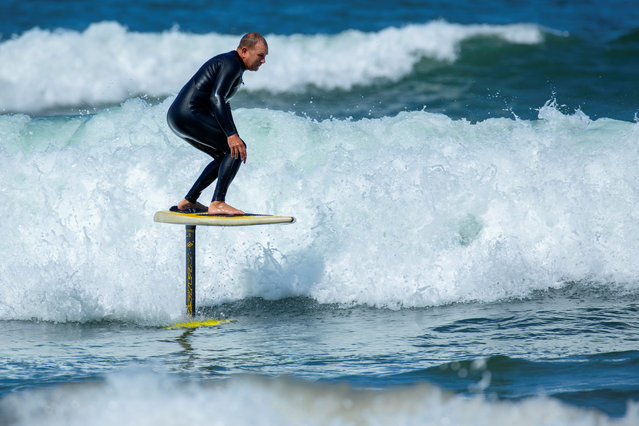
Surfer Gary Clisby rides his foil board on a morning swell of the coast of Carlsbad, California on May 23, 2018. (Photo by Mike Blake/Reuters)

Surfer Gary Clisby rides his foil board on a morning swell of the coast of Carlsbad, California on May 23, 2018. Harnessing the “foiling” technology more typically seen on racing catamarans in sailing's America's Cup, the surfboards appear to fly above the water thanks to a fin attached to the bottom of the board. (Photo by Mike Blake/Reuters)
Details
25 May 2018 00:03:00
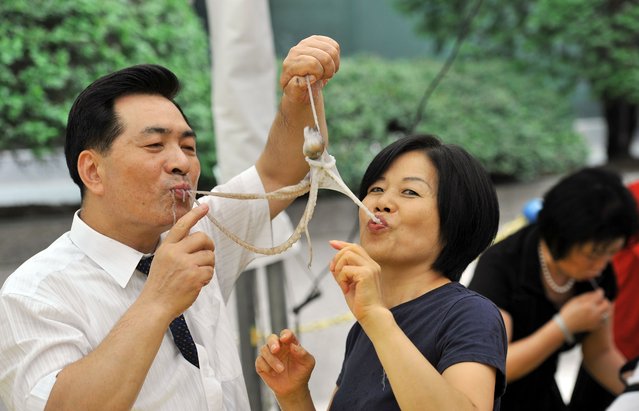
A South Korean man and a woman eat a live octopus during an event to promote a local food festival in Seoul on September 12, 2013. (Photo by Jung Yeon-Je/AFP Photo)

Live octopus is a delicacy in South Korea but is a known choking hazard, since the still-moving suction cups can cause tentacle pieces to stick in a person's throat. A baby octopus is often consumed whole, while larger varieties are cut up and the still-wriggling tentacles eaten with a splash of sesame oil. Photo: A South Korean man and a woman eat a live octopus during an event to promote a local food festival in Seoul on September 12, 2013. (Photo by Jung Yeon-Je/AFP Photo)
Details
13 Sep 2013 09:40:00


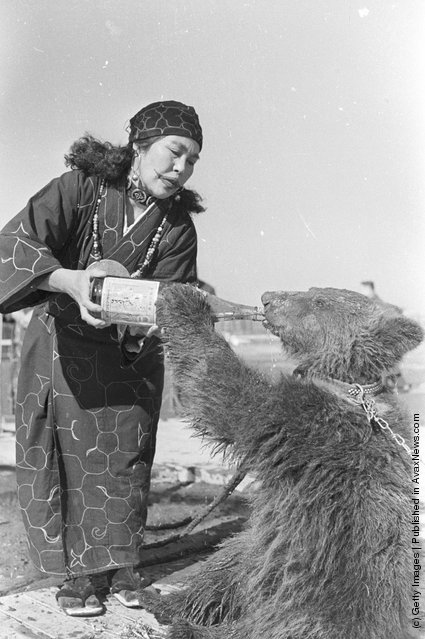
“The Ainu (アイヌ?), also called Aynu, Aino (アイノ), and in historical texts Ezo (蝦夷), are indigenous people or groups in Japan and Russia. Historically they spoke the Ainu language and related varieties and lived in Hokkaidō, the Kuril Islands, and much of Sakhalin. Most of those who identify themselves as Ainu still live in this same region, though the exact number of living Ainu is unknown. This is due to ethnic issues in Japan resulting in those with Ainu backgrounds hiding their identities and confusion over mixed heritages. In Japan, because of intermarriage over many years with Japanese, the concept of a 'pure Ainu' ethnic group is no longer feasible. Official estimates of the population are of around 25,000, while the unofficial number is upwards of 200,000 people”. – Wkipedia

Photo: A captive bear drinking from a large bottle held by an Ainu tribeswoman. (Photo by Evans/Three Lions/Getty Images). Circa 1955
Details
24 Mar 2011 14:01:00