Loading...
Done
A feminist activist uses a slingshot during a protest against gender violence and patriarchy in Santiago on November 29, 2019. Furious Chileans have since October 18 been protesting social and economic inequality, and against an entrenched political elite that comes from a small number of the wealthiest families in the country, among other issues. (Photo by Javier Torres/AFP Photo)

A feminist activist uses a slingshot during a protest against gender violence and patriarchy in Santiago on November 29, 2019. Furious Chileans have since October 18 been protesting social and economic inequality, and against an entrenched political elite that comes from a small number of the wealthiest families in the country, among other issues. (Photo by Javier Torres/AFP Photo)
Details
02 Dec 2019 00:07:00
Local residents crowd a swimming pool during a hot weather in Suining, Sichuan province, 27 July 2008. (Photo by Reuters/Stringer)

Local residents crowd a swimming pool during a hot weather in Suining, Sichuan province, 27 July 2008. (Photo by Reuters/Stringer)
Details
19 Sep 2016 08:54:00
A street scene in London’s Covent Garden with the underground station and a horse and cart in the background in c.1930 and the same street in 2014. (Photo by Museum of London/Streetmuseum app)

“For most Londoners, the most common view they enjoy as they trudge to work is the back of another commuter's head. But now, thanks to the Streetmuseum app, anyone traipsing through the capital's streets can step back in time to see what London looked like in the 19th and 20th century compared with today – all in the same image”. – Joe Krishnan via The Independent. Photo: A street scene in London’s Covent Garden with the underground station and a horse and cart in the background in c.1930 and the same street in 2014. (Photo by Museum of London/Streetmuseum app)
Details
27 Feb 2014 06:48:00
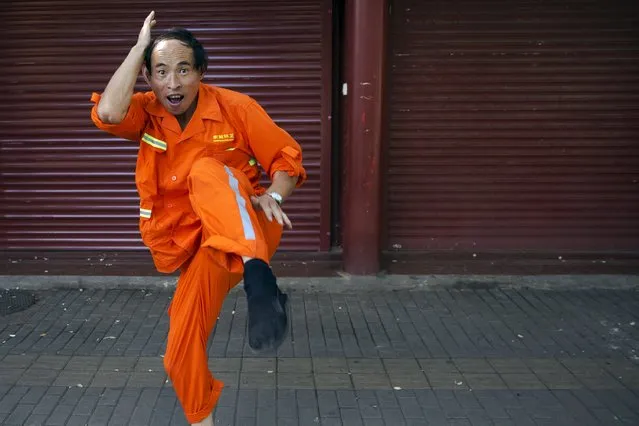
A street cleaner demonstrates his martial arts skills in front of a closed shop near Beijing's Tiananmen Square September 2, 2015 as the capital prepares for tomorrow's parade. (Photo by Damir Sagolj/Reuters)

A street cleaner demonstrates his martial arts skills in front of a closed shop near Beijing's Tiananmen Square September 2, 2015 as the capital prepares for tomorrow's parade. (Photo by Damir Sagolj/Reuters)
Details
07 Sep 2015 12:35:00
In this Thursday, December 1, 2016 photo, Cat Bigney, part of the Oglala Native American tribe, waits on the shore of the Cannonball river for travelers to arrive by canoe at the Oceti Sakowin camp where people have gathered to protest the Dakota Access oil pipeline in Cannon Ball, N.D. So far, those at the camp have shrugged off the heavy snow, icy winds and frigid temperatures. But if they defy next week's government deadline to abandon the camp, demonstrators know the real deep freeze lies ahead. Life-threatening wind chills and towering snow drifts could mean the greatest challenge is simple survival. (Photo by David Goldman/AP Photo)

In this Thursday, December 1, 2016 photo, Cat Bigney, part of the Oglala Native American tribe, waits on the shore of the Cannonball river for travelers to arrive by canoe at the Oceti Sakowin camp where people have gathered to protest the Dakota Access oil pipeline in Cannon Ball, N.D. So far, those at the camp have shrugged off the heavy snow, icy winds and frigid temperatures. But if they defy next week's government deadline to abandon the camp, demonstrators know the real deep freeze lies ahead. Life-threatening wind chills and towering snow drifts could mean the greatest challenge is simple survival. (Photo by David Goldman/AP Photo)
Details
06 Dec 2016 10:22:00
A man takes a picture of models as they pose next to Cosmis Racing Wheels products during the 2016 Moscow International Auto Salon in Moscow, Russia, August 26, 2016. (Photo by Sergei Karpukhin/Reuters)

A man takes a picture of models as they pose next to Cosmis Racing Wheels products during the 2016 Moscow International Auto Salon in Moscow, Russia, August 26, 2016. (Photo by Sergei Karpukhin/Reuters)
Details
27 Aug 2016 11:10:00
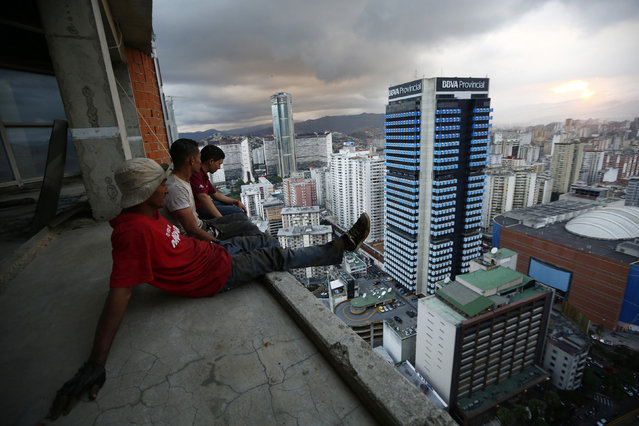
Men rest after salvaging metal on the 30th floor of the “Tower of David” skyscraper in Caracas February 3, 2014. A 45-storey skyscraper in the center of Venezuela's capital Caracas is a slum, probably the highest in the world. Dubbed the “Tower of David”, the building was intended to be a shining new financial center but was abandoned around 1994 after the death of its developer – banker and horse-breeder David Brillembourg – and the collapse of the financial sector. (Photo by Jorge Silva/Reuters)

Men rest after salvaging metal on the 30th floor of the “Tower of David” skyscraper in Caracas February 3, 2014. A 45-storey skyscraper in the center of Venezuela's capital Caracas is a slum, probably the highest in the world. Dubbed the “Tower of David”, the building was intended to be a shining new financial center but was abandoned around 1994 after the death of its developer – banker and horse-breeder David Brillembourg – and the collapse of the financial sector. (Photo by Jorge Silva/Reuters)
Details
03 Apr 2014 12:05:00
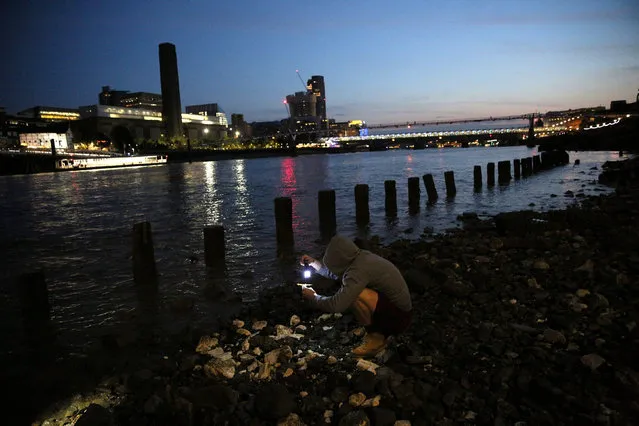
A mudlark uses a torch to look for items on the bank of the River Thames in London, Britain June 06, 2016. Mudlarking is believed to trace its origins to the 18th and 19th century, when scavengers searched the Thames' shores for items to sell. These days, history and archaeology fans are the ones hoping to find old relics such as coins, ceramics, artifacts or everyday items from across centuries. They wait for the low tide and then scour specific areas of exposed shores. "If you're in a field you could be out all day long, with the river you're restricted to about two or three hours," mudlark Nick Stevens said. While many just use the naked eye for their searches, others rely on metal detectors for which a permit from the Port of London Authority is needed. Digging also requires consent. (Photo by Neil Hall/Reuters)

A mudlark uses a torch to look for items on the bank of the River Thames in London, Britain June 06, 2016. Mudlarking is believed to trace its origins to the 18th and 19th century, when scavengers searched the Thames' shores for items to sell. These days, history and archaeology fans are the ones hoping to find old relics such as coins, ceramics, artifacts or everyday items from across centuries. their finds with the Portable Antiquities Scheme. Any item over 300 years old must be recorded. (Photo by Neil Hall/Reuters)
Details
27 Aug 2016 10:43:00