Loading...
Done
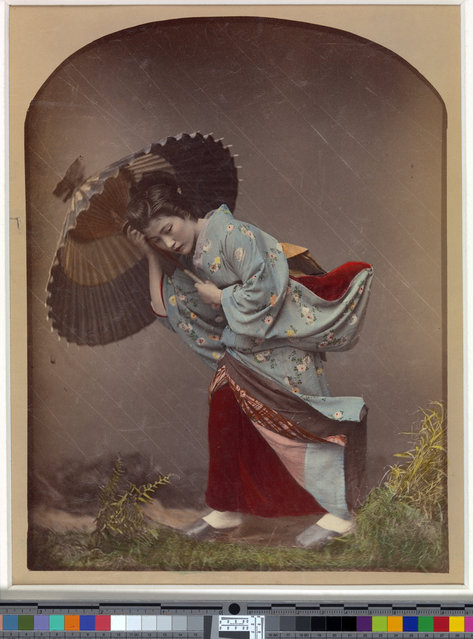
“Woman with Umbrella in Rain” by Raimund von Stillfried. Artist: Kusakabe Kimbei (Japanese, 1841–1934), 1870s. (Photo courtesy of The Metropolitan Museum of Art)

“Woman with Umbrella in Rain” by Raimund von Stillfried. Artist: Kusakabe Kimbei (Japanese, 1841–1934), 1870s. Commercial photography studios in Meiji-era Japan were renowned for the subtlety and refinement of their coloring techniques. This hand-tinted image of a young woman caught in a heavy rainstorm achieved its naturalistic effect by knitting together multiple strands of artifice: the greenery in the foreground was a studio prop; the flaps of the kimono were suspended by thin wires to create the impression of a strong wind; and long, diagonal marks were made on the negative to suggest streaks of rain. (Photo courtesy of The Metropolitan Museum of Art)
Details
12 May 2013 10:13:00
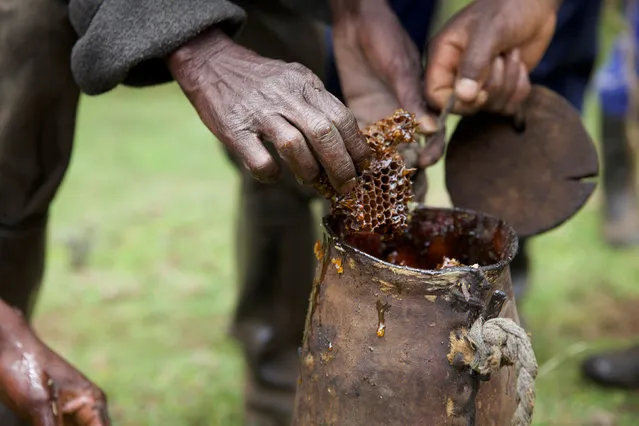
A man from the Ogiek community harvests honey in Mount Elgon game reserve, where they have reached an agreement with the government allowing them to remain in their ancestral lands in western Kenya, April 26, 2016. (Photo by Katy Migiro/Reuters)

A man from the Ogiek community harvests honey in Mount Elgon game reserve, where they have reached an agreement with the government allowing them to remain in their ancestral lands in western Kenya, April 26, 2016. (Photo by Katy Migiro/Reuters)
Details
20 May 2016 12:51:00
Kale grows at Kajodlingen farm in Gothenburg, Sweden, September 28, 2016. (Photo by Maxim Shemetov/Reuters)

Kale grows at Kajodlingen farm in Gothenburg, Sweden, September 28, 2016. They are doing it on the rooftops, on tower block balconies and even on a disused railway: Swedes have discovered a passion for urban gardening as a way of growing fresh food and getting back in touch with nature. Part of a global movement, an increasing number of Swedish city-dwellers are growing their own in window boxes and allotments or are visiting public gardens built in or on industrial or office spaces. (Photo by Maxim Shemetov/Reuters)
Details
11 Nov 2016 07:58:00
A resident walks past big waves spilling over a wall onto a coastal road in the city of Legaspi in Albay province, south of Manila on December 14, 2015, as typhoon Melor approaches the city. More than 700,000 people fled the central Philippines amid threats of giant waves, floods and landslides as powerful Typhoon Melor approached the archipelago nation, officials said December 14. (Photo by Charism Sayat/AFP Photo)

A resident walks past big waves spilling over a wall onto a coastal road in the city of Legaspi in Albay province, south of Manila on December 14, 2015, as typhoon Melor approaches the city. More than 700,000 people fled the central Philippines amid threats of giant waves, floods and landslides as powerful Typhoon Melor approached the archipelago nation, officials said December 14. (Photo by Charism Sayat/AFP Photo)
Details
15 Dec 2015 11:34:00
Devotees ride on the roof of a train as they return to the city after attending the final prayers on the first phase of Bishwa Ijtema in Dhaka January 11, 2015. Hundreds of thousands of pilgrims congregated in the Bangladeshi capital Dhaka as the first phase of this year's Bishwa Ijtema, one of the biggest Islamic gatherings in the world after the Haj in Saudi Arabia, came to an end. (Photo by Reuters/Stringer)

Devotees ride on the roof of a train as they return to the city after attending the final prayers on the first phase of Bishwa Ijtema in Dhaka January 11, 2015. Hundreds of thousands of pilgrims congregated in the Bangladeshi capital Dhaka as the first phase of this year's Bishwa Ijtema, one of the biggest Islamic gatherings in the world after the Haj in Saudi Arabia, came to an end. (Photo by Reuters/Stringer)
Details
17 Jan 2015 12:10:00
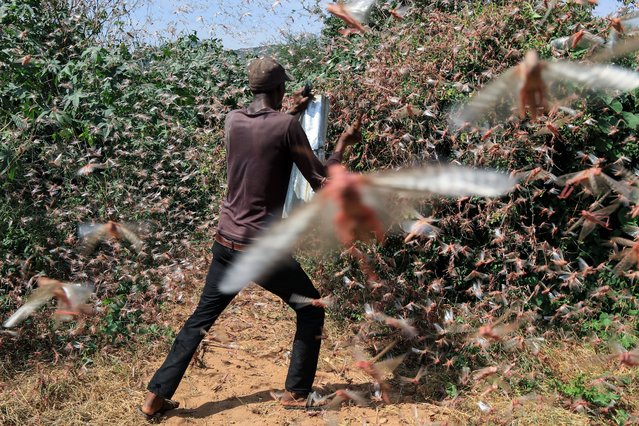
A man uses iron sheet to make noises, as a way of trying to disperse desert locusts that had invaded their farms during the second wave invasion in Kakongo village, in Nuu-Mwingi East, in Kitui, Kenya, 06 February 2021. The second wave invasion of the desert locusts in the country comes at a time where most famers are expecting to harvest their farm produce in the country. According to the United Nations Food and Agriculture Organization (FAO), on 04 February, warned numerous immature desert locust swarms persist in southern Ethiopia and Kenya. Some of the swarms are in community areas and therefore cannot be treated. In Kenya, immature swarms continue to spread westwards across northern and central counties where there are currently about 20 small swarms present, mostly about 50 hectares in size, it said. (Photo by Daniel Irungu/EPA/EFE)

A man uses iron sheet to make noises, as a way of trying to disperse desert locusts that had invaded their farms during the second wave invasion in Kakongo village, in Nuu-Mwingi East, in Kitui, Kenya, 06 February 2021. The second wave invasion of the desert locusts in the country comes at a time where most famers are expecting to harvest their farm produce in the country. (Photo by Daniel Irungu/EPA/EFE)
Details
25 Feb 2021 08:17:00
Young women prepare for Notting Hill Carnival on August 27, 2017 in London, England. The Notting Hill Carnival began with a special ceremony of remembrance following the Grenfell fire tragedy. (Photo by Leon Neal/Getty Images)

Young women prepare for Notting Hill Carnival on August 27, 2017 in London, England. The Notting Hill Carnival began with a special ceremony of remembrance following the Grenfell fire tragedy. (Photo by Leon Neal/Getty Images)
Details
28 Aug 2017 12:10:00
Romain de Tirtoff (Erte) – Symphony In Black

“Romain de Tirtoff (23 November 1892 – 21 April 1990) was a Russian-born French artist and designer known by the pseudonym Erté, the French pronunciation of his initials, R.T. He was a diversely talented 20th-century artist and designer who flourished in an array of fields, including fashion, jewellery, graphic arts, costume and set design for film, theatre, and opera, and interior decor”. – Wikipedia. Photo: Romain de Tirtoff (Erte) – “Symphony In Black” (please click to enlarge).
Details
29 Jan 2014 13:34:00