Loading...
Done


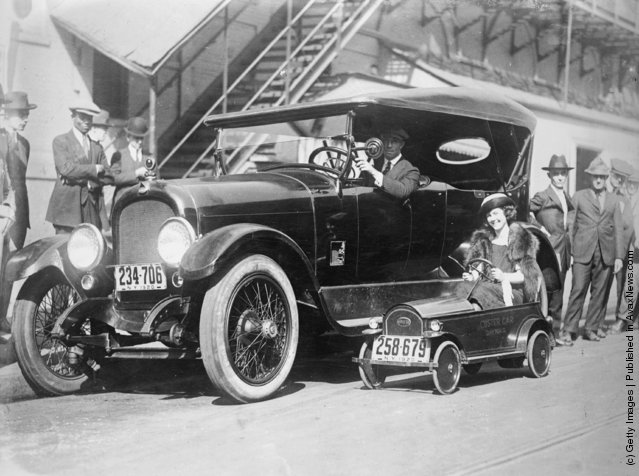
“Custer” the smallest car in the US. (Photo by Topical Press Agency/Getty Images). 1920
Details
28 Mar 2011 14:10:00
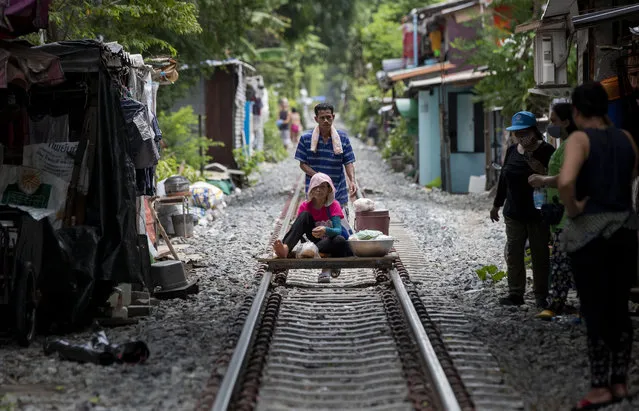
A vendor pushes an improvised cart with a woman and merchandise along a rarely used rail track in Bangkok, Thailand, Thursday, June 25, 2020. Daily life in the capital slowly returns to normal as the Thai government eases many restrictions imposed weeks ago to combat the spread of COVID-19. Though emergency regulations require the use of face masks in public, some residents have become apathetic as Thailand has record zero local transmission for over three weeks. (Photo by Gemunu Amarasinghe/AP Photo)

A vendor pushes an improvised cart with a woman and merchandise along a rarely used rail track in Bangkok, Thailand, Thursday, June 25, 2020. Daily life in the capital slowly returns to normal as the Thai government eases many restrictions imposed weeks ago to combat the spread of COVID-19. Though emergency regulations require the use of face masks in public, some residents have become apathetic as Thailand has record zero local transmission for over three weeks. (Photo by Gemunu Amarasinghe/AP Photo)
Details
17 Jul 2020 00:05:00
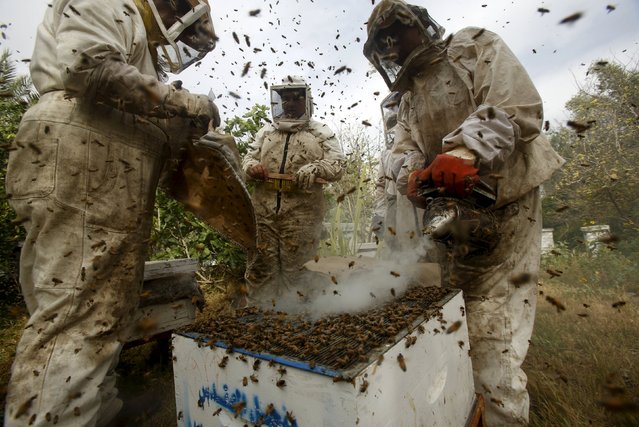
A Palestinian beekeeper uses smoke to calm bees in the process of collecting honey at a farm in Rafah, in the southern Gaza Strip April 11, 2016. (Photo by Suhaib Salem/Reuters)

A Palestinian beekeeper uses smoke to calm bees in the process of collecting honey at a farm in Rafah, in the southern Gaza Strip April 11, 2016. Rateb Samour sees 250 patients a day, whose complaints range from hair loss to cerebral palsy and cancer. He is not a doctor and has never worked in a hospital. Samour inherited the skill of bee-sting therapy from his father. From 2003 the agricultural engineer dedicated all his time to study and develop the alternative-medicine treatment of apitherapy, which uses bee-related products from honey, propolis – or bee glue used to build hives – to venom. (Photo by Suhaib Salem/Reuters)
Details
13 Apr 2016 09:14:00
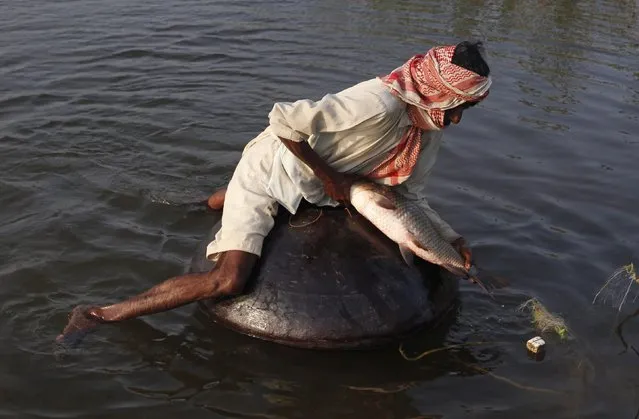
A man uses a floating pitcher to catch a fish after removing it from a net at Keenjhar Lake, near Thatta, February 22, 2015. This technique of fishing using floating pitchers is a unique and traditional one for this community, found only on Keenjhar Lake, one of the largest freshwater lakes in Pakistan, which is famous for its variety of breeding and wintering waterbirds. (Photo by Akhtar Soomro/Reuters)

A man uses a floating pitcher to catch a fish after removing it from a net at Keenjhar Lake, near Thatta, February 22, 2015. This technique of fishing using floating pitchers is a unique and traditional one for this community, found only on Keenjhar Lake, one of the largest freshwater lakes in Pakistan, which is famous for its variety of breeding and wintering waterbirds. (Photo by Akhtar Soomro/Reuters)
Details
23 Feb 2015 13:27:00
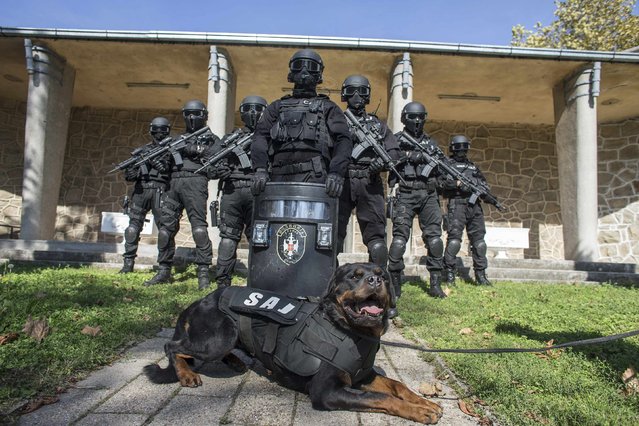
Serbian police officers of the Special Anti-Terrorist Unit pose for a picture in their base outside Belgrade October 8, 2014. (Photo by Marko Djurica/Reuters)

Serbian police officers of the Special Anti-Terrorist Unit pose for a picture in their base outside Belgrade October 8, 2014. When the killing of an unarmed black teenager by a white policeman in Ferguson, Missouri, in August sparked sometimes violent protests, the response of police in camouflage gear and armoured vehicles wielding stun grenades and assault rifles seemed more like a combat operation than a public order measure. Some U.S. police departments have recently acquired U.S. military-surplus hardware from wars abroad, but there are many law enforcers around the world whose rules of engagement also allow the use of lethal force with relatively few restrictions. But for every regulation that gives police wide scope to use firearms, there is another code that sharply limits their use. In Serbia, police may use measures ranging from batons to special vehicles, water cannon and tear gas on groups of people who have gathered illegally and are behaving in a way that is violent or could cause violence, but they may use firearms only when life is endangered. (Photo by Marko Djurica/Reuters)
Details
27 Nov 2014 14:53:00
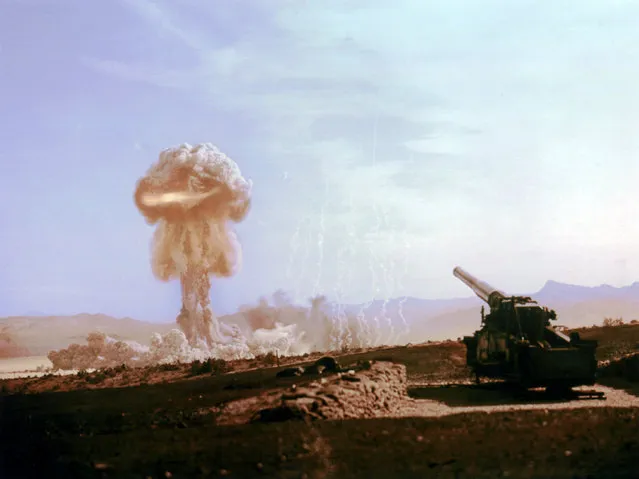
Atomic Annie at work during the Upshot-Knothole test series, 1953. (Photo by Los Alamos National Laboratory/US Army)

“A fter the former Soviet Union conducted its first nuclear test in August 1949, the US reevaluated its postwar defense policies. With the US monopoly on atomic weapons broken, military and political leaders chose to diversify the American stockpile by developing thermonuclear and tactical nuclear weapons. One of the more interesting concepts to come out of this period was atomic artillery, which was successfully tested at the Nevada Proving Grounds (now the Nevada Test Site) in May 1953”. – Alan Carr. Photo: Atomic Annie at work during the Upshot-Knothole test series, 1953. (Photo by Los Alamos National Laboratory/US Army)
Details
11 Mar 2013 11:43:00
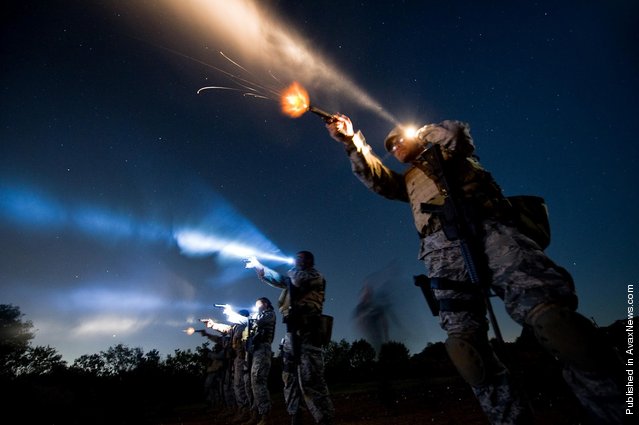
Tech. Sgt. Milo Hinson, 3rd Combat Camera Squadron, uses a flashlight while shooting a Berretta 9mm during the night-fire portion of Advance Weapons, Tactics and Techniques training in San Antonio. During night-fire training, airmen learn how to tactically illuminate targets with flashlights and practice using night vision goggles

Tech. Sgt. Milo Hinson, 3rd Combat Camera Squadron, uses a flashlight while shooting a Berretta 9mm during the night-fire portion of Advance Weapons, Tactics and Techniques training in San Antonio. During night-fire training, airmen learn how to tactically illuminate targets with flashlights and practice using night vision goggles. (Photo by Staff Sgt. Jonathan Snyder/U.S. Air Force). 2011
Details
12 Apr 2012 12:53:00
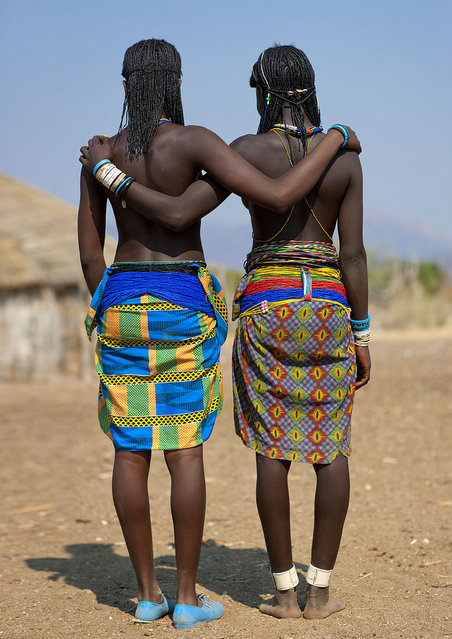
“Show us our butts! Mucawana tribe – Angola. In Soba village, the Muhacaona (Mucawana) tribe, perhaps the best place i have visited. They use cow dung and fat to make this so nice haircut, and love the beads. They asked me to make pictures of their backs... and butts to see on the camera screen if everything was perfect!”. (Eric Lafforgue)

“Show us our butts! Mucawana tribe – Angola. In Soba village, the Muhacaona (Mucawana) tribe, perhaps the best place i have visited. They use cow dung and fat to make this so nice haircut, and love the beads. They asked me to make pictures of their backs... and butts to see on the camera screen if everything was perfect!”. (Photo and comments by Eric Lafforgue)
Details
09 Nov 2012 15:04:00