Loading...
Done
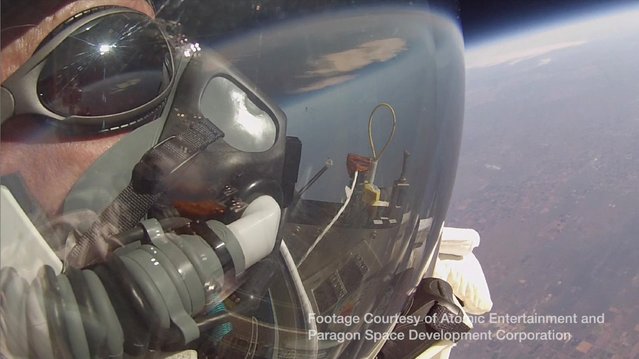
Google's vice president Alan Eustace looks out of his spacesuit into the stratosphere prior to a record-breaking skydive over New Mexico, in this still image taken from video October 24, 2014, a handout courtesy of the Paragon Space Development Corporation. Eustace was lifted up 135,890 ft (41,420 metres) by an enormous balloon while wearing a specially designed pressurized space suit, the Paragon Space Development Corporation said. (Photo by Reuters/Paragon Space Development Corporation)

Google's vice president Alan Eustace looks out of his spacesuit into the stratosphere prior to a record-breaking skydive over New Mexico, in this still image taken from video October 24, 2014, a handout courtesy of the Paragon Space Development Corporation. Eustace was lifted up 135,890 ft (41,420 metres) by an enormous balloon while wearing a specially designed pressurized space suit, the Paragon Space Development Corporation said. Eustace remained in a free fall for approximately 4.5 minutes before landing safely nearly 70 miles (43.4 kms) from his launch point, setting a world record for the highest skydive and breaking the sound barrier in the process. Eustace landed safely on the ground just 15 minutes after he was lifted into the air. (Photo by Reuters/Paragon Space Development Corporation)
Details
26 Oct 2014 12:16:00
Women wear the traditional costume of the Alto Tio Diego carnival during the Women's Afro-Mestizo Carnival of Alto Tio Diego on February 11, 2024 in Veracruz, Mexico. Alto Tio Diego is a small town near the State capital Xalapa where every year inhabitants celebrate their traditional carnival. Women of the town demanded a special day for them to parade and few years ago, they started to do it by walking through the streets wearing traditional costumes and masks (mostly of animals) but the attires have evolved to more modern characters. (Photo by Hector AD Quintanar/Getty Images)

Women wear the traditional costume of the Alto Tio Diego carnival during the Women's Afro-Mestizo Carnival of Alto Tio Diego on February 11, 2024 in Veracruz, Mexico. Alto Tio Diego is a small town near the State capital Xalapa where every year inhabitants celebrate their traditional carnival. Women of the town demanded a special day for them to parade and few years ago, they started to do it by walking through the streets wearing traditional costumes and masks (mostly of animals) but the attires have evolved to more modern characters. (Photo by Hector AD Quintanar/Getty Images)
Details
24 May 2025 02:27:00
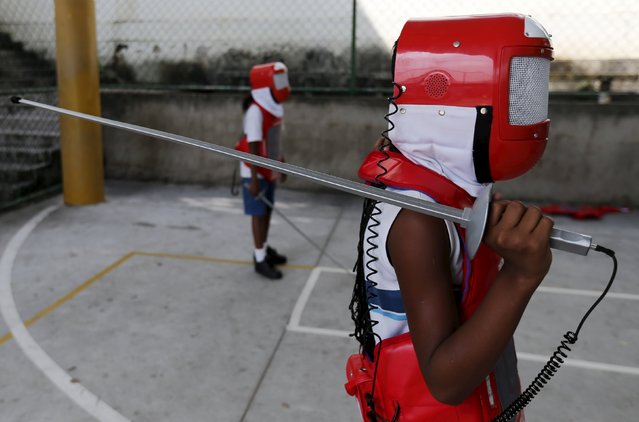
A child, from Municipal school Parana, poses during the project “Fencing School” in Rio de Janeiro, Brazil, March 30, 2016. (Photo by Sergio Moraes/Reuters)

A child, from Municipal school Parana, poses during the project “Fencing School” in Rio de Janeiro, Brazil, March 30, 2016. Children in Rio de Janeiro lift their sights and their swords to new idols, as a round of fencing workshops takes to public schools. The International Fencing Federation, together with the Brazilian and state federations, will reach 40 public schools in March and April. The aim is to whip up a following for the Olympic sport, little known in the soccer-mad nation, as Rio sets the stage for the Summer Games in August. (Photo by Sergio Moraes/Reuters)
Details
02 Apr 2016 09:25:00
Zulmira Jesus poses for a portrait at a street in Povoa de Agracoes, near Chaves, Portugal April 19, 2016. (Photo by Rafael Marchante/Reuters)

Zulmira Jesus poses for a portrait at a street in Povoa de Agracoes, near Chaves, Portugal April 19, 2016. In the villages of Agracoes and Povoa de Agracoe, the steady drip-drip of emigration has brought down population numbers from more than 50 residents to fewer than a dozen each. These remaining villagers share the same glum acceptance that, after they have gone, their villages will die out too. It is the same desolate picture in scores of other backwater settlements in Portugal's interior, north to south. (Photo by Rafael Marchante/Reuters)
Details
29 Apr 2016 12:05:00
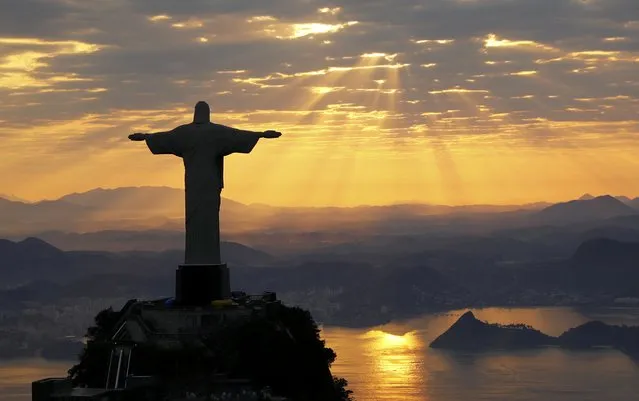
Jesus Christ The Redeemer is seen during sunrise in Rio de Janeiro, Brazil August 2, 2016. (Photo by Wolfgang Rattay/Reuters)

Jesus Christ The Redeemer is seen during sunrise in Rio de Janeiro, Brazil August 2, 2016. Christ the Redeemer is an Art Deco statue of Jesus Christ in Rio de Janeiro, Brazil, created by Polish-French sculptor Paul Landowski and built by the Brazilian engineer Heitor da Silva Costa, in collaboration with the French engineer Albert Caquot. The face was created by the Romanian artist Gheorghe Leonida1. (Photo by Kai Pfaffenbach/Reuters)
Details
03 Aug 2016 11:33:00
Instructor Raquel Potí leads a stilt walking workshop at the Museum of Modern Art in Rio de Janeiro, Brazil, Saturday, January 27, 2024.  Potí is chiefly responsible for the explosion of stilt walking in Rio, having trained more than 1,000 kids and adults over the past decade. (Photo by Silvia Izquierdo/AP Photo)

Instructor Raquel Potí leads a stilt walking workshop at the Museum of Modern Art in Rio de Janeiro, Brazil, Saturday, January 27, 2024. Potí is chiefly responsible for the explosion of stilt walking in Rio, having trained more than 1,000 kids and adults over the past decade. (Photo by Silvia Izquierdo/AP Photo)
Details
02 Mar 2024 00:53:00
Colombia's Tatiana Renteria Renteria (red) wrestles Japan's Yuka Kagami (blue) in their women's freestyle 76kg wrestling semi-final match at the Champ-de-Mars Arena during the Paris 2024 Olympic Games, in Paris on August 10, 2024. (Photo by Punit Paranjpe/AFP Photo)

Colombia's Tatiana Renteria Renteria (red) wrestles Japan's Yuka Kagami (blue) in their women's freestyle 76kg wrestling semi-final match at the Champ-de-Mars Arena during the Paris 2024 Olympic Games, in Paris on August 10, 2024. (Photo by Punit Paranjpe/AFP Photo)
Details
04 Dec 2025 03:07:00
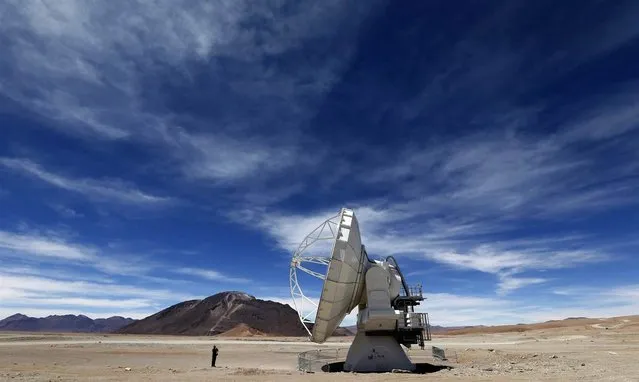
A man takes a photo of a radio antenna that's part of the Atacama Large Milimeter Array Observatory on March 12, 2013 at Llano de Chajnantor, about 43 miles (70 kilometers) from San Pedro de Atacama, Chile. The $1.5 billion ALMA facility, which had its official inauguration on March 13, is considered the world's most expensive ground-based observatory. (Photo by Felipe Trueba/EPA)

A man takes a photo of a radio antenna that's part of the Atacama Large Milimeter Array Observatory on March 12, 2013 at Llano de Chajnantor, about 43 miles (70 kilometers) from San Pedro de Atacama, Chile. The $1.5 billion ALMA facility, which had its official inauguration on March 13, is considered the world's most expensive ground-based observatory. (Photo by Felipe Trueba/EPA)
Details
03 Apr 2013 09:25:00