Loading...
Done
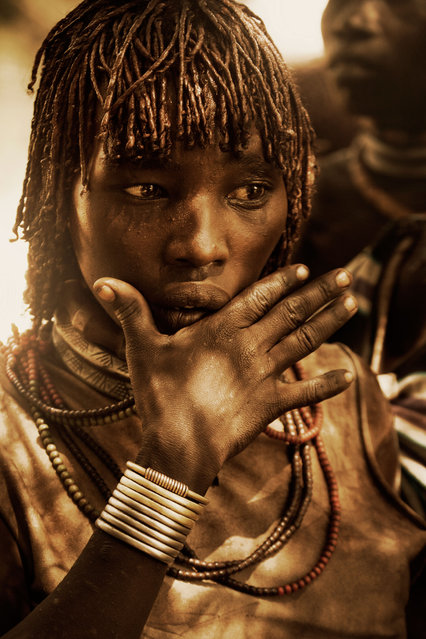
The Hamar people traditionally use red ocher clay to braid the hair of their women. (Photo by Diego Arroyo)

During his time in Ethiopia, New York-based art director and photographer Diego Arroyo spent time with the Hamar, Mursi, Dassanech, and Arbore Tribes. They, along with several others tribes, make up the 200,000 people situated in Africa’s Great Rift Valley. The people of the Omo Valley are still primarily herders and farmers, living an isolated and simple life. While they have yet to be truly touched by globalization, they could soon disappear. Their way of life is being threatened by a massive hydroelectric dam. (Photo by Diego Arroyo)
Details
13 Aug 2014 10:00:00
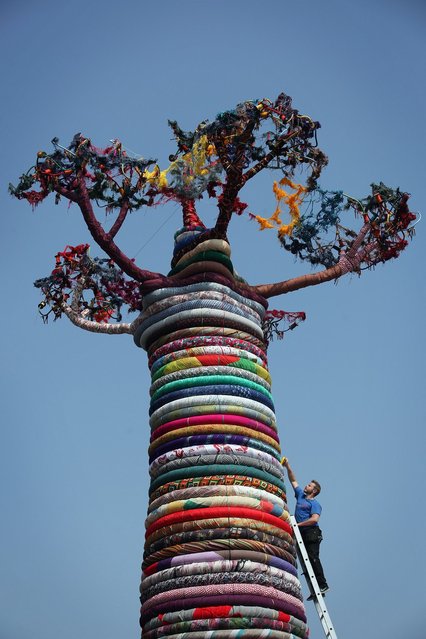
The Pirate Technics Sculpture “Under The Baobab”  by Mike De Butts Is Installed At The Southbank Centre

Mike De Butts adds the finishing touches to a giant Baobab Tree sculpture entitled “Under the Baobab”, outside the Southbank Centre on May 24, 2012 in London, England. The Pirate Technics' installation is made from a selection of brightly coloured fabrics from around the world, and is part of the Southbank Centre's “Festival of the World” exhibition, which includes a series of large scale pieces of art that will be in place around the Southbank centre over the Summer. (Photo by Dan Kitwood)
Details
29 May 2012 10:42:00
New Illustrations In The Sky Between Buildings By Thomas Lamadieu

French artist Thomas Lamadieu, also know as Roots Art, must really love looking at the sky. Every time he looks up, Thomas sees a potential canvas where the building rooftops frame the sky. He photographs it and uses the odd sky shapes to create whimsical line drawings. “My artistic aim is to show a different perception of urban architecture and the everyday environment around us, what we can construct with a boundless imagination,” says Thomas. (Photo by Thomas Lamadieu)


See Also:Whimsical Sky Art by Thomas Lamadieu
Details
26 Apr 2014 11:43:00
Black women in Brazil sit at the intersection of racism and misogyny, and have in recent years been at the forefront of a movement that challenges issues ranging from sexual and domestic violence to police brutality and stereotyping. Kolor Collective considers itself to be a part of this movement and questions expectations imposed on black women with satirical and subversive images, as seen here. (Photo by Kolor Art Collective/The Guardian)

Photographer Pol Kurucz’s vivid collection of photos explores issues faced by black Brazilian women, from political misrepresentation to unrealistic beauty standards. Kolor Collective is a Rio de Janeiro-based creative group that challenges the struggle faced by black women in Brazil through theatrical and provocative art. It was founded in 2015 by Franco-Hungarian photographer Pol Kurucz, who often touches on his own experiences of discrimination to call out sensitive social problems. (Photo by Kolor Art Collective/The Guardian)
Details
28 Dec 2016 07:24:00
Nino, a ten-year-old toreador apprentice of the French Tauromachy Centre, nicknamed El Nino, touches a practice bull at the bullring of Garons, near Nimes, September 25, 2013. (Photo by Jean-Paul Pelissier/Reuters)

Nino, a ten-year-old toreador apprentice of the French Tauromachy Centre, nicknamed El Nino, touches a practice bull at the bullring of Garons, near Nimes, September 25, 2013. Since 1983, the French Tauromachy Centre in Nimes has trained some 1,000 youths in the art of bullfighting. Twenty of them have gone on to become professional matadors, facing fighting bulls in the arena. Twice a week, students take courses with a matador to learn the movements and gestures of the bullfighter in the ring, but without an animal present. Students train with calves in the surrounding fields during spring, and regularly participate in beginner's bullfights (becerradas) without killing calves. Solal has been taking courses for three years and Nino, for just a year now. Both are normally enrolled in French public schools, but have one thought in mind – bullfighting. They share a passion linked to the city of Nimes, famous for its ferias and bullring. (Photo by Jean-Paul Pelissier/Reuters)
Details
06 Nov 2013 10:12:00
Women in lingerie touching each other. (Photo by BDLM/Getty Images)

Women in lingerie touching each other. (Photo by BDLM/Getty Images)
Details
29 Apr 2018 00:05:00
Mayu adjusts Koiku’s kimono, as Koiku wears a protective face mask while posing for a photograph, before they work at a party where they will entertain with other geisha at Japanese luxury restaurant Asada in Tokyo, Japan, June 23, 2020. The coronavirus pandemic has made Tokyo's geisha fear for their centuries-old profession as never before. Though the number of geisha - famed for their witty conversation, beauty and skill at traditional arts - has been falling for years, they were without work for months due to Japan's state of emergency and now operate under awkward social distancing rules. Engagements are down 95 percent, and come with new rules: no pouring drinks for customers or touching them even to shake hands, and sitting 2 meters apart. Masks are hard to wear with their elaborate wigs, so they mostly don't. “I was just full of anxiety”, said Mayu, 47. “I went through my photos, sorted my kimonos ... The thought of a second wave is terrifying”. (Photo by Kim Kyung-Hoon/Reuters)

Mayu adjusts Koiku’s kimono, as Koiku wears a protective face mask while posing for a photograph, before they work at a party where they will entertain with other geisha at Japanese luxury restaurant Asada in Tokyo, Japan, June 23, 2020. (Photo by Kim Kyung-Hoon/Reuters)
Details
23 Jul 2020 00:03:00
Black Nazarene devotees clamber on top of one another to to touch the cross on January 9, 2015 in Manila, Philippines. The Feast of the Black Nazarene culminates in a day long procession on January 9 as barefoot devotees march to see and touch the image of the Black Nazarene. (Photo by Dondi Tawatao/Getty Images)

Black Nazarene devotees clamber on top of one another to to touch the cross on January 9, 2015 in Manila, Philippines. The Feast of the Black Nazarene culminates in a day long procession on January 9 as barefoot devotees march to see and touch the image of the Black Nazarene. The Black Nazarene is a dark wood sculpture of Jesus brought to the Philippines in 1606 from Spain and considered miraculous by Filipino devotees. The event falls a week ahead of the visit of Pope Francis who will travel to Leyte and Manila during his visit to the Philippines from January 15–19. The visit is expected to attract crowds in the millions as Filipino Catholics flock to catch a glimpse of the leader of the Catholic Church. The Philippines is the only Catholic majority nation in Asia with around 90 percent of the population professing the faith. (Photo by Dondi Tawatao/Getty Images)
Details
11 Jan 2015 13:46:00