Loading...
Done
Frozen Frog By Svein Nordrum

After some days with temperatures below freezing point, I was out skating at some lakes at the outskirts of Oslo in Norway. After a while I noticed something on the ice. To my astonishment it was a dead frozen frog.


Svein Nordrum
Details
04 Feb 2014 11:43:00
Lion Playing In Autumn Leaves

An adorable 11-week old lion cub named Karis had a very exciting day playing in a pile of autumn leaves that her keeper swept into her enclosure at the Blair Drummond Safari and Adventure Park in Scotland. This proved to be a very wise decision on her keeper’s part, as she seems to have had the time of her life frolicking around in the pile of leaves
Details
28 Jul 2014 09:46:00


“Kumbh Mela is a mass Hindu pilgrimage in which Hindus gather at the Ganges river. The normal Kumbh Mela is celebrated every 3 years, the Ardh (half) Kumbh Mela is celebrated every six years at Haridwar and Prayag, the Purna (complete) Kumbh takes place every twelve years, at four places (Prayag (Allahabad), Haridwar, Ujjain, and Nashik). The Maha (great) Kumbh Mela which comes after 12 “Purna Kumbh Melas”, or 144 years, is held at Allahabad.

The last Ardh Kumbh Mela was held over a period of 45 days beginning in January 2007, more than 70 million Hindu pilgrims took part in the Ardh Kumbh Mela at Prayag, and on January 15, the most auspicious day of the festival of Makar Sankranti, more than 5 million participated. The previous Maha Kumbh Mela, held in 2001, was attended by around 60 million people, making it at the time the largest gathering anywhere in the world in recorded history”. – Wikipedia

Photo: Sadhus (holy men) smoke at their camp near the ritual site at Sangam, the confluence of the Ganges, Yamuna and mythical Saraswati rivers during the Ardh Kumbh Mela festival (Half Pitcher festival) January 18, 2007 in Allahabad, India. Millions of Hindu pilgrims have flocked to the largest religious gathering in the world which lasts for 45 days in northern India. The festival commemorates the mythical conflict between gods and demons over a pitcher filled with the “nectar of immortality”. Devotees believe that taking a holy dip in the Ganges at this time washes away their sins and paves the path to salvation. (Photo by Mario Tama/Getty Images)
Details
30 Jun 2011 10:27:00
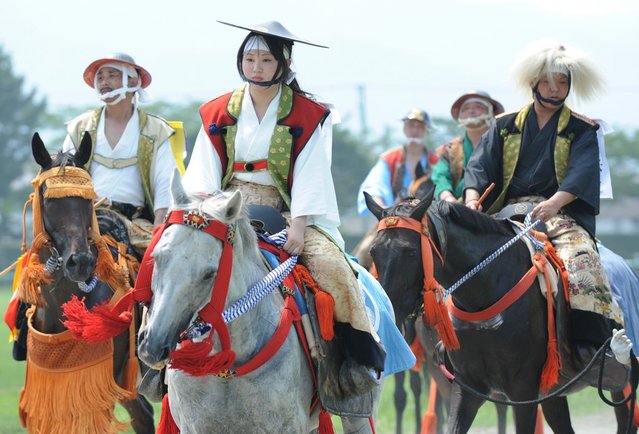
A young woman (C) clad in samurai costume leads other local poeple as she rides her horse during a parade at the annual Soma Nomaoi festival in Minamisoma, Fukushima Prefecture, on July 28, 2012.  The traditional full-scale festival kicked off for the first time after the accident of the Fukushima Dai-ichi Nuclear Power Plant following the massive earthquake and the tsunami on March 11, 2011. (Photo by Toru Yamanaka/AFP Photo)

Soma-Nomaoi is a festival that recreates a battle scene from more than 1,000 years ago. It is annually held for 4 days from July 22 to 25 in Haramachi City, Fukushima Prefecture, in the eastern part of Japan. In this historical event, 600 mounted samurai in traditional Japanese armor, with long swords at their side and ancestral flagstaffs streaming from their backs, ride across open fields. Soma-Nomaoi has been designated an Important Intangible Folk Cultural Property.

Photo: A young woman (C) clad in samurai costume leads other local poeple as she rides her horse during a parade at the annual Soma Nomaoi festival in Minamisoma, Fukushima Prefecture, on July 28, 2012. The traditional full-scale festival kicked off for the first time after the accident of the Fukushima Dai-ichi Nuclear Power Plant following the massive earthquake and the tsunami on March 11, 2011. (Photo by Toru Yamanaka/AFP Photo)

Details
02 Aug 2012 12:59:00
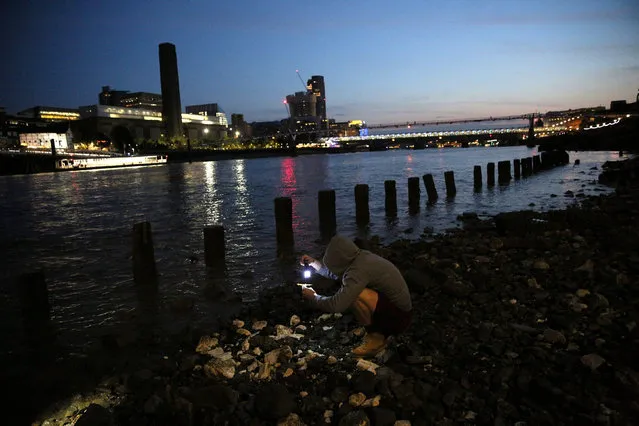
A mudlark uses a torch to look for items on the bank of the River Thames in London, Britain June 06, 2016. Mudlarking is believed to trace its origins to the 18th and 19th century, when scavengers searched the Thames' shores for items to sell. These days, history and archaeology fans are the ones hoping to find old relics such as coins, ceramics, artifacts or everyday items from across centuries. They wait for the low tide and then scour specific areas of exposed shores. "If you're in a field you could be out all day long, with the river you're restricted to about two or three hours," mudlark Nick Stevens said. While many just use the naked eye for their searches, others rely on metal detectors for which a permit from the Port of London Authority is needed. Digging also requires consent. (Photo by Neil Hall/Reuters)

A mudlark uses a torch to look for items on the bank of the River Thames in London, Britain June 06, 2016. Mudlarking is believed to trace its origins to the 18th and 19th century, when scavengers searched the Thames' shores for items to sell. These days, history and archaeology fans are the ones hoping to find old relics such as coins, ceramics, artifacts or everyday items from across centuries. their finds with the Portable Antiquities Scheme. Any item over 300 years old must be recorded. (Photo by Neil Hall/Reuters)
Details
27 Aug 2016 10:43:00
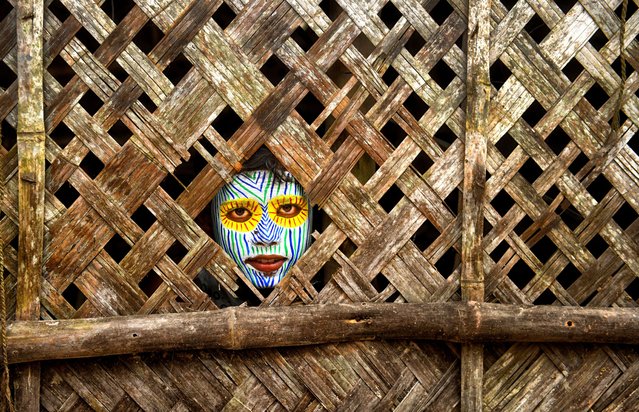
A child poses with face painting during the event in Canning, West Bengal on June 15, 2025. For generations Bahurupi artists from West Bengal have been practicing in the art of face painting. Using their painting techniques they can easily metamorphose into different characters during a performance, which often represents tribal myths. These traditional artists scrape a living from their performances, relying on the generosity of audiences for their income. (Photo by Avishek Das/SOPA Images/LightRocket via Getty Images)

A child poses with face painting during the event in Canning, West Bengal on June 15, 2025. For generations Bahurupi artists from West Bengal have been practicing in the art of face painting. Using their painting techniques they can easily metamorphose into different characters during a performance, which often represents tribal myths. These traditional artists scrape a living from their performances, relying on the generosity of audiences for their income. (Photo by Avishek Das/SOPA Images/LightRocket via Getty Images)
Details
24 Jul 2025 04:11:00
Son Doong Cave

Son doong cave is a cave in Phong Nha-Kẻ Bàng National Park, Bố Trạch district, Quảng Bình Province, Vietnam. Currently the biggest known cave in the world, the cave is located near the Laos-Vietnam border. Inside is a large, fast-flowing underground river.
In early August 2013, the first tourist group explored the cave on a guided tour at a cost of US$3,000 each. The group had six members from Australia, Norway, Russia and USA and spent 7 days and 6 nights for the tour. Next exploration trips will be arranged.
Details
22 Sep 2013 12:30:00
Tuna Melts My Heart

Tuna is an adorable and charming 3 year-old Chiweenie who was born with an aggressive overbite and a lower recessed jawline. He also has 5 moles surrounding his mouth, a crumbled chin and a neck that looks like he has been soaking in a bathtub for days! Those who can see past his irregularities will also adore him for them. They have eyes see his true beauty, because true beauty captivates our hearts and not just our eyes.
Details
10 Nov 2013 09:26:00