Loading...
Done
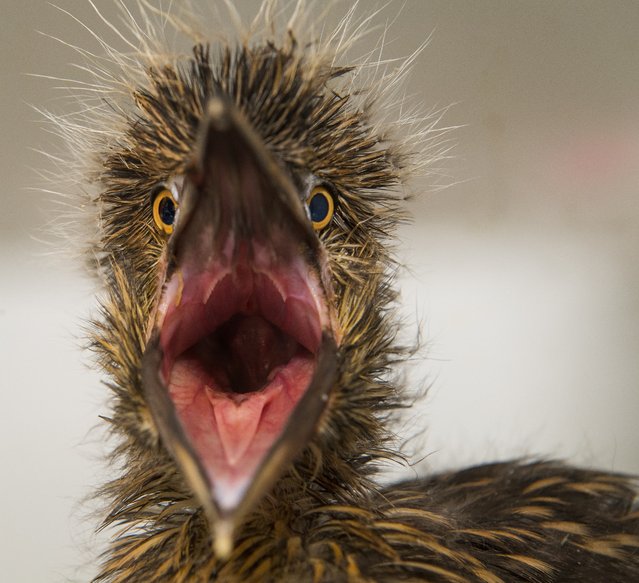
A baby Black-crowned Night Heron squawks in its incubator while being cared for at City Wildlife rescue and rehabilitation center in Washington, DC on May 31, 2017. The heron is one of several that have been brought to CW by the staff at The National Zoo over the past few years. The heron is a native bird and has made an established rookery inside the zoo grounds over a hundred years ago.  Every year at this time, some of the chicks get pushed or fall out of the nest and require human care.  Because the birds are native and not part of the Smithsonian collection, they partnered with CW to rehabilitate the herons for re-release back to the flock inside Zoo. They're reintroduced back to their flock so that they can migrate together in the Fall. The Black-crowned heron usually migrates from the DC area down to southeast North Carolina, some going as far as Jacksonville, FL in winter. The Black-crowned heron is the species of greatest conservation need in the District of Columbia because their numbers are in such rapid decline due to habitat loss. (Photo Linda Davidson/The Washington Post)

A baby Black-crowned Night Heron squawks in its incubator while being cared for at City Wildlife rescue and rehabilitation center in Washington, DC on May 31, 2017. The heron is one of several that have been brought to CW by the staff at The National Zoo over the past few years. (Photo Linda Davidson/The Washington Post)
Details
04 Jun 2017 08:04:00
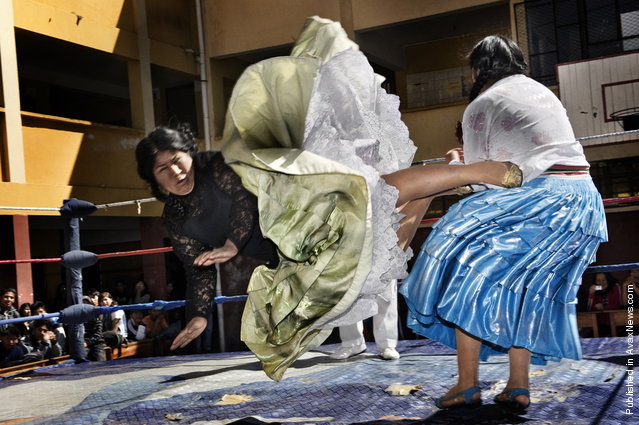
Women Wrestlers, Bolivia. Lucha libre (Bolivian wrestling) is one of the most popular sports in the country. Women wrestlers are known as cholitas and have in the last ten years become popular in the sport. Here, Carmen Rosa and Yulia la Pacena perform in a benefit show to raise money for the bathrooms of a school in La Paz, Bolivia, 26 June 2011

Women Wrestlers, Bolivia. Lucha libre (Bolivian wrestling) is one of the most popular sports in the country. Women wrestlers are known as cholitas and have in the last ten years become popular in the sport. Here, Carmen Rosa and Yulia la Pacena perform in a benefit show to raise money for the bathrooms of a school in La Paz, Bolivia, 26 June 2011. (Photo by Daniele Tamagni)
Details
11 Apr 2012 12:57:00
Max Verstappen of Netherlands and Red Bull Racing prepares to drive in the garage during practice for the F1 Grand Prix of Spain at Circuit de Barcelona-Catalunya on August 14, 2020 in Barcelona, Spain. (Photo by Mark Thompson/Getty Images)

Max Verstappen of Netherlands and Red Bull Racing prepares to drive in the garage during practice for the F1 Grand Prix of Spain at Circuit de Barcelona-Catalunya on August 14, 2020 in Barcelona, Spain. (Photo by Mark Thompson/Getty Images)
Details
18 Aug 2020 00:01:00
A couple embraces at the railway station in Kramatorsk, on May 20, 2023, amid the Russian invasion of Ukraine. (Photo by Sergey Shestak/AFP Photo)

A couple embraces at the railway station in Kramatorsk, on May 20, 2023, amid the Russian invasion of Ukraine. (Photo by Sergey Shestak/AFP Photo)
Details
27 Jun 2023 03:31:00
A protester wearing improvised protective headgear walks away from a cloud of tear gas on July 18, 2021 in Bangkok, Thailand. Student protesters called for a demonstration demanding the resignation of Thailand Prime Minister Prayuth Chan-o-Cha, despite a ban on gatherings because of the country's current Covid-19 outbreak, and folded a demand for better action in combating the virus into their demands. (Photo by Sirachai Arunrugstichai/Getty Images)

A protester wearing improvised protective headgear walks away from a cloud of tear gas on July 18, 2021 in Bangkok, Thailand. Student protesters called for a demonstration demanding the resignation of Thailand Prime Minister Prayuth Chan-o-Cha, despite a ban on gatherings because of the country's current Covid-19 outbreak, and folded a demand for better action in combating the virus into their demands. (Photo by Sirachai Arunrugstichai/Getty Images)
Details
07 Aug 2021 09:20:00
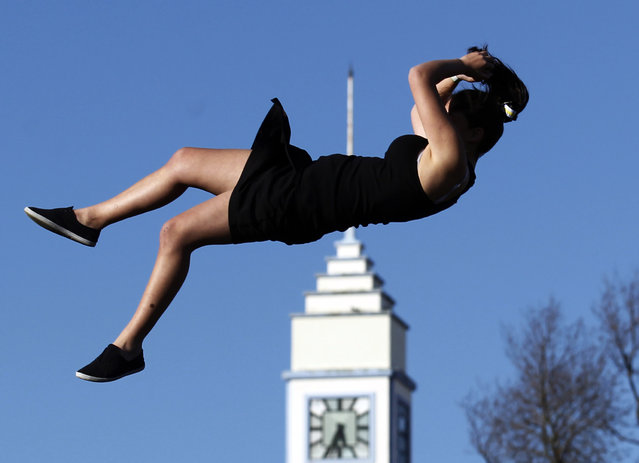
8. NEW ZEALAND: A woman dives from a platform into a giant air bed at a park in Palmerston North September 29, 2011. (Photo by Marcos Brindicci/Reuters)

The report, prepared by the Sustainable Development Solutions Network (SDSN) and the Earth Institute at Columbia University, showed Syria, Afghanistan and eight sub-Saharan countries as the 10 least happy places on earth to live. The top 10 this year were Denmark, Switzerland, Iceland, Norway, Finland, Canada, Netherlands, New Zealand, Australia, and Sweden. Denmark was in third place last year, behind Switzerland and Iceland. The bottom 10 were Madagascar, Tanzania, Liberia, Guinea, Rwanda, Benin, Afghanistan, Togo, Syria and Burundi. The United States came in at 13, the United Kingdom at 23, France at 32, and Italy at 50. Here: #8. NEW ZEALAND: A woman dives from a platform into a giant air bed at a park in Palmerston North September 29, 2011. (Photo by Marcos Brindicci/Reuters)
Details
26 Mar 2016 13:19:00
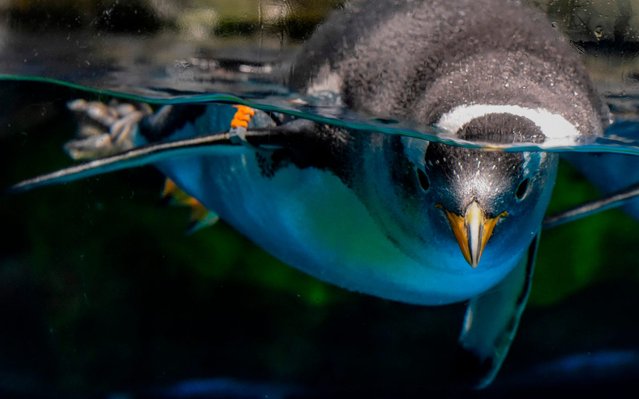
This picture taken on May 4, 2020 shows a gentoo penguin swimming in an enclosure at the Ocean Park theme park, which is currently closed due to the COVID-19 novel coronavirus, in Hong Kong. (Photo by Richard A. Brooks/AFP Photo)

This picture taken on May 4, 2020 shows a gentoo penguin swimming in an enclosure at the Ocean Park theme park, which is currently closed due to the COVID-19 novel coronavirus, in Hong Kong. (Photo by Richard A. Brooks/AFP Photo)
Details
15 Jan 2021 00:03:00
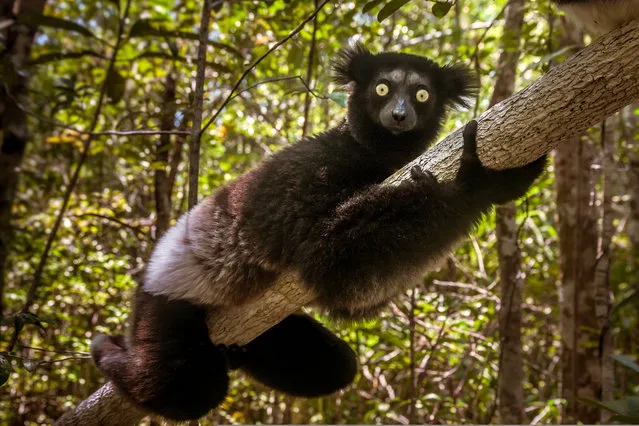
The secretive indri (Indri indri) of Madagascar, the largest living lemur. It is also critically endangered and highly evolutionarily distinct with no close relatives, which makes its branch one of most precarious on the mammal evolutionary tree. In the likely event that the indri goes extinct, we will lose 19m years of unique evolutionary history from the mammal tree of life. (Photo by Pierre-Yves Babelon/Aarhus University)

The secretive indri (Indri indri) of Madagascar, the largest living lemur. It is also critically endangered and highly evolutionarily distinct with no close relatives, which makes its branch one of most precarious on the mammal evolutionary tree. In the likely event that the indri goes extinct, we will lose 19m years of unique evolutionary history from the mammal tree of life. (Photo by Pierre-Yves Babelon/Aarhus University)
Details
18 Nov 2018 00:02:00