Loading...
Done
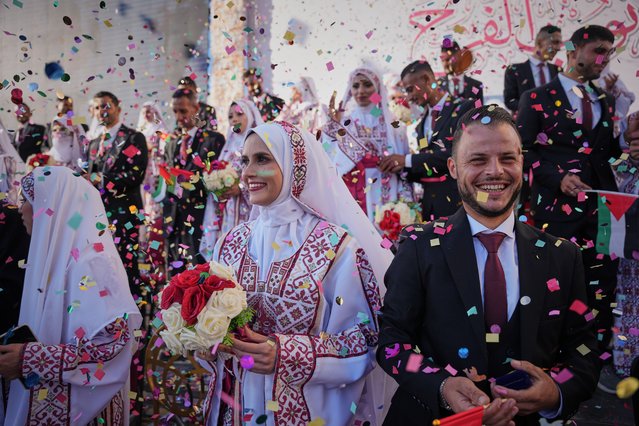
Palestinian couples participate in a mass wedding ceremony in Hamad City in Khan Younis, Gaza Strip, Tuesday, December 2, 2025. (Photo by Abdel Kareem Hana/AP Photo)

Palestinian couples participate in a mass wedding ceremony in Hamad City in Khan Younis, Gaza Strip, Tuesday, December 2, 2025. (Photo by Abdel Kareem Hana/AP Photo)
Details
25 Dec 2025 10:46:00
Krysten Ritter is seen at Sundance Festival on January 19, 2014 in Park City, Utah. (Photo by Alo Ceballos/GC Images)

Krysten Ritter is seen at Sundance Festival on January 19, 2014 in Park City, Utah. (Photo by Alo Ceballos/GC Images)
Details
26 Jan 2014 12:56:00
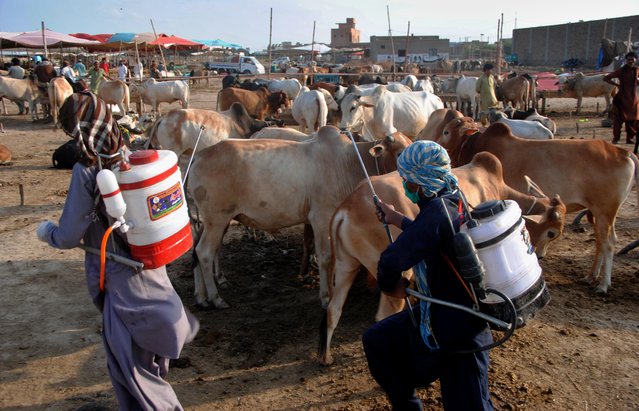
Health workers wearing face masks spray disinfectant liquid on sacrificial animals amid concerns over the spread of the SARS-CoV-2 coronavirus that causes the pandemic COVID-19 disease ahead of the Muslim festival of Eid al-Adha at an animal market in Hyderabad, southern Pakistan, 21 July 2020. Eid al-Adha, also known as the Festival of the Sacrifice, is the second and holiest of the two main Islamic holidays celebrated each year (the other one being Eid al-Fitr). Every year, on the 10th day of the Islamic lunar month of Dhu al-Hijjah, Muslims around the world ritually slaughter a sacrificial animal and split the meat into three parts: one is reserved for the family, another for friends and relatives, and the third is given to the poor and needy. The Saudi Supreme Court has declared that the first day of Eid al-Adha this year falls on 31 July. (Photo by Nadeem Khawar/EPA/EFE)

Health workers wearing face masks spray disinfectant liquid on sacrificial animals amid concerns over the spread of the SARS-CoV-2 coronavirus that causes the pandemic COVID-19 disease ahead of the Muslim festival of Eid al-Adha at an animal market in Hyderabad, southern Pakistan, 21 July 2020. (Photo by Nadeem Khawar/EPA/EFE)
Details
23 Jul 2020 00:07:00
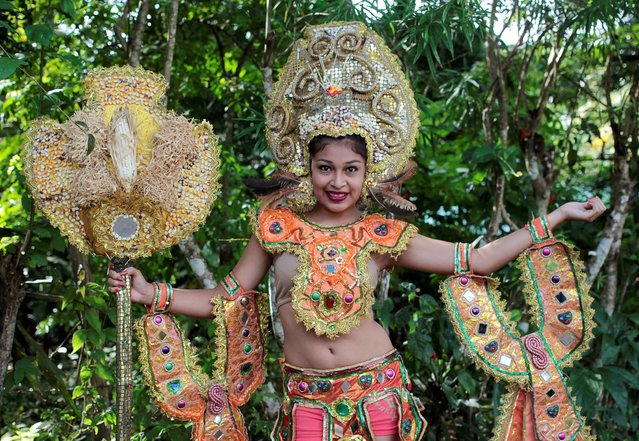
An Indigenous schoolchild dressed in traditional attire takes part in a rally to commemorate Indigenous Resistance Day in Catarina town, Nicaragua October 12, 2016. (Photo by Oswaldo Rivas/Reuters)

An Indigenous schoolchild dressed in traditional attire takes part in a rally to commemorate Indigenous Resistance Day in Catarina town, Nicaragua October 12, 2016. This holiday coincides with Columbus Day which commemorates Christopher Columbus landing in America in 1492. But rather than celebrating the discovery of the Americas, the Nicaraguans observe Indigenous Resistance Day to celebrate the bravery of the indigenous population in the fight against the Spanish conquistadors. (Photo by Oswaldo Rivas/Reuters)
Details
14 Oct 2016 12:04:00
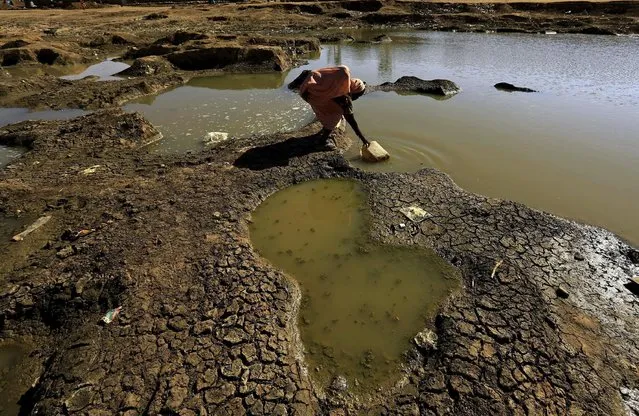
An internally displaced woman collects water from a pond to construct a mud-house at the Aboushok camp in El Fasher, North Darfur, Sudan, November 17, 2015. (Photo by Mohamed Nureldin Abdallah/Reuters)

An internally displaced woman collects water from a pond to construct a mud-house at the Aboushok camp in El Fasher, North Darfur, Sudan, November 17, 2015. The conflict in Sudan's Darfur region that erupted 12 years ago shows no sign of ending. But it hasn't stopped displaced youngsters, some of whom have spent their entire lives in refugee camps, from dreaming big. Twelve children aged 12 explain their hopes and dreams for the future; ambitions include becoming a doctor, an engineer and a teacher. (Photo by Mohamed Nureldin Abdallah/Reuters)
Details
13 Dec 2015 08:00:00
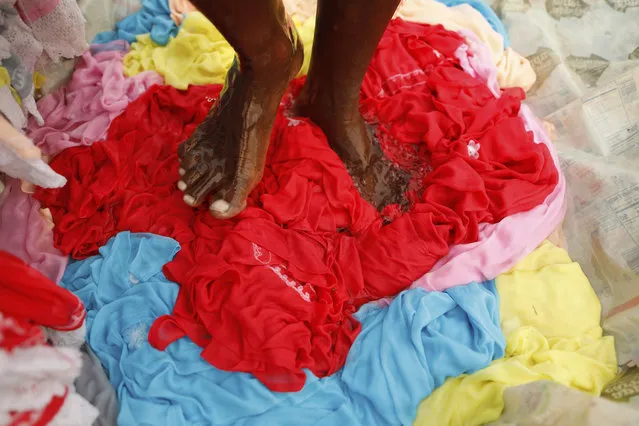
A dhobi, or a washerman washes cloths on the banks of the River Gomti in Lucknow, India, Saturday, September 12, 2020. Dhobis are traditional laundry workers who wash clothes by hand and dry them in the sun, an occupation which has been in existence for generations. Most cities in India have a Dhobi Ghat, or washermen's area, where the city's pile of clothes is laundered. This practice is still popular in India, despite of modern technology. Around 1,000 families work in Lucknow's Dhobi Ghat. However, in light of the novel coronavirus, their wages have decreased drastically. With each family earning around US$100-200 per month. (Photo by Rajesh Kumar Singh/AP Photo)

A dhobi, or a washerman washes cloths on the banks of the River Gomti in Lucknow, India, Saturday, September 12, 2020. Dhobis are traditional laundry workers who wash clothes by hand and dry them in the sun, an occupation which has been in existence for generations. Most cities in India have a Dhobi Ghat, or washermen's area, where the city's pile of clothes is laundered. This practice is still popular in India, despite of modern technology. Around 1,000 families work in Lucknow's Dhobi Ghat. However, in light of the novel coronavirus, their wages have decreased drastically. With each family earning around US$100-200 per month. (Photo by Rajesh Kumar Singh/AP Photo)

Details
25 Sep 2020 00:03:00
Evangelia Platanioti of Greece competes in the Solo Technical Routine at the Glasgow 2018 European Synchronised Swimming Championships, Glasgow, Britain, 06 August 2018. (Photo by Neil Hall/EPA/EFE)

Evangelia Platanioti of Greece competes in the Solo Technical Routine at the Glasgow 2018 European Synchronised Swimming Championships, Glasgow, Britain, 06 August 2018. (Photo by Neil Hall/EPA/EFE)
Details
07 Aug 2018 07:43:00
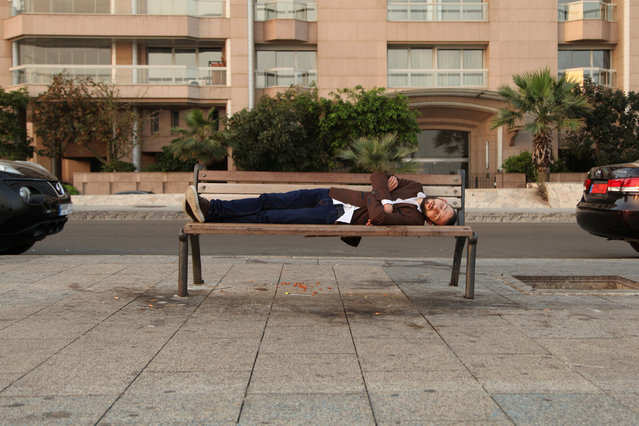
A man sleeps at Beirut's Corniche, a seaside promenade, in Lebanon May 2, 2016. (Photo by Alia Haju/Reuters)

A man sleeps at Beirut's Corniche, a seaside promenade, in Lebanon May 2, 2016. (Photo by Alia Haju/Reuters)
Details
12 Oct 2018 00:01:00