Loading...
Done
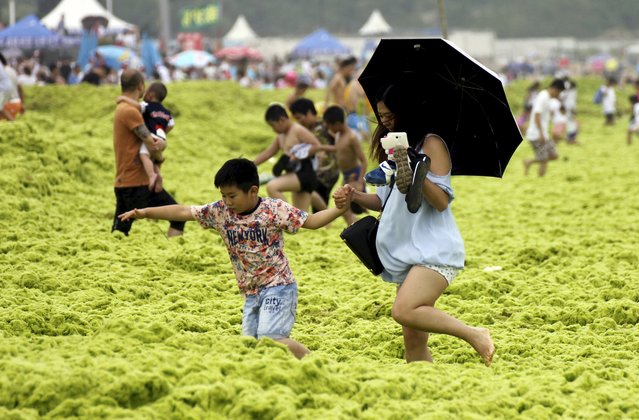
People make their way on an algae-covered beach in Qingdao, Shandong province, China, July 19, 2015. (Photo by Reuters/Stringer)

People make their way on an algae-covered beach in Qingdao, Shandong province, China, July 19, 2015. (Photo by Reuters/Stringer)
Details
20 Jul 2015 10:44:00
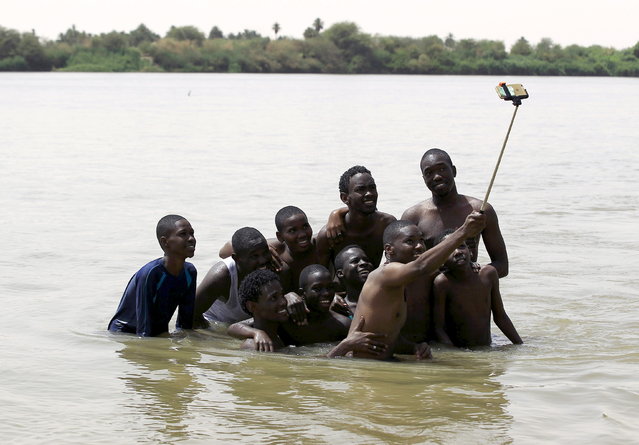
A group of young men use a selfie stick to take a picture of themselves in shallow waters known as the first cataract of the River Nile outside Khartoum, Sudan, May 22, 2015. In Sudan, which faces insurgences in the western region of Darfur and along its border with breakaway South Sudan, as well as double-digit inflation and high unemployment, life goes on for young people in the capital Khartoum. (Photo by Mohamed Nureldin Abdallah/Reuters)

A group of young men use a selfie stick to take a picture of themselves in shallow waters known as the first cataract of the River Nile outside Khartoum, Sudan, May 22, 2015. In Sudan, which faces insurgences in the western region of Darfur and along its border with breakaway South Sudan, as well as double-digit inflation and high unemployment, life goes on for young people in the capital Khartoum. (Photo by Mohamed Nureldin Abdallah/Reuters)
Details
09 Jul 2015 12:20:00
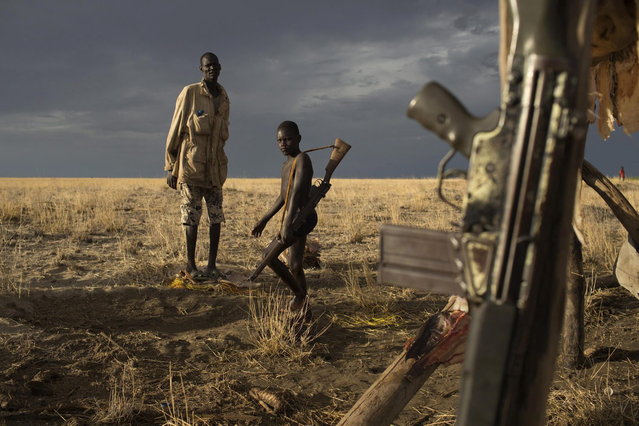
A Turkana man and a boy carrying a gun look on as a G3 battle rifle hangs from a structure used to dry fish at a fishing camp on the shores of Lake Turkana, some kilometres from Todonyang near the Kenya-Ethiopia border in northwestern Kenya October 12, 2013. (Photo by Siegfried Modola/Reuters)

A Turkana man and a boy carrying a gun look on as a G3 battle rifle hangs from a structure used to dry fish at a fishing camp on the shores of Lake Turkana, some kilometres from Todonyang near the Kenya-Ethiopia border in northwestern Kenya October 12, 2013The Turkana are traditionally nomadic pastoralists, but they have seen the pasture that they need to feed their herds suffer from recurring droughts and many have turned to fishing. However, Lake Turkana is overfished, and scarcity of food and pastureland is fuelling long-standing conflict with Ethiopian indigenous Dhaasanac, who have seen grazing grounds squeezed by large-scale government agricultural schemes in southern Ethiopia. The Dhaasanac now venture ever deeper into Kenyan territory in search of fish and grass, clashing with neighbours. Fighting between the communities has a long history, but the conflict has become ever more fatal as automatic weapons from other regional conflicts seep into the area. While the Turkana region is short of basics like grass and ground-water, it contains other resources including oil reserves and massive, newly discovered underground aquifers. (Photo by Siegfried Modola/Reuters)
Details
05 Dec 2013 12:08:00
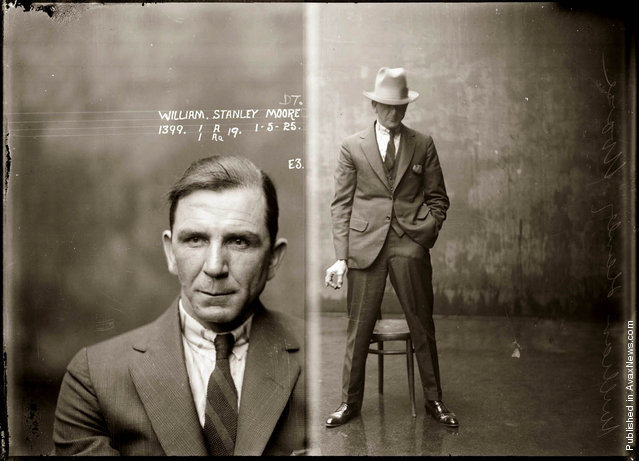
Mug shot of William Stanley Moore, 1 May 1925, Central Police Station, Sydney

Mug shot of William Stanley Moore, 1 May 1925, Central Police Station, Sydney. This picture appears in the Photo Supplement to the NSW Police Gazette, 28 July, 1926 captioned: “Opium dealer. Operates with large quantities of faked opium and cocaine. A wharf labourer; associates with water front thieves and drug traders”. (Photo by NSW Police Forensic Photography Archive, Justice & Police Museum, Histiric Houses Trust of NSW)
Details
24 Apr 2012 11:46:00
Buddhist novice poses for a picture while monks gather to receive alms at Wat Phra Dhammakaya temple, in what organizers said was a meeting of over 100,000 monks, in Pathum Thani, outside Bangkok April 22, 2016. (Photo by Jorge Silva/Reuters)

Buddhist novice poses for a picture while monks gather to receive alms at Wat Phra Dhammakaya temple, in what organizers said was a meeting of over 100,000 monks, in Pathum Thani, outside Bangkok April 22, 2016. (Photo by Jorge Silva/Reuters)
Details
23 Apr 2016 13:27:00
Yang Juan, an employee at Goopal Group, takes a nap in her seat after lunch, in Beijing, China, April 21, 2016. (Photo by Jason Lee/Reuters)

Yang Juan, an employee at Goopal Group, takes a nap in her seat after lunch, in Beijing, China, April 21, 2016. Office workers sleeping on the job is a common sight in China, where a surplus of cheap labour can lead to downtime at work. But in China's technology sector, where business is growing faster than many start-up firms can hire new staff, workers burn the midnight oil to meet deadlines and compete with their rivals. Some companies provide sleeping areas and beds for workers to rest during late nights. (Photo by Jason Lee/Reuters)
Details
12 May 2016 14:53:00
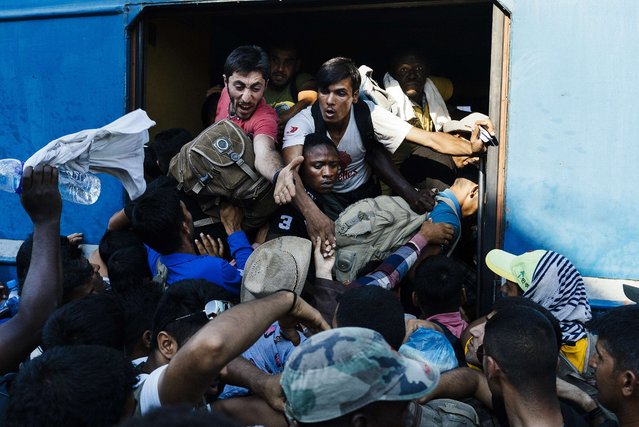
Migrants rush as they try to get on a train heading to the border with Serbia at the train station of Gevgelija, on the Macedonian-Greek border, on August 9, 2015. Non-EU Serbia's frontier with Hungary, which is in the bloc's passport-free Schengen zone, has become a major crossing point for the huge numbers of migrants entering the EU. (Photo by Dimitar Dilkoff/AFP Photo)

Migrants rush as they try to get on a train heading to the border with Serbia at the train station of Gevgelija, on the Macedonian-Greek border, on August 9, 2015. Non-EU Serbia's frontier with Hungary, which is in the bloc's passport-free Schengen zone, has become a major crossing point for the huge numbers of migrants entering the EU. (Photo by Dimitar Dilkoff/AFP Photo)
Details
11 Aug 2015 13:56:00
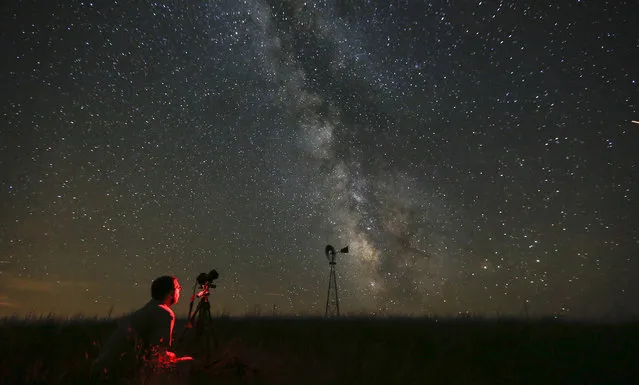
In this Wednesday, July 23, 2014 file photo, Omaha photographer Lane Hickenbottom photographs the night sky in a pasture near Callaway, Neb. With no moon in the sky, the Milky Way was visible to the naked eye. More than one-third of the world’s population can no longer see the Milky Way because of man-made lights, according to a scientific paper by Light Pollution Science and Technology Institute's Fabio Falchi and his team members, published on Friday, June 10, 2016. (Photo by Travis Heying/The Wichita Eagle via AP Photo)

In this Wednesday, July 23, 2014 file photo, Omaha photographer Lane Hickenbottom photographs the night sky in a pasture near Callaway, Neb. With no moon in the sky, the Milky Way was visible to the naked eye. More than one-third of the world’s population can no longer see the Milky Way because of man-made lights, according to a scientific paper by Light Pollution Science and Technology Institute's Fabio Falchi and his team members, published on Friday, June 10, 2016. (Photo by Travis Heying/The Wichita Eagle via AP Photo)
Details
11 Jun 2016 12:37:00