Loading...
Done


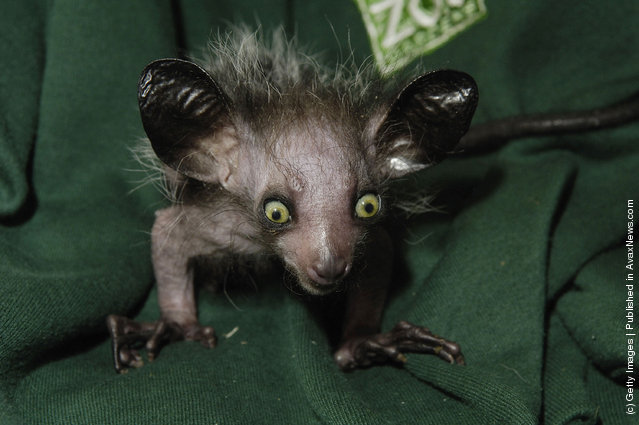
“The aye-aye (Daubentonia madagascariensis) is a lemur, a strepsirrhine primate native to Madagascar that combines rodent-like teeth and a special thin middle finger to fill the same ecological niche as a woodpecker. It is the world's largest nocturnal primate, and is characterized by its unusual method of finding food; it taps on trees to find grubs, then gnaws holes in the wood and inserts its narrow middle finger to pull the grubs out. The only other animal species known to find food in this way is the striped possum. From an ecological point of view the aye-aye fills the niche of a woodpecker as it is capable of penetrating wood to extract the invertebrates within”. – Wikipedia

Photo: In this handout image from Bristol Zoo is seen the first captive bred aye-aye in the UK named “Kintana” (meaning star in Malagasy) April 15, 2005 at Bristol Zoo Gardens, England. The zoo announced today only the second baby aye-aye to be hand-reared in the world (the first was in Jersey Zoo) and has now made his first public appearance since his birth on 11 February 2005. (Photo by Rob Cousins/Bristol Zoo via Getty Images)
Details
13 Apr 2011 13:33:00
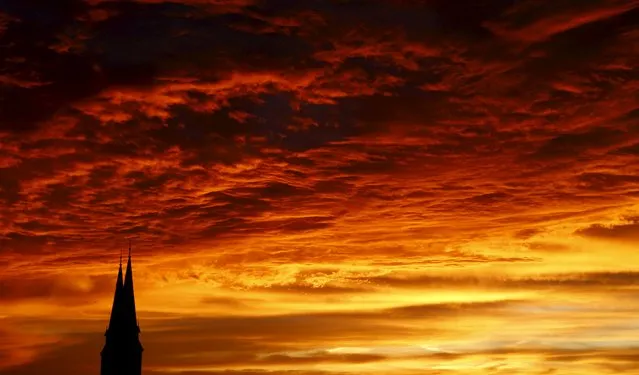
The rising sun illuminates the sky above the spires of a church in Vienna, Austria, November 17, 2015. (Photo by Heinz-Peter Bader/Reuters)

The rising sun illuminates the sky above the spires of a church in Vienna, Austria, November 17, 2015. (Photo by Heinz-Peter Bader/Reuters)
Details
19 Nov 2015 08:05:00
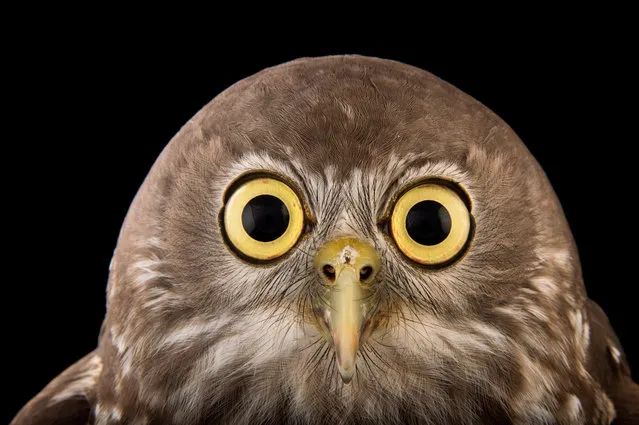
The National Geographic Photo Ark is a travelling exhibition of photographer Joel Sartore’s quest to create a photo archive of biodiversity around the world. So far, Sartore has captured studio portraits of more than 6,000 species – a number that he hopes to double. On 1 July, the ark will open at Melbourne zoo – the first time it has been exhibited in the southern hemisphere. More than 50 portraits will be on display, including many of Australian endangered animals being protected by programs at the zoo itself. These captions have been edited from text supplied by Melbourne zoo. Here: Barking owl. So-named because its call sounds like a barking dog, these birds are native to Australia, Indonesia and Papua New Guinea. In Victoria they are listed as an endangered species, and in 2003 there were estimated to be fewer than 50 breeding pairs. The main threat to the species in Victoria is loss of habitat, especially large trees with hollows in which they can nest and on which many of their prey depend. Apart from a bark, they may utter a chilling scream when they feel threatened. (Photo by Joel Sartore/National Geographic Photo Ark/The Guardian)

The National Geographic Photo Ark is a travelling exhibition of photographer Joel Sartore’s quest to create a photo archive of biodiversity around the world. So far, Sartore has captured studio portraits of more than 6,000 species – a number that he hopes to double. On 1 July, the ark will open at Melbourne zoo – the first time it has been exhibited in the southern hemisphere. More than 50 portraits will be on display, including many of Australian endangered animals being protected by programs at the zoo itself. These captions have been edited from text supplied by Melbourne zoo. Here: Barking owl. (Photo by Joel Sartore/National Geographic Photo Ark/The Guardian)
Details
01 Jul 2017 07:45:00
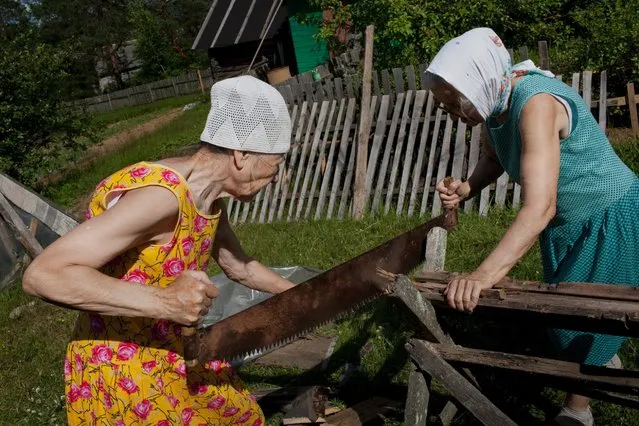
“Two-Handed Saw, 2014”. “Most of the neighbors have switched to power tools to run their households, the buzz of chain saws and weed-whackers overpowering the quieter sounds of country life, but my aunts hold on to the two-handed saw that's decades old, the sickle and scythe that need to be sharpened and polished after each use, the old axe that's becoming heavier each year. Each of these objects is familiar, holding memories of their brother, who succumbed to cancer a few years ago, of days before my grandfather lost his vision in the 50's, of busier days and longer futures”, Sablin told. (Photo by Nadia Sablin)

In northwest Russia, in a small village called Alekhovshchina, Nadia Sablin's aunts spend the warmer months together in the family home and live as the family has always lived, chopping wood to heat the house and making their own clothes. Sablin's book of photographs, “Aunties: The Seven Summers of Alevtina and Ludmila”, is published by Duke University Press. Here: “Two-Handed Saw, 2014”. (Photo by Nadia Sablin)
Details
25 Feb 2016 12:12:00
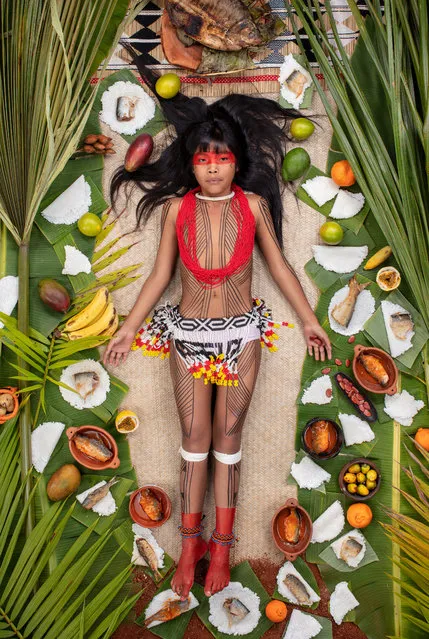
Kawakanih Yawalapiti, 9, Upper Xingu region of Mato Grosso, Brazil, 2018: Kawakanih lives with her tribe, the Yawalapiti, in Xingu national park, a preserve in the Amazon basin of Brazil. The Yawalapiti collect seeds to preserve species unique to their ecosystem, which lies between the rain forest and savannah. Kawakanih’s diet is simple, consisting mainly of fish, cassava, porridge, fruit and nuts. “It takes five minutes to catch dinner”, says Kawakanih. “When you’re hungry, you just go to the river with your net”. (Photo by Gregg Segal/The Guardian)

Photographer Gregg Segal travelled the world to document children and the food they eat in a week. Partly inspired by the increasing problems of childhood obesity, he tracked traditional regional diets as yet unaffected by globalisation, and ironically, found that the healthiest diets were often eaten by the least well off. (Photo by Gregg Segal/The Guardian)
Details
03 Jul 2019 00:03:00
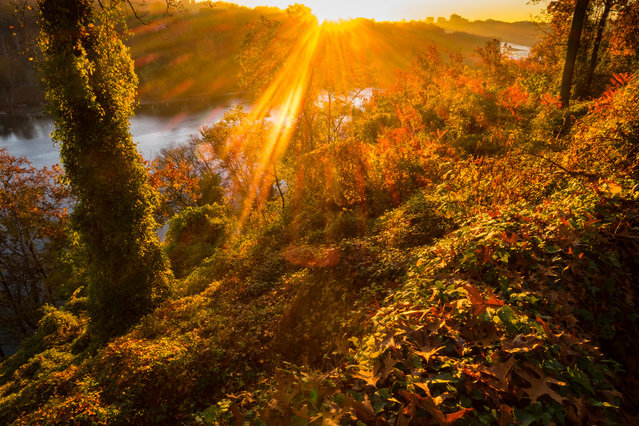
The sun streaks through the fall foliage at sunrise along the Potomac River in Arlington, Va., Wednesday, November 4, 2015 on a warm fall day in the nation's Capitol area. (Photo by J. David Ake/AP Photo)

The sun streaks through the fall foliage at sunrise along the Potomac River in Arlington, Va., Wednesday, November 4, 2015 on a warm fall day in the nation's Capitol area. (Photo by J. David Ake/AP Photo)
Details
07 Nov 2015 08:05:00
A passer-by takes a selfie with an extra newspaper reporting on President-elect Joe Biden's win in the U.S. presidential election, in Tokyo Sunday, November 8, 2020. The headline reads: “Mr. Biden Assured to win”. (Photo by Eugene Hoshiko/AP Photo)

A passer-by takes a selfie with an extra newspaper reporting on President-elect Joe Biden's win in the U.S. presidential election, in Tokyo Sunday, November 8, 2020. The headline reads: “Mr. Biden Assured to win”. (Photo by Eugene Hoshiko/AP Photo)
Details
27 Nov 2020 00:05:00
A view of an installation as part of the “S.A.C.R.E.D” exhibition by Chinese artist Ai Weiwei during the 55th La Biennale of Venice, in the church of Sant'Antonin in Venice May 28, 2013. (Photo by Stefano Rellandini/Reuters)

A view of an installation as part of the “S.A.C.R.E.D” exhibition by Chinese artist Ai Weiwei during the 55th La Biennale of Venice, in the church of Sant'Antonin in Venice May 28, 2013. (Photo by Stefano Rellandini/Reuters)
Details
26 Sep 2014 13:11:00