Loading...
Done


Captain George Ash lies on his back as he prepares to shoot the bowl from the clay pipe held between a blindfolded corporal's teeth. (Photo by Fox Photos/Getty Images). 18th April 1932
Details
25 Jun 2011 09:16:00
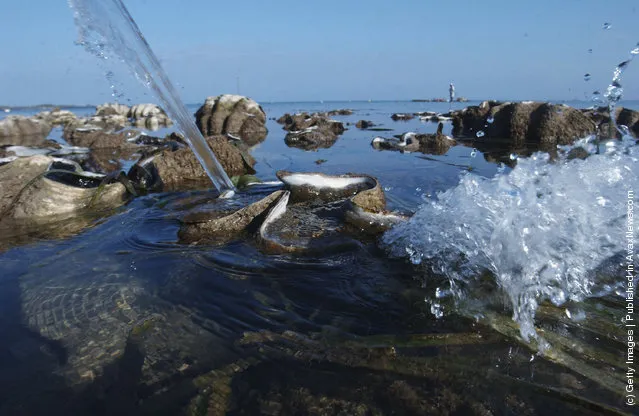
Tridacna Gigas, or Giant Clams

“The giant clam, Tridacna gigas (known as pā’ua in Cook Islands Māori), is the largest living bivalve mollusc. T. gigas is one of the most endangered clam species. It was mentioned as early as 1825 in scientific reports. One of a number of large clam species native to the shallow coral reefs of the South Pacific and Indian oceans, they can weigh more than 200 kilograms (440 lb) measure as much as 120 cm (47 in) across, and have an average lifespan in the wild of 100 years or more”. – Wikipedia

Photo: Tridacna Gigas, or Giant Clams spew water as a traditional fisherman passes by a small sanctuary on January 23, 2004 near Bolinao in the Northern Philippines. The clams, prime builders for coral reefs and providing shelter for spawning fish and other marine life, are exposed by low tides in the sanctuary. Overfishing and pollution throughout the country are not only threatening food security, but are also starting to choke one of the few working clam sanctuaries in the world. (Photo by David Greedy/Getty Images)
Details
01 Oct 2011 13:10:00
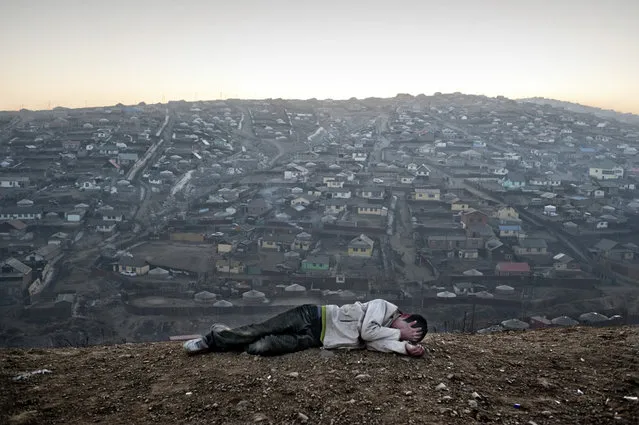
Asia, Mongolia, March 27, 2011. A view of Ulaan Baator over the shoulder of a slumbering drunk. Alcoholism is a huge problem in the city, home to almost half of Mongolia's people. The capital's population has doubled in the past two years, expanding outward in a haphazard sprawl, and many inhabitants live in slums known as the “Gher District”. (Photo by Alessandro Grassani)

“Environmental Migrants: The Last Illusion” by photographer Alessandro Grassani, documents the life of people in Kenya, Mongolia and Bangladesh who migrate to escape environmental stresses to the city of their own countries in hopes for a better life. Here: Asia, Mongolia, March 27, 2011. A view of Ulaan Baator over the shoulder of a slumbering drunk. Alcoholism is a huge problem in the city, home to almost half of Mongolia's people. The capital's population has doubled in the past two years. High levels of unemployment and poverty await herders who abandon rural areas and arrive in the city, illiterate and untrained in any skills necessary for urban jobs. (Photo by Alessandro Grassani)
Details
21 Jul 2015 10:10:00
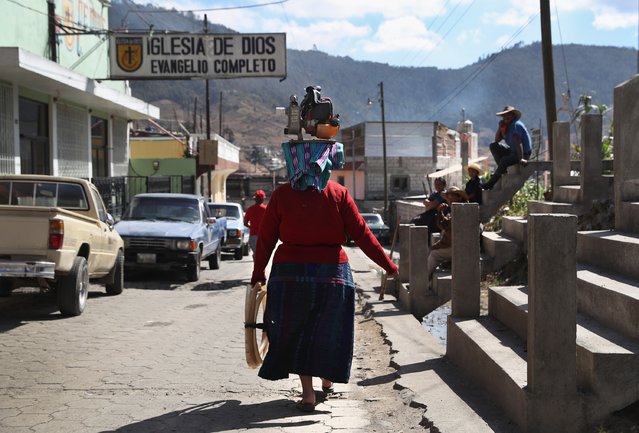
A woman carries a water pump to work on February 11, 2017 in Almolonga, Guatemala. (Photo by John Moore/Getty Images)

A woman carries a water pump to work on February 11, 2017 in Almolonga, Guatemala. The Mayan town in the western highlands district of Quetzaltenango has surged in prosperity in recent years with high-productivity vegetable farming, exporting much of its excess crops to neighborning El Salvador. (Photo by John Moore/Getty Images)
Details
25 Feb 2017 00:00:00
A woman holds an elderly woman on her back to cross a flooded street after a heavy rain in Shenyang, Liaoning province on July 14, 2017. (Photo by Fred Dufour/AFP Photo)

A woman holds an elderly woman on her back to cross a flooded street after a heavy rain in Shenyang, Liaoning province on July 14, 2017. (Photo by Fred Dufour/AFP Photo)
Details
16 Jul 2017 08:08:00
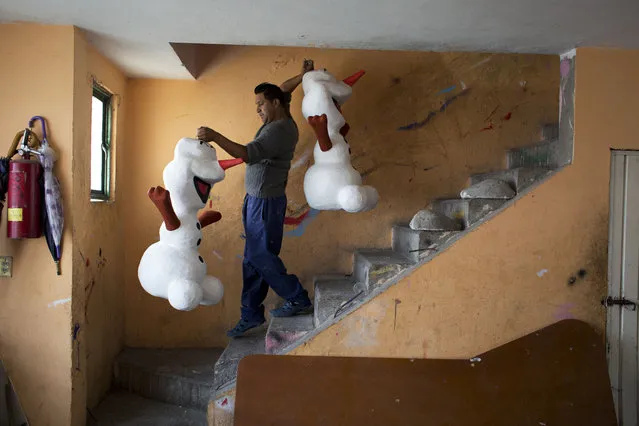
In this January 23, 2015 photo, Guillermo Luna Martinez, 36, carries freshly painted piñatas representing Disney's Frozen snowman character Olaf downstairs to where his wife Elvia Vicente Albarran will use paper to craft the character's eyes, teeth, and distinctive tuft of hair, at the family's workshop in the Iztapalapa neighborhood of Mexico City. (Photo by Rebecca Blackwell/AP Photo)

In this January 23, 2015 photo, Guillermo Luna Martinez, 36, carries freshly painted piñatas representing Disney's Frozen snowman character Olaf downstairs to where his wife Elvia Vicente Albarran will use paper to craft the character's eyes, teeth, and distinctive tuft of hair, at the family's workshop in the Iztapalapa neighborhood of Mexico City. Though Luna and his wife have chosen to work in the family business, they plan to let their children, Guillermo, 10, and Melissa, 9, decide for themselves. “Who knows if the business will last forever”, said Luna, “I'd prefer that they study and get a career, for them to have a better future”. (Photo by Rebecca Blackwell/AP Photo)

Details
01 Feb 2015 10:43:00
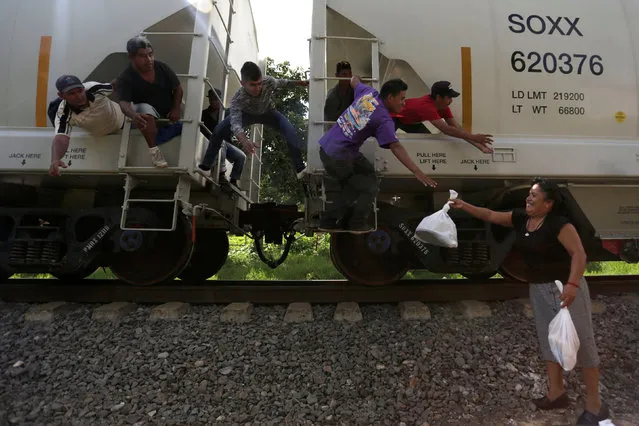
A woman from a group called “Las Patronas” (The bosses), a charitable organization that feeds Central American immigrants who travel atop a freight train known as “La Bestia”, passes food and water to immigrants on their way to the border with the United States, at Amatlan de los Reyes, in Veracruz state, Mexico October 22, 2016. (Photo by Daniel Becerril/Reuters)

A woman from a group called “Las Patronas” (The bosses), a charitable organization that feeds Central American immigrants who travel atop a freight train known as “La Bestia”, passes food and water to immigrants on their way to the border with the United States, at Amatlan de los Reyes, in Veracruz state, Mexico October 22, 2016. (Photo by Daniel Becerril/Reuters)
Details
18 Nov 2016 10:55:00
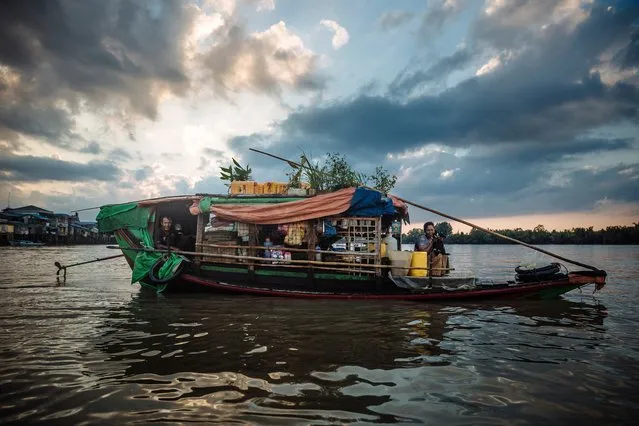
Tin and Naing win live on a small boat which they sail throughout the Delta region in Myanmar. The former gardeners once had a home on land but it was destroyed when a powerful cyclone ravaged the area in 2008. Since then, the couple have not been able to afford to rebuild their home, so they live on the boat from which they sell fish paste to make a living. (Photo by Muse Mohammed/IOM)

The ferocity of crises worldwide is forcing a record number of people to flee their homes, seeking some form of safety within their own country or across international borders. There are 65.3 million displaced people worldwide, including 21.3 million refugees. Most have lost their homes to armed conflict or natural disasters but other factors, such as extreme poverty and climate change, also drive displacement. The International Organisation for Migration commissioned photojournalist Muse Mohammed to document the plight of the displaced. (Photo by Muse Mohammed/IOM)
Details
02 Jan 2017 12:04:00