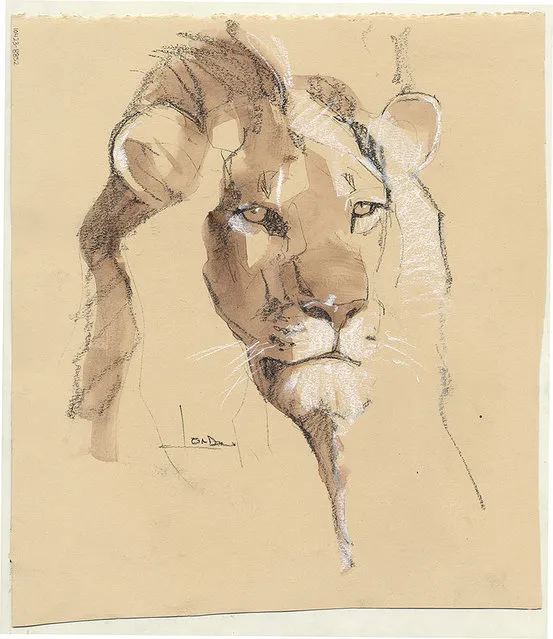
Anne London found her focus at the age of 19 while working for Tippi Hedren, founder of Shambala , a refuge for big cats, elephants and other species located in California. There, as she walked among the animals, she realized that the commercial art field was not for her, and she dedicated her life to bringing about awareness of the plight of endangered wildlife across the globe, and raising money for conservation efforts.
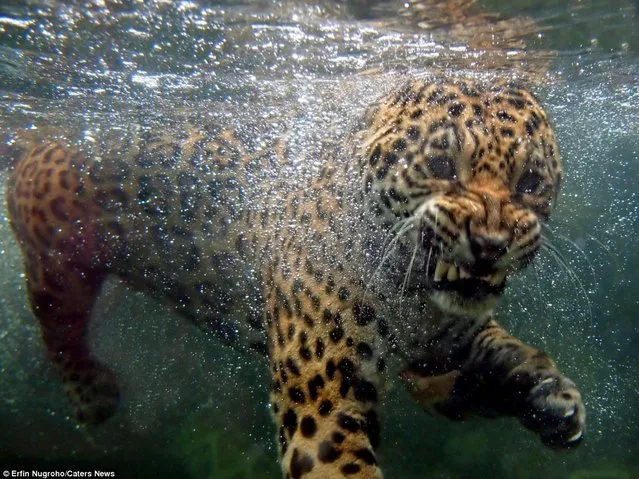
“Most cats run away at the first sign of water but this jaguar shows that some just love to make a splash. The fierce-looking feline was spotted doing an impressive moggy paddle as it swam for meat at Taman Safari in Indonesia. The spectacular shots were captured by professional photographer, Erfin Nugroho, who was visiting the centre for endangered animals with his family”. – Richard Hartley-Parkinson. (Photo by Erfin Nugroho/Caters News)
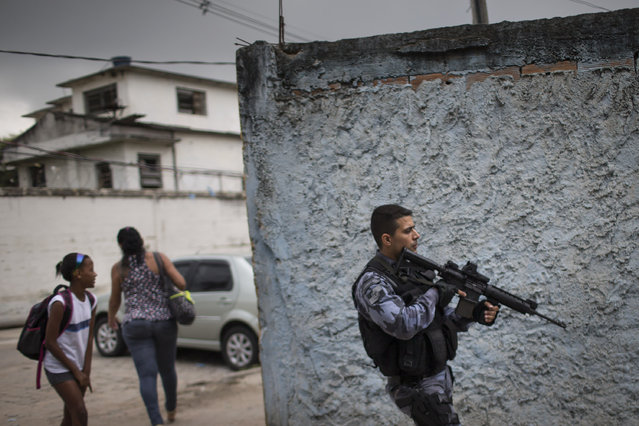
A military police officer patrols in the Roquette Pinto shantytown, part of the Mare slum complex in Rio de Janeiro, Brazil, Wednesday, April 1, 2015. The Brazilian army has begun to pull out of one of Rio de Janeiro's most violent slums, with police assuming responsibility for security in the area. (Photo by Felipe Dana/AP Photo)
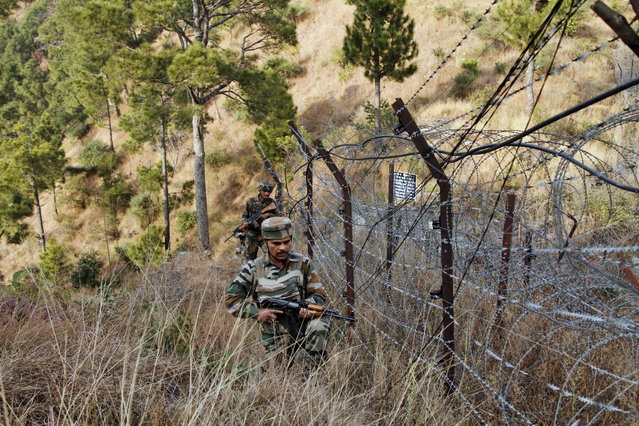
In this December 23, 2013 photo, Indian army soldiers patrol near one of their forward post at the Line of Control (LOC), that divides Kashmir between India and Pakistan, at Krishna Ghati (KG Sector) in Poonch, 290 kilometers (180 miles) from Jammu, India. The military commanders of longtime rivals India and Pakistan met on Tuesday in a bid to stop frequent cross-border attacks in disputed Kashmir which escalated tensions in the region in recent months. (Photo by Channi Anand/AP Photo)
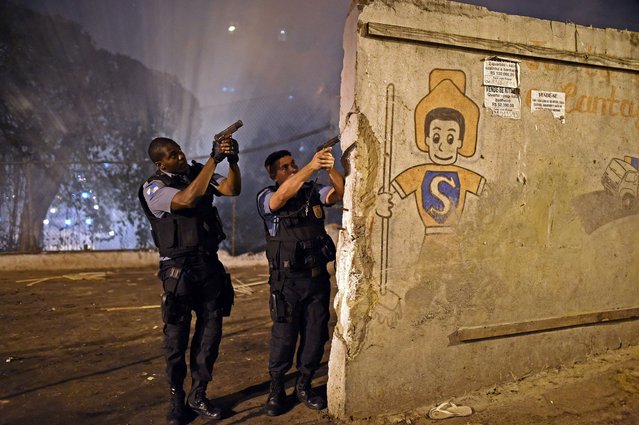
Rio de Janeiro's state military policemen aim their guns during a violent protest in a favela next to Copacabana, Rio de Janeiro on April 22, 2014. Violent protests broke out in Rio's landmark beachfront district, Copacabana, following the death of a resident last weekend during clashes with the Army in a nearby favela. (Photo by Christophe Simon/AFP Photo)
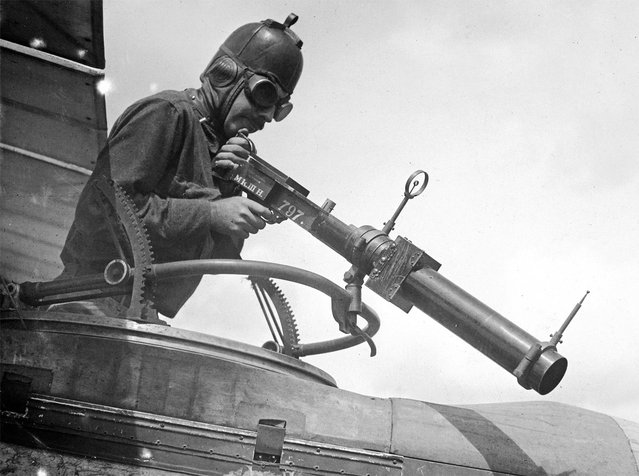
A soldier poses with a Hythe Mk III Gun Camera during training activities at Ellington Field, Houston, Texas in April of 1918. The Mk III, built to match the size, handling, and weight of a Lewis Gun, was used to train aerial gunners, recording a photograph when the trigger was pulled, for later review, when an instructor could coach trainees on better aiming strategies. (Photo by Harry Kidd/WWI Army Signal Corps Photograph Collection via The Atlantic)
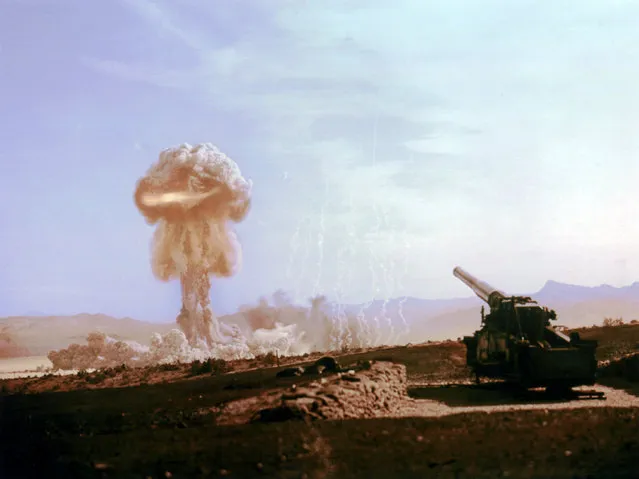
“A fter the former Soviet Union conducted its first nuclear test in August 1949, the US reevaluated its postwar defense policies. With the US monopoly on atomic weapons broken, military and political leaders chose to diversify the American stockpile by developing thermonuclear and tactical nuclear weapons. One of the more interesting concepts to come out of this period was atomic artillery, which was successfully tested at the Nevada Proving Grounds (now the Nevada Test Site) in May 1953”. – Alan Carr. Photo: Atomic Annie at work during the Upshot-Knothole test series, 1953. (Photo by Los Alamos National Laboratory/US Army)