Loading...
Done
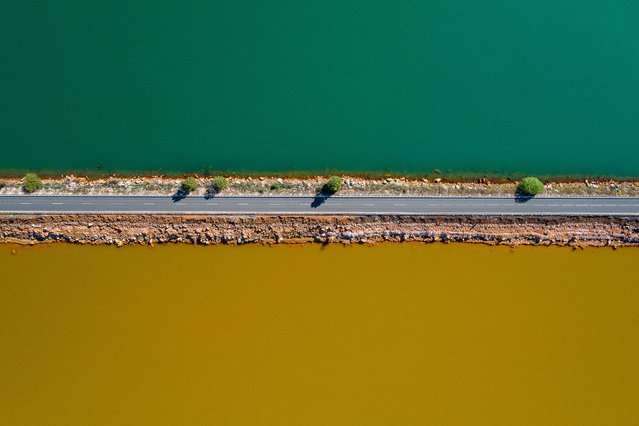
Shortlisted: The Life: A narrow strip, Río Tinto, Huelva, Spain. A narrow strip of road divides ochre-coloured and fresh waters. Trees wait on the fresh side of the road opposite the toxic waters of a nearby mine reservoir. (Photo by Roberto Bueno/CIWEM Environmental Photographer of the Year 2021)

Shortlisted: The Life: A narrow strip, Río Tinto, Huelva, Spain. A narrow strip of road divides ochre-coloured and fresh waters. Trees wait on the fresh side of the road opposite the toxic waters of a nearby mine reservoir. (Photo by Roberto Bueno/CIWEM Environmental Photographer of the Year 2021)
Details
10 Nov 2021 08:04:00
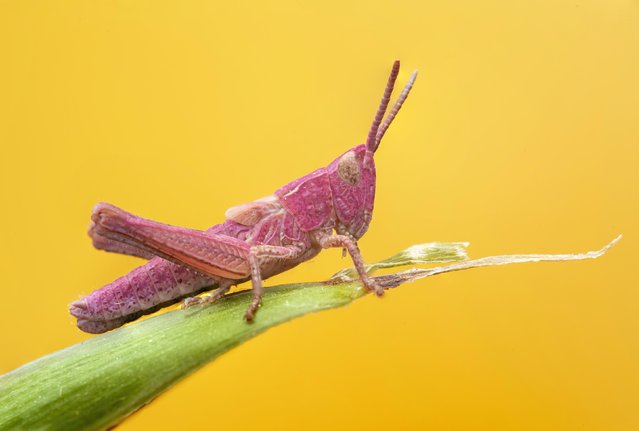
A pink grasshopper is spotted at the Messingham Sand Quarry in Scunthorpe, Lincolnshire, UK in the second decade of July 2023. The dazzling creature is incredibly rare, with experts estimating that a person has a chance of about 1 per cent of seeing one in their lifetime. (Photo by Calvin Taylor Lee/Animal News Agency)

A pink grasshopper is spotted at the Messingham Sand Quarry in Scunthorpe, Lincolnshire, UK in the second decade of July 2023. The dazzling creature is incredibly rare, with experts estimating that a person has a chance of about 1 per cent of seeing one in their lifetime. (Photo by Calvin Taylor Lee/Animal News Agency)
Details
05 Sep 2023 03:43:00
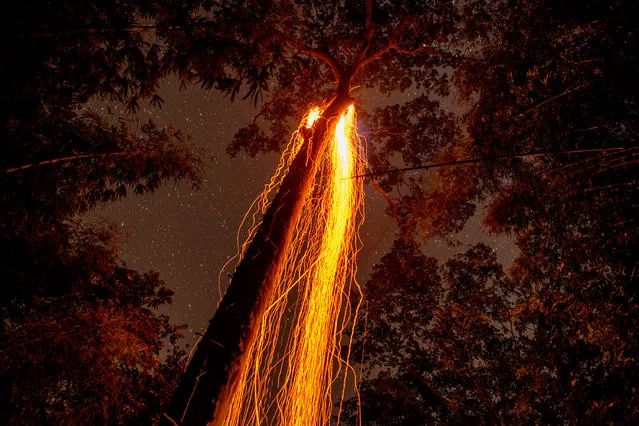
Bees are sensitive to light, which makes them follow the glowing embers down to the ground. (Photo by Hasnoor Hussain/The Guardian)

During the spring harvest season, a group of traditional Malaysian honey hunters travel to the rainforest near the Thai border to collect honeycombs from giant bees – and risk their lives climbing 200ft trees. Here: Bees are sensitive to light, which makes them follow the glowing embers down to the ground. (Photo by Hasnoor Hussain/The Guardian)
Details
22 Oct 2016 10:26:00
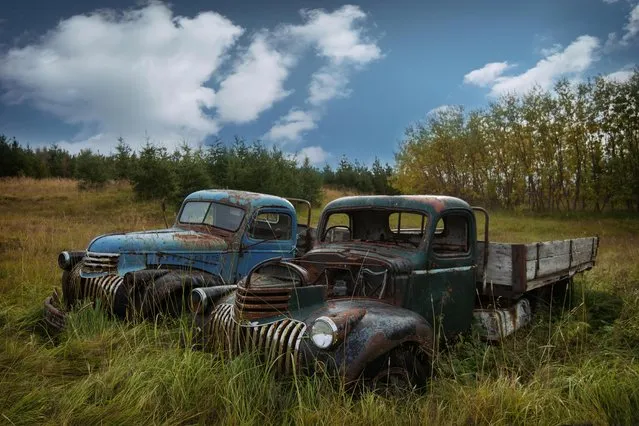
1941 Chevrolet 1.5 tonnes are left to rot in a field. (Photo by Robert Kahl/Mediadrumworld)

Feast your eyes on Europe’s most spectacular car graveyards as discovered by one auto-obsessed explorer who has dedicated over ten years to finding the best cars left to rot in the European wilderness. The beautiful set of images were taken in Germany, Sweden and Belgium by German Civil Servant Robert Kahl (30) using a Nikon D7100. He describes his photographs as showcasing “the beauty of transience and decayed charm”. Here: 1941 Chevrolet 1.5 tonnes are left to rot in a field. (Photo by Robert Kahl/Mediadrumworld)
Details
01 Mar 2017 00:04:00
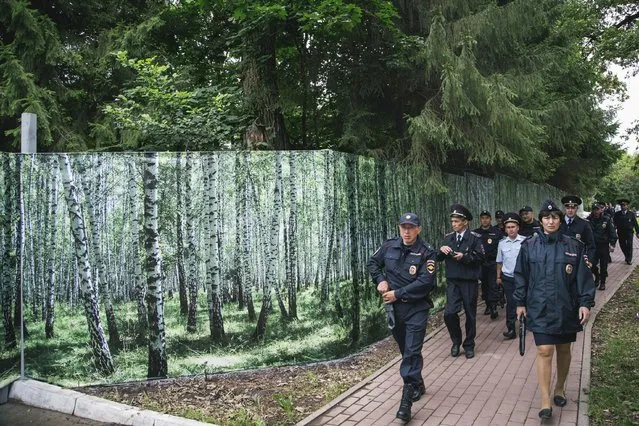
In this photo taken on Sunday, July  5, 2015, police officers walk along a giant poster to give an improved appearance, in downtown Ufa, Russia. Ufa will host SOC (Shanghai Cooperation Organization) and BRICS (Brazil, Russia, India, China and South Africa) summits July 7 to July 9, 2015. (Photo by Vadim Braydov/AP Photo)

In this photo taken on Sunday, July 5, 2015, police officers walk along a giant poster to give an improved appearance, in downtown Ufa, Russia. Ufa will host SOC (Shanghai Cooperation Organization) and BRICS (Brazil, Russia, India, China and South Africa) summits July 7 to July 9, 2015. (Photo by Vadim Braydov/AP Photo)
Details
07 Jul 2015 11:40:00
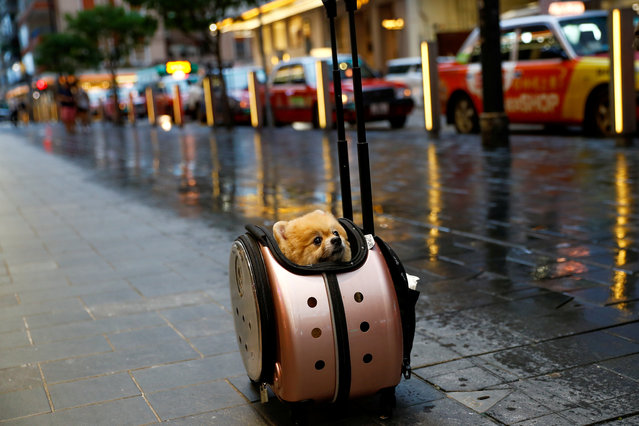
A Pomeranian dog sits in a rolling pet carrier in Hong Kong, China on September 4, 2019. (Photo by Kai Pfaffenbach/Reuters)

A Pomeranian dog sits in a rolling pet carrier in Hong Kong, China on September 4, 2019. (Photo by Kai Pfaffenbach/Reuters)
Details
06 Sep 2019 00:03:00
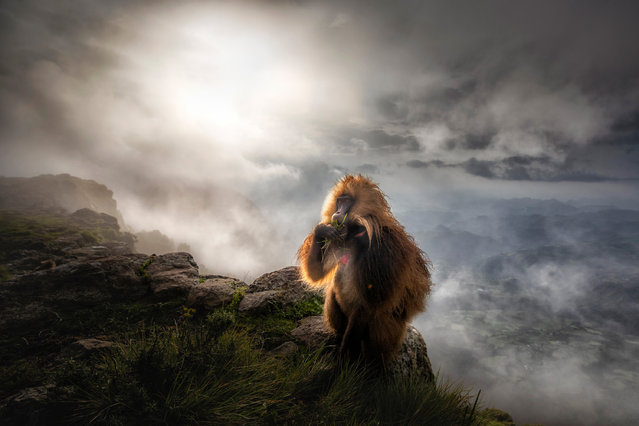
Highly commended, mammals: Gelada after the storm – Marco Gaiotti (Italy). “Gelada baboons are the only monkey species in the world that feed on grasses. They are native to the tableland of Ethiopia. Every morning large family groups wander from their sleeping places in the steep rock face, up to 1,000 metres high, to the feeding grounds at the tablelands. This image clearly depicts their feeding strategy: they pull out bunches of grass, sort the stalks and then lift them to their mouth. This shot was taken towards the end of the rainy season after a heavy storm”. (Photo by Marco Gaiotti/2019 GDT European Wildlife Photographer of the Year)

Highly commended, mammals: Gelada after the storm – Marco Gaiotti (Italy). “Gelada baboons are the only monkey species in the world that feed on grasses. They are native to the tableland of Ethiopia. Every morning large family groups wander from their sleeping places in the steep rock face, up to 1,000 metres high, to the feeding grounds at the tablelands. This image clearly depicts their feeding strategy: they pull out bunches of grass, sort the stalks and then lift them to their mouth. This shot was taken towards the end of the rainy season after a heavy storm”. (Photo by Marco Gaiotti/2019 GDT European Wildlife Photographer of the Year)
Details
31 Oct 2019 00:03:00
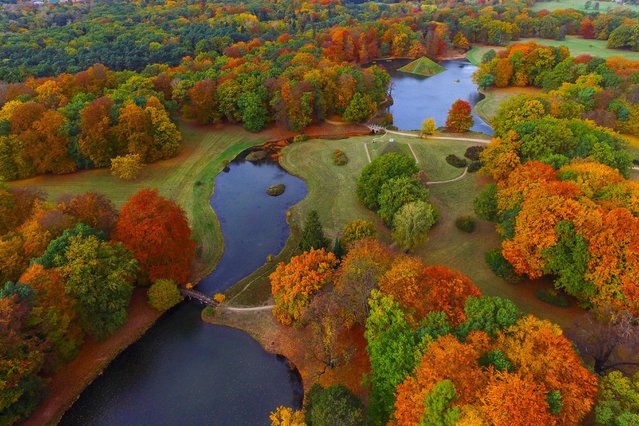
An aerial view taken with a drone shows the autumnally colored Fuerst-Pueckler-Park near Cottbus, eastern Germany, Saturday, October 29, 2016. The park, composed with great sensitivity in the 19th century by Prince Hermann von Pueckler-Muskau, is considered as one of the last great German landscape gardens. (Photo by Patrick Pleul/DPA via AP Photo)

An aerial view taken with a drone shows the autumnally colored Fuerst-Pueckler-Park near Cottbus, eastern Germany, Saturday, October 29, 2016. The park, composed with great sensitivity in the 19th century by Prince Hermann von Pueckler-Muskau, is considered as one of the last great German landscape gardens. (Photo by Patrick Pleul/DPA via AP Photo)
Details
18 Jan 2017 08:01:00