Loading...
Done
Emma Watson attends the Elle Style Awards 2014 at one Embankment on February 18, 2014 in London, England. (Photo by Tim P. Whitby/Getty Images)

Emma Watson attends the Elle Style Awards 2014 at one Embankment on February 18, 2014 in London, England. (Photo by Tim P. Whitby/Getty Images)


Details
20 Feb 2014 11:11:00


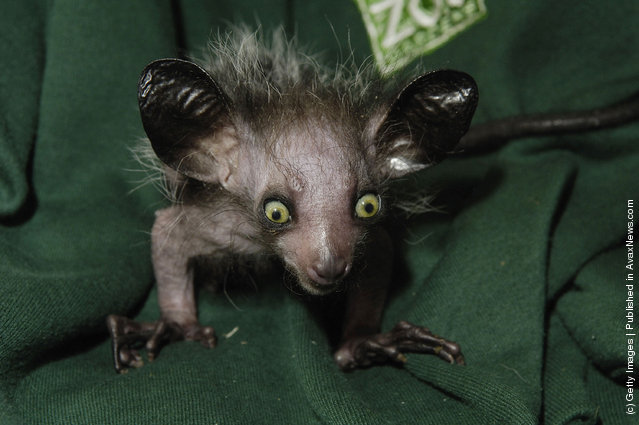
“The aye-aye (Daubentonia madagascariensis) is a lemur, a strepsirrhine primate native to Madagascar that combines rodent-like teeth and a special thin middle finger to fill the same ecological niche as a woodpecker. It is the world's largest nocturnal primate, and is characterized by its unusual method of finding food; it taps on trees to find grubs, then gnaws holes in the wood and inserts its narrow middle finger to pull the grubs out. The only other animal species known to find food in this way is the striped possum. From an ecological point of view the aye-aye fills the niche of a woodpecker as it is capable of penetrating wood to extract the invertebrates within”. – Wikipedia

Photo: In this handout image from Bristol Zoo is seen the first captive bred aye-aye in the UK named “Kintana” (meaning star in Malagasy) April 15, 2005 at Bristol Zoo Gardens, England. The zoo announced today only the second baby aye-aye to be hand-reared in the world (the first was in Jersey Zoo) and has now made his first public appearance since his birth on 11 February 2005. (Photo by Rob Cousins/Bristol Zoo via Getty Images)
Details
13 Apr 2011 13:33:00


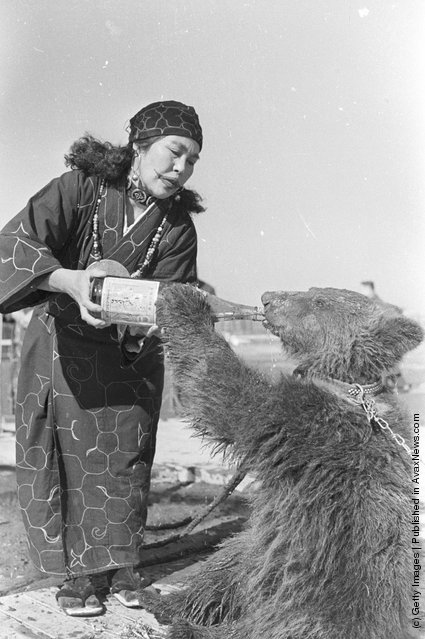
“The Ainu (アイヌ?), also called Aynu, Aino (アイノ), and in historical texts Ezo (蝦夷), are indigenous people or groups in Japan and Russia. Historically they spoke the Ainu language and related varieties and lived in Hokkaidō, the Kuril Islands, and much of Sakhalin. Most of those who identify themselves as Ainu still live in this same region, though the exact number of living Ainu is unknown. This is due to ethnic issues in Japan resulting in those with Ainu backgrounds hiding their identities and confusion over mixed heritages. In Japan, because of intermarriage over many years with Japanese, the concept of a 'pure Ainu' ethnic group is no longer feasible. Official estimates of the population are of around 25,000, while the unofficial number is upwards of 200,000 people”. – Wkipedia

Photo: A captive bear drinking from a large bottle held by an Ainu tribeswoman. (Photo by Evans/Three Lions/Getty Images). Circa 1955

Details
24 Mar 2011 14:01:00


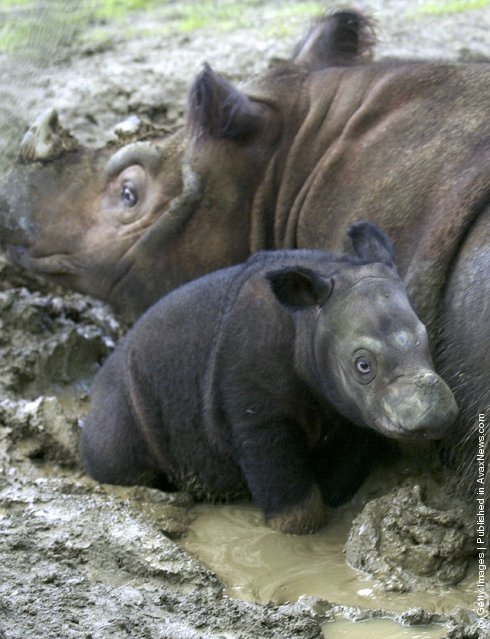
“The Sumatran Rhinoceros (Dicerorhinus sumatrensis) is a member of the family Rhinocerotidae and one of five extant rhinoceroses. It is the only extant species of the genus Dicerorhinus. It is the smallest rhinoceros, standing about 120–145 centimetres (3.9–4.76 ft) high at the shoulder, with a body length of 250 centimetres (8.2 ft) and weight of 500–800 kilograms (1,100–1,800 lb). Like the African species, it has two horns; the larger is the nasal horn, typically 15–25 centimetres (5.9–9.8 in), while the other horn is typically a stub. A coat of reddish-brown hair covers most of the Sumatran Rhino's body”. – Wikipedia

Photo: Emi, a Sumatran rhinoceros lies in the mud with her three-week-old female calf at the Cincinnati Zoo and Botanical Garden August 19, 2004 in Cincinnati, Ohio. Emi made history by becoming the first Sumatran rhino to produce two calves in captivity. (Photo by Mike Simons/Getty Images)
Details
22 Jun 2011 12:37:00
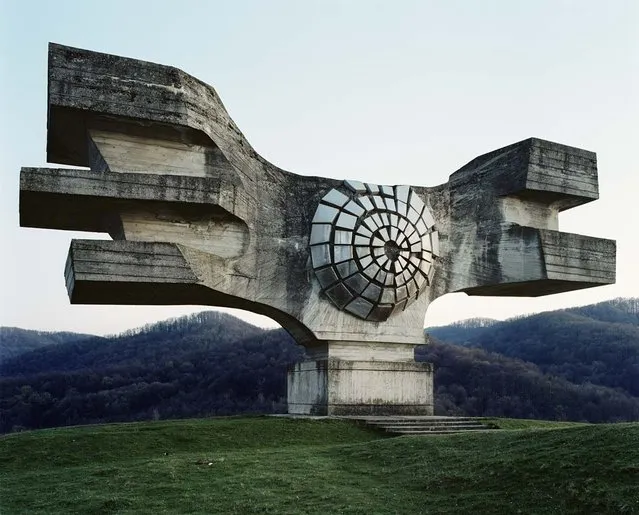
The monument of Ilirska Bistrica was designed by Janez Lenassi and built in 1965. It is dedicated to Slovenian soldiers that fell in World War II. (Photo by Jan Kempenaers)

The brutalist war memorials found throughout the former Yugoslavia were weird enough when they were built in the 1960s and 70s. Today, separated by the end of an architectural movement and the disintegration of the country, they seem almost alien. Belgian photographer Jan Kempenaers treats them purely as artistic objects in his book, “Spomenik”, named for the Serb-Croat word for monument. Known for photographing geographical oddities, Kempenaers was captivated by the spomenik after seeing them in an art encyclopedia. After hearing that many had been destroyed or abandoned, he set out to record what was left. (Photo by Jan Kempenaers)
Details
18 Aug 2014 09:07:00
South Korean football fans react during a public screening in Seoul of the South Korea vs Russia football match at the 2014 World Cup in Brazil, early on June 18, 2014. (Photo by Ed Jones/AFP Photo)

South Korean football fans react during a public screening in Seoul of the South Korea vs Russia football match at the 2014 World Cup in Brazil, early on June 18, 2014. (Photo by Ed Jones/AFP Photo)
Details
21 Jun 2014 13:16:00
A fan looks at the Germany flag before the 2014 World Cup final between Germany and Argentina at the Maracana stadium in Rio de Janeiro July 13, 2014. (Photo by Darren Staples/Reuters)

A fan looks at the Germany flag before the 2014 World Cup final between Germany and Argentina at the Maracana stadium in Rio de Janeiro July 13, 2014. (Photo by Darren Staples/Reuters)
Details
14 Jul 2014 13:18:00
Players battle for the ball during their match at the swamp soccer China tournament in Beijing, June 26, 2014. The 32 teams from across the country participated in the soccer event to celebrate the 2014 World Cup in Brazil. (Photo by Kim Kyung-Hoon/Reuters)

Players battle for the ball during their match at the swamp soccer China tournament in Beijing, June 26, 2014. The 32 teams from across the country participated in the soccer event to celebrate the 2014 World Cup in Brazil. (Photo by Kim Kyung-Hoon/Reuters)
Details
29 Jun 2014 11:58:00