Vendor Yegor Dyachkovsky, 45, poses for a picture at an open-air market on a frosty day in Yakutsk, Russia, January 15, 2023. Yakutsk, one of the Russia's north-most cities, is hit by an extreme cold snap as the air temperature on Sunday (January 15) plunged as low as minus 51 degrees Celsius (minus 59.8 degrees Fahrenheit). (Photo by Roman Kutukov/Reuters)
Palestinian girls struggle as they get donated food at a distribution center in Khan Younis, Gaza Strip, on Friday, December 6, 2024. (Photo by Abdel Kareem Hana/AP Photo)
A model wears a creation for Schiaparelli's Haute Couture Spring-Summer 2024 collection presented in Paris, Monday, January 22, 2024. (Photo by Christophe Ena/AP Photo)
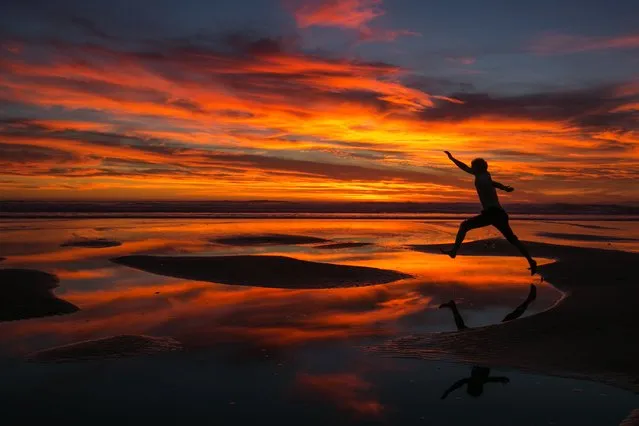
A brilliant sunset makes for a fun silhouette picture by jumping between sand bars at Shi Shi Beach on the Olympic Peninsula Friday July 17, 2015. (Photo by Bettina Hansen/The Seattle Times)
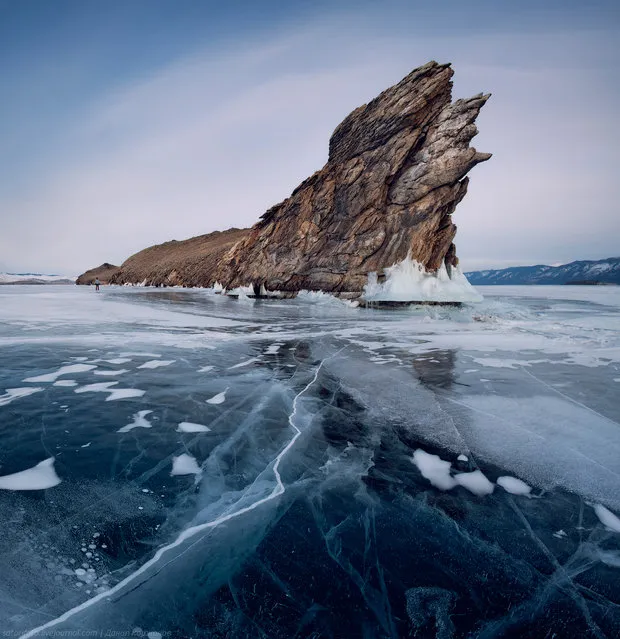
Lake Baikal is the world's oldest lake, at 25 million years (possibly older), and deepest, averaging 744.4 metres (2,442 ft).
Located in the south of the Russian region of Siberia, between Irkutsk Oblast to the northwest and the Buryat Republic to the southeast, it is the most voluminous freshwater lake in the world, containing roughly 20% of the world's unfrozen surface fresh water.
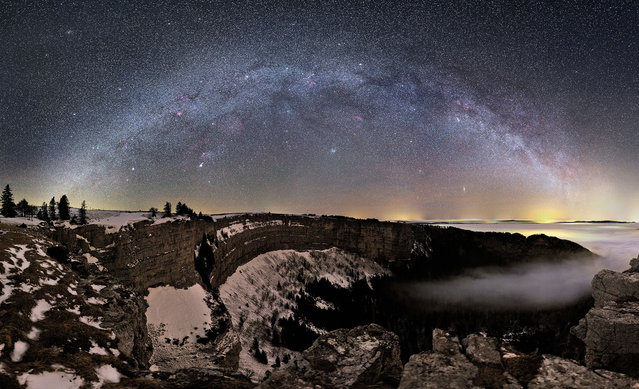
The Milky Way is the galaxy in which Earth is contained. This name derives from its appearance as a dim “milky” glowing band arching across the night sky, in which the naked eye cannot distinguish individual stars. The term “Milky Way” is a translation of the Classical Latin via lactea, from the Hellenistic Greek γαλαξίας κύκλος (pr. galaxías kýklos, “milky circle”). The Milky Way appears like a band because it is a disk-shaped structure being viewed from inside. The fact that this faint band of light is made up of stars was proven in 1610 when Galileo Galilei used his telescope to resolve it into individual stars. In the 1920s, observations by astronomer Edwin Hubble showed that the Milky Way is just one of many galaxies.