A Hindu devotee performs a stunt with fire during a rehearsal for the annual Rath Yatra, or chariot procession, which commemorates a journey by Hindu god Jagannath, his brother Balabhadra and sister Subhadra, in specially made chariots, in Ahmedabad, India, June 26, 2016. (Photo by Amit Dave/Reuters)
Emma the Maltese's fur blows in the wind as she rides in her owner's purse on 5th Avenue at Central Park in New York December 2, 2014. (Photo by Carlo Allegri/Reuters)
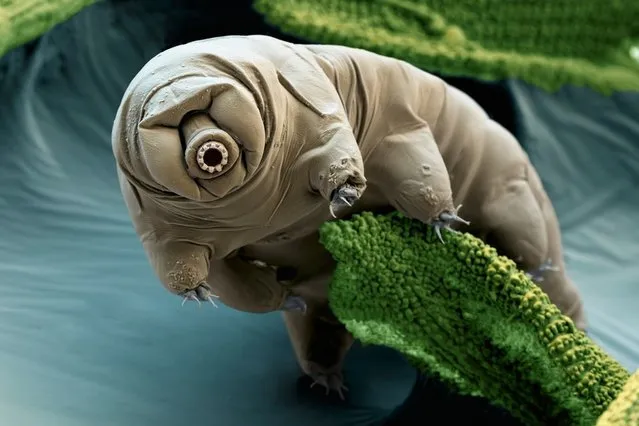
“Tardigrades (commonly known as waterbears or moss piglets) are small, water-dwelling, segmented animals with eight legs. Tardigrades were first discovered in 1773 by Johann August Ephraim Goeze, who called them kleiner Wasserbär, meaning “little water bear” in German. The name Tardigrada means “slow walker” and was given by Lazzaro Spallanzani in 1777. The name water bear comes from the way they walk, reminiscent of a bear's gait. The biggest adults may reach a body length of 1.5 millimetres (0.059 in), the smallest below 0.1 mm. Freshly hatched tardigrades may be smaller than 0.05 mm”. – Wikipedia. Photo: Tardigrades. (Photo by SPL/East News)
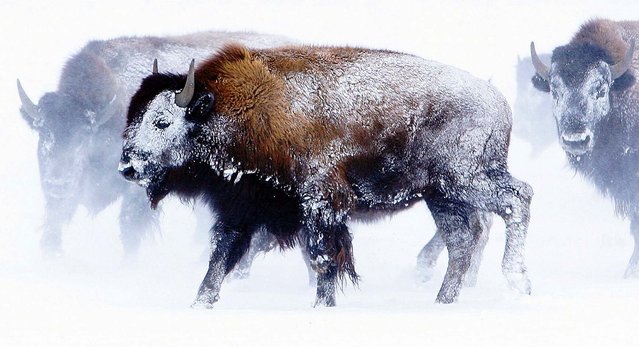
Bison along the Bitterroot Valley's Eastside Highway north of Stevensville, Montana, are covered in snow following a blizzard on November 23, 2010. (Photo by Perry Backus/The Missoulian)
Artist Sayna Soleimanpour shaves her legs in a bathtub as she performs a photoshoot in protest against the mistreatment and alienation of Turkish women based on their clothing, during a two-day curfew amid the spread of the coronavirus disease (COVID-19), on a street leading to the historical Galata Tower in Istanbul, Turkey, late December 25, 2020. (Photo by Umit Bektas/Reuters)
A cat dressed in a traditional outfit takes part during the Orthodox Christmas celebration in Kiev, Ukraine on January 7, 2020. Orthodox Christians celebrate Christmas Day on December 25 of the older Julian calendar, which currently corresponds to January 7 in the Gregorian calendar. (Photo by Pavlo Gonchar/SOPA Images/LightRocket via Getty Images)