Loading...
Done
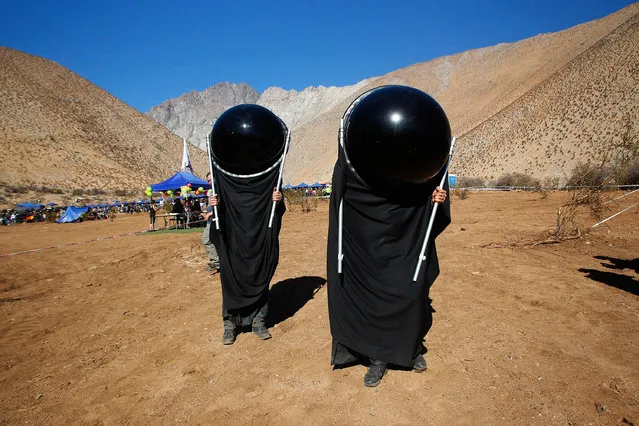
Chileans watch the sky with special suits prior to a total solar eclipse on July 2, 2019 in Paiguano, Chile. Around 25,0000 tourists arrived to Paiguano, a small town of around 1,000 inhabitants in the Elqui Valley, 650 km away Santiago. This is the only Earth's total solar eclipse of 2019 and the first one since 2017. From this point, the sun will fully disappear for around two minutes. It is best visible from a stripe in the South Pacific, Chile and Argentina. (Photo by Marcelo Hernandez/Getty Images)

Chileans watch the sky with special suits prior to a total solar eclipse on July 2, 2019 in Paiguano, Chile. Around 25,0000 tourists arrived to Paiguano, a small town of around 1,000 inhabitants in the Elqui Valley, 650 km away Santiago. This is the only Earth's total solar eclipse of 2019 and the first one since 2017. From this point, the sun will fully disappear for around two minutes. It is best visible from a stripe in the South Pacific, Chile and Argentina. (Photo by Marcelo Hernandez/Getty Images)
Details
04 Jul 2019 00:05:00
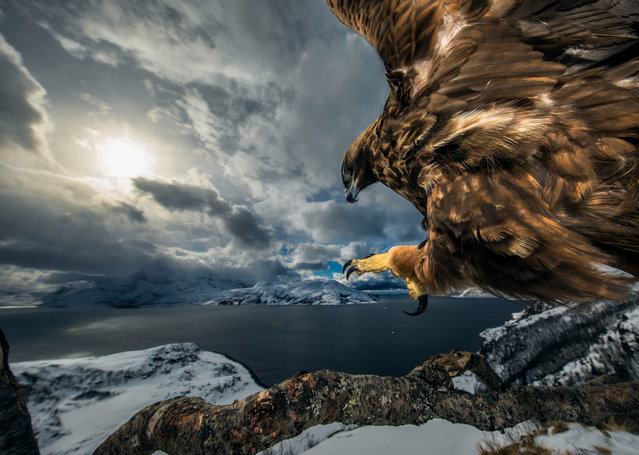
Birds behaviour winner: Land of the Eagle by Audun Rikardsen, Norway. High on a ledge, on the coast near his home in northern Norway, Rikardsen carefully positioned an old tree branch that he hoped would make a perfect golden eagle lookout. To this, he bolted a tripod head with a camera, flashes and motion sensor attached, and built himself a hide a short distance away. From time to time, he left road‑kill carrion nearby. Very gradually – over the next three years – a golden eagle got used to the camera and started to use the branch regularly to survey the coast below. (Photo by Audun Rikardsen/2019 Wildlife Photographer of the Year)

Birds behaviour winner: Land of the Eagle by Audun Rikardsen, Norway. High on a ledge, on the coast near his home in northern Norway, Rikardsen carefully positioned an old tree branch that he hoped would make a perfect golden eagle lookout. To this, he bolted a tripod head with a camera, flashes and motion sensor attached, and built himself a hide a short distance away. From time to time, he left road‑kill carrion nearby. Very gradually – over the next three years – a golden eagle got used to the camera and started to use the branch regularly to survey the coast below. (Photo by Audun Rikardsen/2019 Wildlife Photographer of the Year)
Details
17 Oct 2019 00:03:00
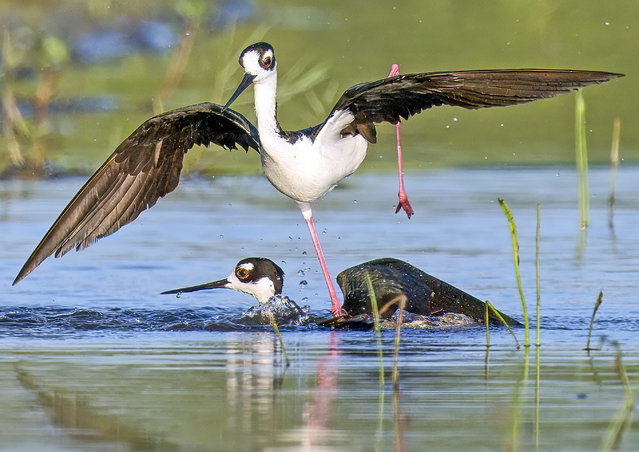
A pair of black-necked stilts fight over their marshland territory in Orlando, Florida in the last decade of July 2024. (Photo by Jake Landing/Solent News)

A pair of black-necked stilts fight over their marshland territory in Orlando, Florida in the last decade of July 2024. (Photo by Jake Landing/Solent News)
Details
11 Aug 2024 04:19:00
Children at Somerleyton School in Suffolk, UK on February 27, 2025 tuck into an iced bun, given by the Lord and Lady Somerleyton along with a £1 coin, as part of a long-standing tradition dating back to 1877". (Photo by Jason Bye for the Times)

Children at Somerleyton School in Suffolk, UK on February 27, 2025 tuck into an iced bun, given by the Lord and Lady Somerleyton along with a £1 coin, as part of a long-standing tradition dating back to 1877". (Photo by Jason Bye for the Times)
Details
10 Mar 2025 04:40:00
Flashmob: Water Battle on All-Russian Exhibition Center in Moscow, Russia, on August 5, 2012

Flashmob: Water Battle on All-Russian Exhibition Center in Moscow, Russia, on August 5, 2012. (Photo by Lilja Dal)
Details
05 Aug 2012 11:25:00
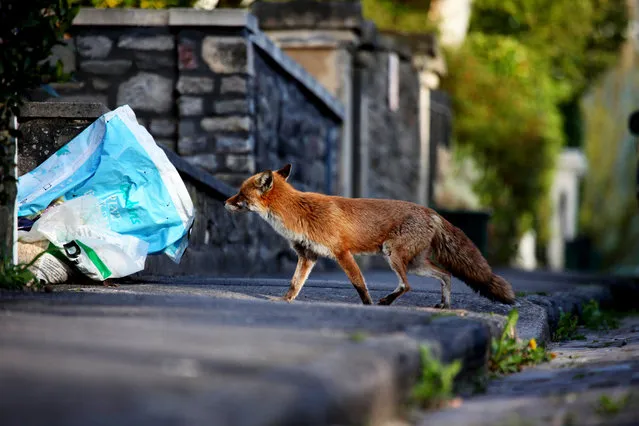
Urban Fox Project by Photographer Ian Wade

“I have been photographing this group of urban foxes in Bristol for over 12 months; what started off as a chance encounter has become an obsession for me and has changed my feelings and attitudes towards urban foxes forever...”. – Ian Wade. (Photo by Ian Wade)
Details
30 Jun 2013 12:36:00
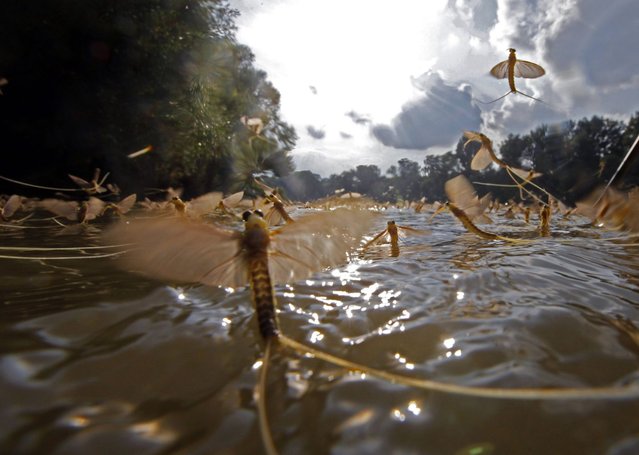
Long-tailed mayflies fly over the surface of the Tisza river southeast of Budapest. (Photo by Laszlo Balogh/Reuters)

Long-tailed mayflies (Palingenia longicauda) at Tisza river near Tiszainoka 135km (84 miles) southeast of Budapest, June 23, 2013. Millions of these short-lived mayflies engage in a frantic rush to mate and reproduce before they perish in just a few hours during “Tiszaviragzas” or Tisza blooming season from late spring to early summer every year. (Photo by Laszlo Balogh/Reuters)
Details
14 Jul 2013 11:20:00


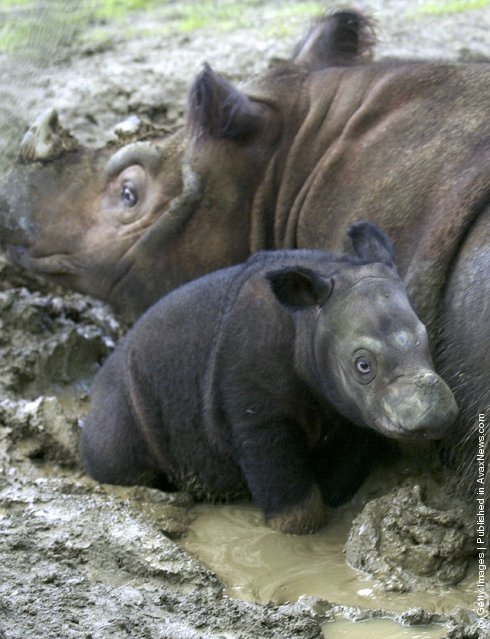
“The Sumatran Rhinoceros (Dicerorhinus sumatrensis) is a member of the family Rhinocerotidae and one of five extant rhinoceroses. It is the only extant species of the genus Dicerorhinus. It is the smallest rhinoceros, standing about 120–145 centimetres (3.9–4.76 ft) high at the shoulder, with a body length of 250 centimetres (8.2 ft) and weight of 500–800 kilograms (1,100–1,800 lb). Like the African species, it has two horns; the larger is the nasal horn, typically 15–25 centimetres (5.9–9.8 in), while the other horn is typically a stub. A coat of reddish-brown hair covers most of the Sumatran Rhino's body”. – Wikipedia

Photo: Emi, a Sumatran rhinoceros lies in the mud with her three-week-old female calf at the Cincinnati Zoo and Botanical Garden August 19, 2004 in Cincinnati, Ohio. Emi made history by becoming the first Sumatran rhino to produce two calves in captivity. (Photo by Mike Simons/Getty Images)
Details
22 Jun 2011 12:37:00