Loading...
Done
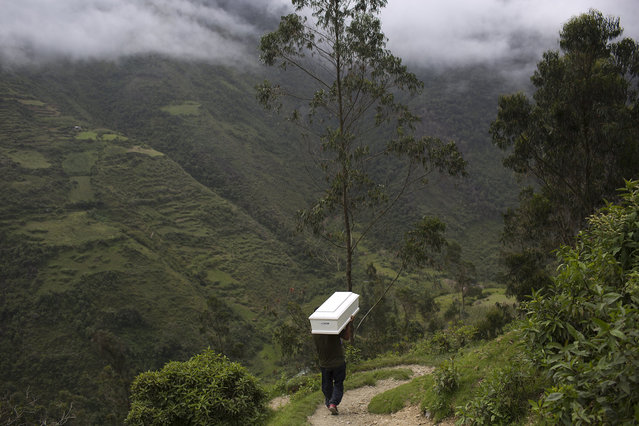
In this March 29, 2016 photo, a man shoulders a coffin with the remains of a loved one who was slain more than two decades ago by Shining Path rebels, as he walks to the cemetery for a group burial service, in Ccano, a village in the Huanta area of Ayachcuo department, Peru. Presidential candidate Keiko Fujimori's base of support is in places like Ccano, where promises to build roads, clinics and schools recall her agronomist father’s own legacy of delivering aid to the long-overlooked countryside. (Photo by Rodrigo Abd/AP Photo)

In this March 29, 2016 photo, a man shoulders a coffin with the remains of a loved one who was slain more than two decades ago by Shining Path rebels, as he walks to the cemetery for a group burial service, in Ccano, a village in the Huanta area of Ayachcuo department, Peru. Presidential candidate Keiko Fujimori's base of support is in places like Ccano, where promises to build roads, clinics and schools recall her agronomist father’s own legacy of delivering aid to the long-overlooked countryside. (Photo by Rodrigo Abd/AP Photo)
Details
08 Apr 2016 14:43:00
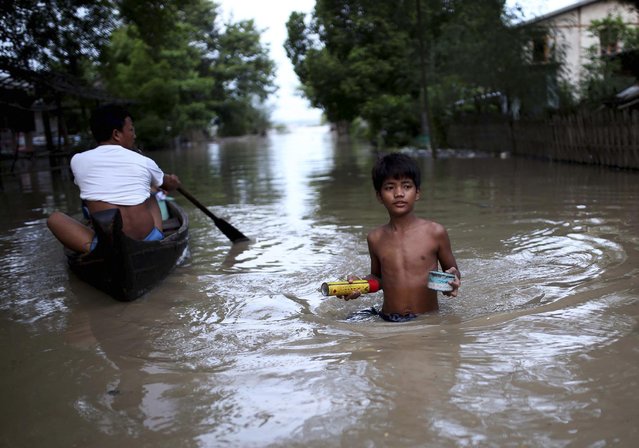
In this August 3, 2015, photo, residents make their way through floodwaters in Minbu, Magway division, in Myanmar. The Ministry of Social Welfare, Relief and Resettlement said that more than 200,000 people are affected in 11 of the country's 14 states and divisions by flooding. In addition to damage to houses and farmland, infrastructure has been very badly hit, with roads and rail lines cut in many places and telecommunication links broken. (Photo by Hkun Lat/AP Photo)

In this August 3, 2015, photo, residents make their way through floodwaters in Minbu, Magway division, in Myanmar. The Ministry of Social Welfare, Relief and Resettlement said that more than 200,000 people are affected in 11 of the country's 14 states and divisions by flooding. In addition to damage to houses and farmland, infrastructure has been very badly hit, with roads and rail lines cut in many places and telecommunication links broken. (Photo by Hkun Lat/AP Photo)
Details
05 Aug 2015 13:46:00
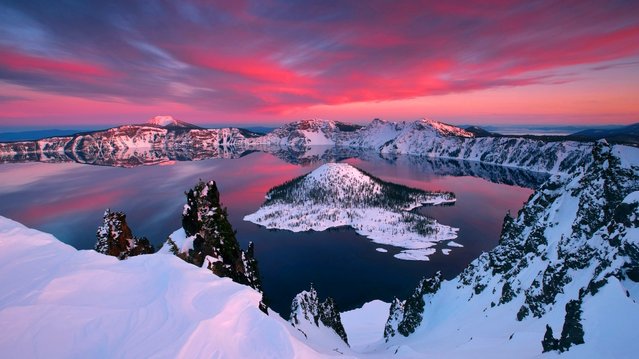
Crater Lake In Oregon

As you look at the majestic Crater Lake, located in south-central Oregon, United States, it is hard to imagine that thousands of years ago this place was one giant crater with scorching hot lava spilling over the sides. Those were the times of turmoil. Now, however, this place is the essence of tranquility. The lake that was formed, after the volcano died down, is amazingly clear due to the fact that the water isn’t moving at all. No rivers go in or out of the Crater Lake, and the water lost through evaporation is compensated by the rain and snowfall. This lake is also frighteningly deep – 1,943 feet (592 m) at its deepest point – making it the deepest lake in the United States. If you love nature and if you ever come to Oregon, this is truly a sight to behold.
Details
19 Nov 2014 14:14:00
A hostage runs towards a police officer outside Lindt cafe, where other hostages are being held, in Martin Place in central Sydney December 15, 2014. Two more hostages have run out of the cafe at the center of a siege in Sydney, Australia's largest city, according to a Reuters witness at the site. (Photo by Jason Reed/Reuters)

A hostage runs towards a police officer outside Lindt cafe, where other hostages are being held, in Martin Place in central Sydney December 15, 2014. Two more hostages have run out of the cafe at the center of a siege in Sydney, Australia's largest city, according to a Reuters witness at the site. The two women were both wearing aprons indicating they were staff at the Lindt cafe where a gunman has been holding an unknown number of hostages for several hours. Three men had earlier run out of the cafe. (Photo by Jason Reed/Reuters)
Details
15 Dec 2014 11:49:00
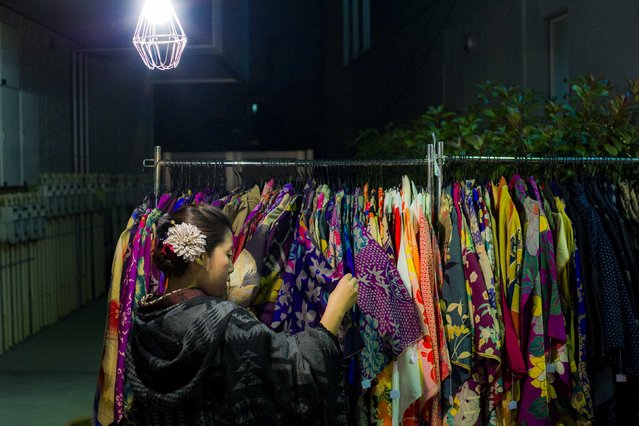
A woman browses through kimonos for sale at Boroichi flea market in Tokyo December 15, 2014. In the 16th century, Boroichi was a place for farmers to buy and sell rags, known as boro, for mending clothes and weaving sandals. Now in its 436th year, the original spirit lingers, with about 700 stands hawking fabric, used clothes and piles of rags. Others sell kitchen tools, pottery, seaweed and spices. (Photo by Thomas Peter/Reuters)

A woman browses through kimonos for sale at Boroichi flea market in Tokyo December 15, 2014. In the 16th century, Boroichi was a place for farmers to buy and sell rags, known as boro, for mending clothes and weaving sandals. Now in its 436th year, the original spirit lingers, with about 700 stands hawking fabric, used clothes and piles of rags. Others sell kitchen tools, pottery, seaweed and spices. About 200,000 people flock to the market, which is only open for four mid-winter days a year – two in December and two in January. (Photo by Thomas Peter/Reuters)
Details
19 Dec 2014 12:50:00
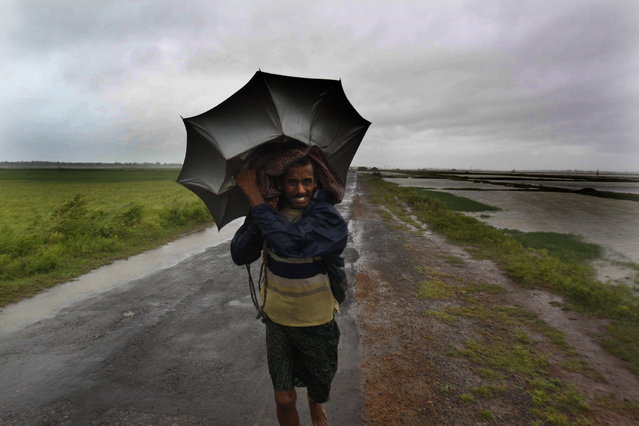
An Indian villager braving strong winds and rain walk to a safer place, in village Podampeta, in Ganjam district about 200 kilometers  (125 miles) from the eastern Indian city Bhubaneswar, India, Saturday, October 12, 2013. Strong winds and heavy rains pounded India's eastern coastline Saturday, as hundreds of thousands of people took shelter from a massive, powerful Cyclone Phailin expected to reach land in a few hours. (Photo by Biswaranjan Rout/AP Photo)

An Indian villager braving strong winds and rain walk to a safer place, in village Podampeta, in Ganjam district about 200 kilometers (125 miles) from the eastern Indian city Bhubaneswar, India, Saturday, October 12, 2013. Strong winds and heavy rains pounded India's eastern coastline Saturday, as hundreds of thousands of people took shelter from a massive, powerful Cyclone Phailin expected to reach land in a few hours. (Photo by Biswaranjan Rout/AP Photo)
Details
14 Oct 2013 08:44:00
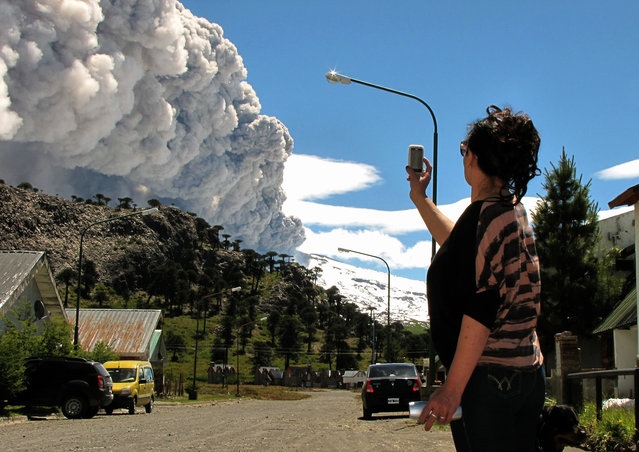
A woman takes a picture with her mobile phone from Caviahue, Neuquen province, Argentina, some 1500 km southwest of Buenos Aires, of the Copahue volcano spewing ashes on December 22, 2012. The authorities of Chile and Argentina issued yellow alerts due to the eruption of the Copahue volcano, placed in the border between both countries. (Photo by Antonio Huglich/AFP Photo)

A woman takes a picture with her mobile phone from Caviahue, Neuquen province, Argentina, some 1500 km southwest of Buenos Aires, of the Copahue volcano spewing ashes on December 22, 2012. The authorities of Chile and Argentina issued yellow alerts due to the eruption of the Copahue volcano, placed in the border between both countries. (Photo by Antonio Huglich/AFP Photo)
Details
23 Dec 2012 09:25:00
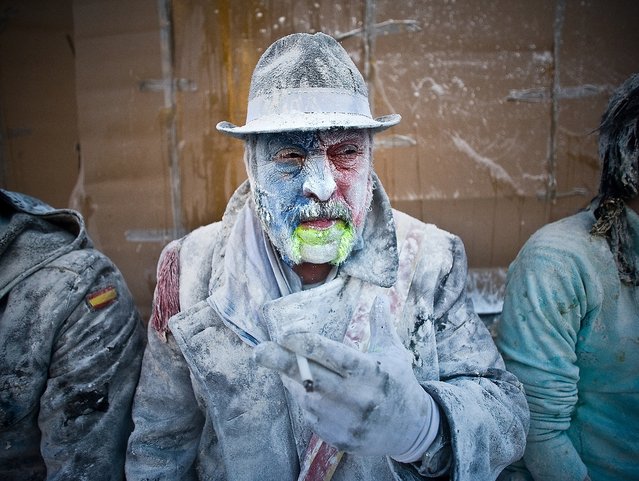
A Reveller smokes during the battle of “Enfarinats”, a flour fight in celebration of the Els Enfarinats festival. (Photo by David Ramos)

It’s a classic tale of dictatorship gone wrong and the fight for freedom. Like in any good battle, there’s fire, albeit from firecrackers, but the ammunition in this one is – flour. It takes place in a Hemingway-esque Spanish village. The battle of “Enfarinats” in celebration of the Els Enfarinats festival, rages on on December 28, 2012 in Ibi, Spain. Citizens of Ibi annually celebrate the festival with a fight using flour, eggs and firecrackers. The battle takes place between two groups, a group of married men called “Els Enfarinats” who take the control of the village for one day pronouncing a number of ridiculous laws and fining the citizens that infringe them and a group called “La Oposicio” who try to restore order. At the end of the day the money collected from the fines is donated to charitable causes in the village. The festival has been celebrated since 1981 after the town of Ibi recovered the tradition but the origins remain unknown.

Photo: A Reveller smokes during the battle of “Enfarinats”, a flour fight in celebration of the Els Enfarinats festival. (Photo by David Ramos)
Details
30 Dec 2012 10:28:00