Loading...
Done
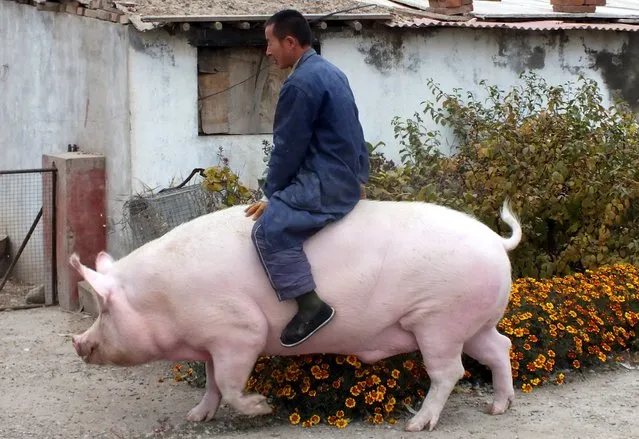
Farmer Zhang Xianping rides his pig "Big Precious" during an interview with the media, in Zhangjiakou, Hebei province, China, November 2, 2015. Zhang, a pig breeder, instead of killing it, decided to keep the two-year-old "Big Precious" as pet when its weight reached 600 kg, according to local media. (Photo by Reuters/China Daily)

Farmer Zhang Xianping rides his pig "Big Precious" during an interview with the media, in Zhangjiakou, Hebei province, China, November 2, 2015. Zhang, a pig breeder, instead of killing it, decided to keep the two-year-old "Big Precious" as pet when its weight reached 600 kg, according to local media. (Photo by Reuters/China Daily)
Details
06 Nov 2015 08:02:00
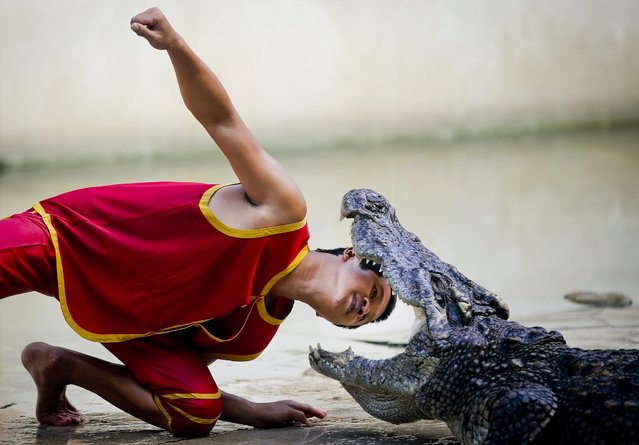
A picture made available 27 November 2015 shows a handler putting his head between the gaping fangs of a crocodile during a show at the Samutprakarn Crocodile Farm and Zoo, Samutprakarn province, outside Bangkok, Thailand, 26 November 2015. The farm and zoo claims to be the world's largest crocodile farm with more than 80,000 freshwater and marine crocodiles, and offers shows such as crocodile wrestling to attract tourists. (Photo by Diego Azubel/EPA)

A picture made available 27 November 2015 shows a handler putting his head between the gaping fangs of a crocodile during a show at the Samutprakarn Crocodile Farm and Zoo, Samutprakarn province, outside Bangkok, Thailand, 26 November 2015. The farm and zoo claims to be the world's largest crocodile farm with more than 80,000 freshwater and marine crocodiles, and offers shows such as crocodile wrestling to attract tourists. (Photo by Diego Azubel/EPA)
Details
28 Nov 2015 08:51:00
Dancers Daisy Kerry (R) and Alice Rathbone pose as characters from The Nutcracker, for the annual Christmas event at Chatsworth House near Bakewell in Britain November 4, 2016. (Photo by Darren Staples/Reuters)

Dancers Daisy Kerry (R) and Alice Rathbone pose as characters from The Nutcracker, for the annual Christmas event at Chatsworth House near Bakewell in Britain November 4, 2016. (Photo by Darren Staples/Reuters)
Details
05 Nov 2016 13:03:00
A wax figure depicting Jennifer Lopez by wax museum Madame Tussauds dressed in a new set of clothes attracts the attention of pedestrians during a press event at a beach bar in Berlin,†Germany, August 21, 2015. (Photo by Jens Kalaene/EPA)

A wax figure depicting Jennifer Lopez by wax museum Madame Tussauds dressed in a new set of clothes attracts the attention of pedestrians during a press event at a beach bar in Berlin,†Germany, August 21, 2015. (Photo by Jens Kalaene/EPA)
Details
22 Aug 2015 13:10:00
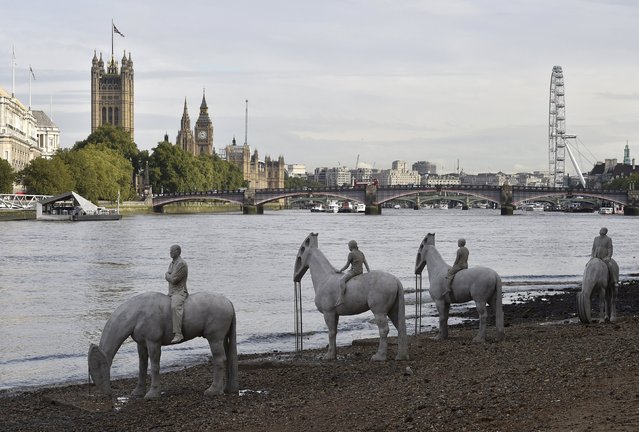
Sculptures entitled “The Rising Tide” by British sculptor Jason deCaires Taylor are seen beside the River Thames in front of the Houses of Parliament and the London Eye ferris wheel in London, September 3, 2015. The representations of four horses and riders are fully visible at low tide but become immersed underwater twice a day as the Thames rises to reach full tide. The installation will be on display throughout September as part of the annual Totally Thames festival. (Photo by Toby Melville/Reuters)

Sculptures entitled “The Rising Tide” by British sculptor Jason deCaires Taylor are seen beside the River Thames in front of the Houses of Parliament and the London Eye ferris wheel in London, September 3, 2015. The representations of four horses and riders are fully visible at low tide but become immersed underwater twice a day as the Thames rises to reach full tide. The installation will be on display throughout September as part of the annual Totally Thames festival. (Photo by Toby Melville/Reuters)
Details
04 Sep 2015 13:58:00
Galapagos – Rocking the Cradle: Four major ocean currents converge along the Galapagos archipelago, creating the conditions for an extraordinary diversity of animal life, April 25, 2016. The islands are home to at least 7,000 flora and fauna species, of which 97 percent of the reptiles, 80 percent of the land birds, 50 percent of the insects and 30 percent of the plants are endemic. The local ecosystem is highly sensitive to the changes in temperature, rainfall and ocean currents that characterize the climatic events known as El Niño and La Niña. These changes cause marked fluctuations in weather and food availability. Many scientists expect the frequency of El Niño and La Niña to increase as a result of climate change, making the Galapagos a possible early-warning location for its effects. (Photo by Thomas P. Peschak for National Geographic/World Press Photo)

Galapagos – Rocking the Cradle: Four major ocean currents converge along the Galapagos archipelago, creating the conditions for an extraordinary diversity of animal life, April 25, 2016. The islands are home to at least 7,000 flora and fauna species, of which 97 percent of the reptiles, 80 percent of the land birds, 50 percent of the insects and 30 percent of the plants are endemic. (Photo by Thomas P. Peschak for National Geographic/World Press Photo)
Details
16 Apr 2018 00:01:00
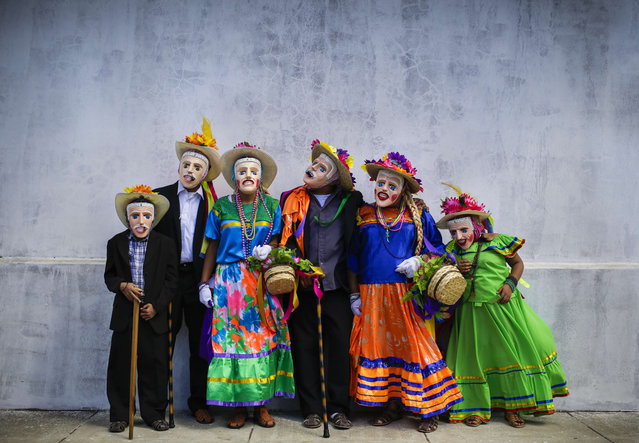
Dancers pose after performing “El Macho Raton”, “El Toro Huaco” and “El Gueguense” traditional dances during San Sebastian festivity in Diriamba, province of Carazo, some 50 km south of Managua on January 19, 2016. Devotees of Saint Sebastian dance in traditional costumes between the cities of Diriamba and Dolores, which are some three kilometers away. (Photo by Inti Ocon/AFP Photo)

Dancers pose after performing “El Macho Raton”, “El Toro Huaco” and “El Gueguense” traditional dances during San Sebastian festivity in Diriamba, province of Carazo, some 50 km south of Managua on January 19, 2016. Devotees of Saint Sebastian dance in traditional costumes between the cities of Diriamba and Dolores, which are some three kilometers away. (Photo by Inti Ocon/AFP Photo)
Details
21 Jan 2016 12:08:00
Rooftops of solar powered houses are pictured in Ota, 80 km northwest of Tokyo in this October 28, 2008 file photo. One by one, Japan is turning off the lights at the giant oil-fired power plants that propelled it to the ranks of the world's top industrialised nations. With nuclear power in the doldrums after the Fukushima disaster, it's solar energy that is becoming the alternative. (Photo by Yuriko Nakao/Reuters)

Rooftops of solar powered houses are pictured in Ota, 80 km northwest of Tokyo in this October 28, 2008 file photo. One by one, Japan is turning off the lights at the giant oil-fired power plants that propelled it to the ranks of the world's top industrialised nations. With nuclear power in the doldrums after the Fukushima disaster, it's solar energy that is becoming the alternative. Solar power is set to become profitable in Japan as early as this quarter, according to the Japan Renewable Energy Foundation (JREF), freeing it from the need for government subsidies and making it the last of the G7 economies where the technology has become economically viable. (Photo by Yuriko Nakao/Reuters)
Details
24 Nov 2015 08:04:00