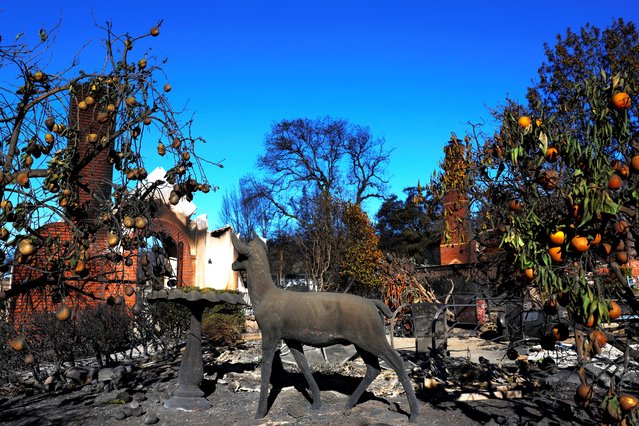
A charred deer figure stands in the ruins of a devastated home, as the Eaton Fire continues, in Altadena, California, on January 14, 2025. (Photo by Shannon Stapleton/Reuters)
Kate O'Connor, of Ireland, makes an attempt in the pentathlon long jump at the World Athletics Indoor Championships in Nanjing, China, Friday, March 21, 2025. (Photo by Vincent Thian/AP Photo)
Emma Navarro of the U.S. celebrates with supporters after beating Veronika Kudermetova of Russia in their second round women's singles match at the Wimbledon Tennis Championships in London, Thursday, July 3, 2025. (Photo by Joanna Chan/AP Photo)
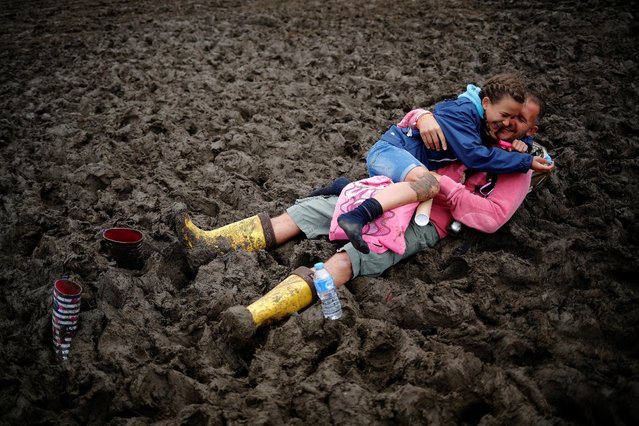
Revellers react after falling in the mud at Worthy Farm in Somerset during the Glastonbury Festival, Britain, June 26, 2016. (Photo by Stoyan Nenov/Reuters)
Nepal's Kumari, or living goddess, adjusts her ornament as she watches the Rato Machindranath chariot Festival in Lalitpur, Nepal, Friday, April 24, 2015. Nepal's living goddesses are young pre-pubescent girls considered by devotees to be incarnations of a Hindu goddess. Selected as toddlers, living goddesses usually keep their positions until they reach puberty. (Photo by Niranjan Shrestha/AP Photo)
French actress Frederique Bel arrives for the NRJ Music Awards ceremony at the Festival Palace in Cannes December 13, 2014. (Photo by Eric Gaillard/Reuters)
This Thursday, January 22, 2015 photo made with a long exposure shows the glow from a Noctiluca scintillans algal bloom along the seashore in Hong Kong. The luminescence, also called Sea Sparkle, is triggered by farm pollution that can be devastating to marine life and local fisheries, according to University of Georgia oceanographer Samantha Joye. Noctiluca itself does not produce neurotoxins like other similar organisms do. But its role as both prey and predator tends can eventually magnify the accumulation of toxins in the food chain, according to R. Eugene Turner at Louisiana State University. (Photo by Kin Cheung/AP Photo)