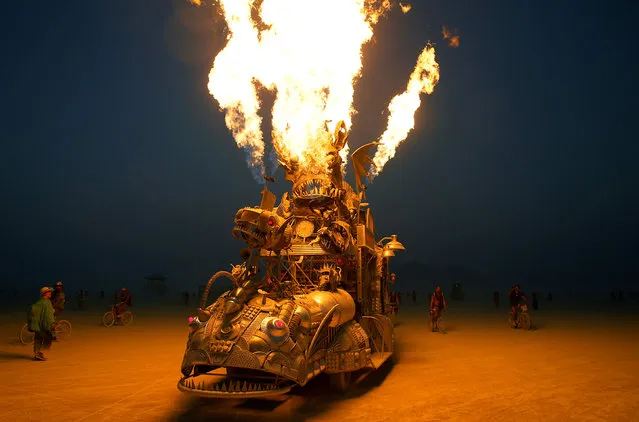
The “Rabid Transit” Burning Man art car erupts with flames from it's onboard propane poofers during the 4th day of the annual Burning Man arts and music festival in the Black Rock Desert of Nevada, U.S., August 31, 2017. (Photo by Jim Bourg/Reuters)
Labourers break fast outside a shop in a market on the first day of the Muslim holy month of Ramadan in Karachi, Pakistan June 7, 2016. (Photo by Akhtar Soomro/Reuters)
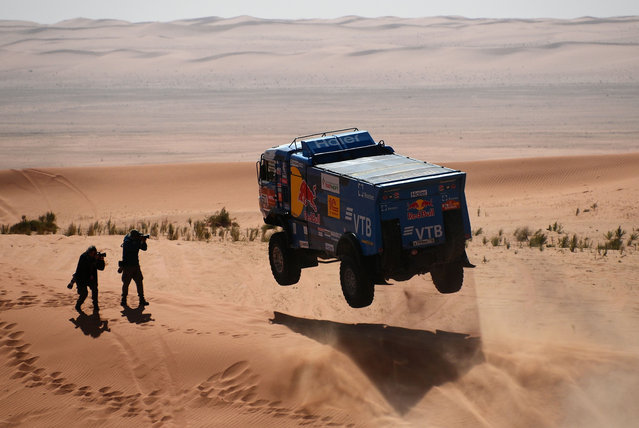
Kamaz' Russia driver Andrey Karginov, co-driver Andrey Mokeev and Igor Lenonov compete during the Stage 6 of the Dakar 2020 between Ha'il and Riyadh, Saudi Arabia, on January 10, 2020. (Photo by Franck Fife/AFP Photo)
Russian policemen detain participants of an unauthorized “Russian March 2020: For freedom and justice! We go out to say that Russian lives matter” organised by Russian nationalists on the National Unity Day in Moscow, Russia, 04 November 2020. Russian nationalists demand freedom for political prisoners in prisons and a fair investigation into the deaths of political prisoners, including representatives of radical movements who were killed during detention or found dead in places of detention. (Photo by Sergei Ilnitsky/EPA/EFE)
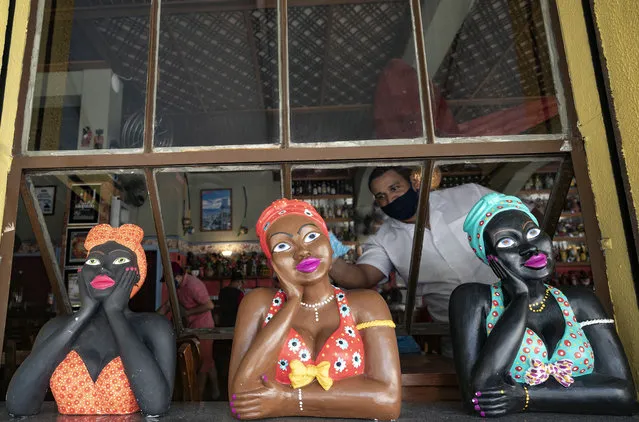
A restaurant worker wearing a mask cleans the windows as the restaurant reopens amid the COVID-19 pandemic in Sao Paulo, Brazil, Monday, July 6, 2020. Bars, restaurants and beauty salons were allowed to re-open Monday after over three months of quarantine, and are required to observe preventative measures and reduced operating hours only during the day. (Photo by Andre Penner/AP Photo)
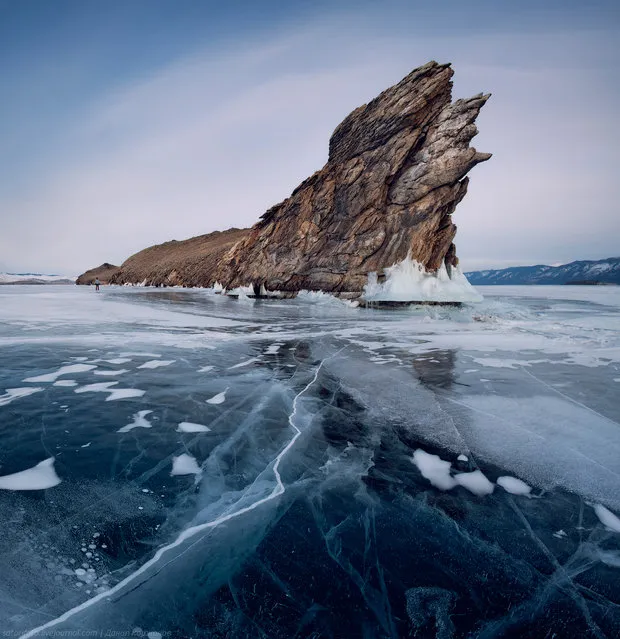
Lake Baikal is the world's oldest lake, at 25 million years (possibly older), and deepest, averaging 744.4 metres (2,442 ft).
Located in the south of the Russian region of Siberia, between Irkutsk Oblast to the northwest and the Buryat Republic to the southeast, it is the most voluminous freshwater lake in the world, containing roughly 20% of the world's unfrozen surface fresh water.
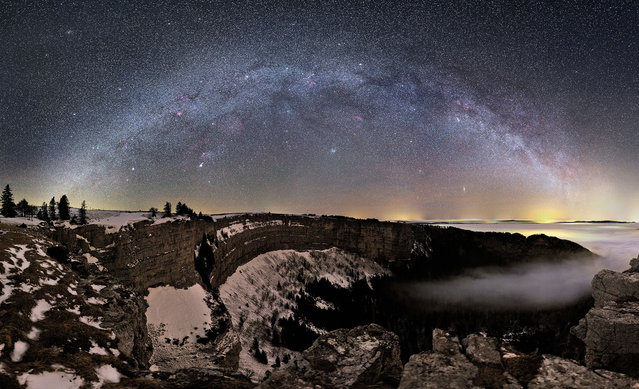
The Milky Way is the galaxy in which Earth is contained. This name derives from its appearance as a dim “milky” glowing band arching across the night sky, in which the naked eye cannot distinguish individual stars. The term “Milky Way” is a translation of the Classical Latin via lactea, from the Hellenistic Greek γαλαξίας κύκλος (pr. galaxías kýklos, “milky circle”). The Milky Way appears like a band because it is a disk-shaped structure being viewed from inside. The fact that this faint band of light is made up of stars was proven in 1610 when Galileo Galilei used his telescope to resolve it into individual stars. In the 1920s, observations by astronomer Edwin Hubble showed that the Milky Way is just one of many galaxies.