Loading...
Done
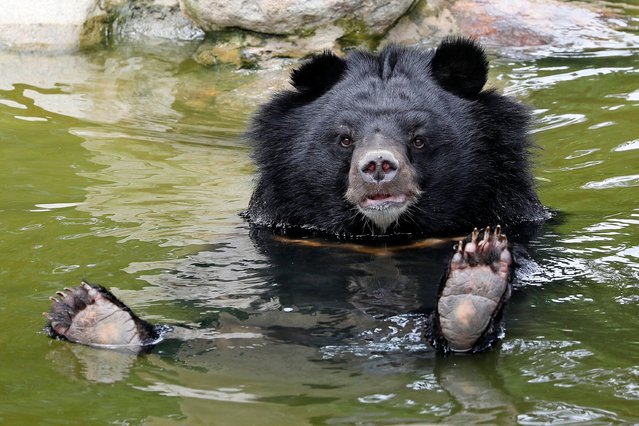
A moon bear rests in a pool inside an enclosure at the Vietnam bear rescue centre, in Tam Dao national park, Vinh Phuc, Vietnam, 09 July 2019. The center is operated by international organization Animals Asia. There are currently 184 bears living at the the Vietnam Bear Rescue Centre. It is estimated that there are less than a few hundred bears left in the wild in Vietnam. According to the latest data from the Ministry of Agriculture and Rural development, around 600 bears are still being kept on farms. In Vietnam, Animals Asia has rescued a total of 209 sun bears and moon bears. (Photo by Minh Hoang/EPA/EFE/Rex Features/Shutterstock)

A moon bear rests in a pool inside an enclosure at the Vietnam bear rescue centre, in Tam Dao national park, Vinh Phuc, Vietnam, 09 July 2019. The center is operated by international organization Animals Asia. There are currently 184 bears living at the the Vietnam Bear Rescue Centre. It is estimated that there are less than a few hundred bears left in the wild in Vietnam. According to the latest data from the Ministry of Agriculture and Rural development, around 600 bears are still being kept on farms. In Vietnam, Animals Asia has rescued a total of 209 sun bears and moon bears. (Photo by Minh Hoang/EPA/EFE/Rex Features/Shutterstock)
Details
14 Jul 2019 00:05:00
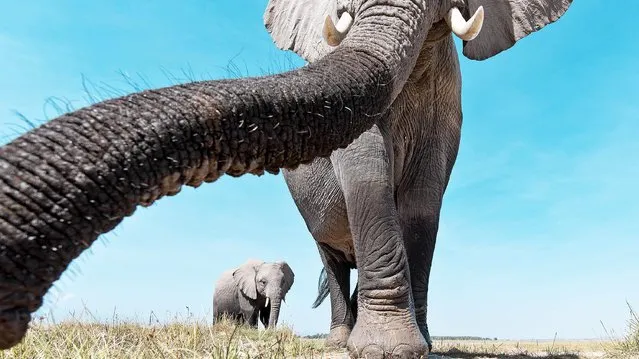
An elephant in Amboseli National Park in Kenya, June 2021. Gurcharan Roopra, 42, a Nairobi-born engineer-turned-wildlife photographer, has dedicated the past four years of his career to photographing these animals. He spends hours in his workshop camouflaging and encasing his equipment with protective gear before laying his camera in the path of lions, elephants, rhino, zebra and buffalo. (Photo by Gurcharan Roopra/Mercury Press)

An elephant in Amboseli National Park in Kenya, June 2021. Gurcharan Roopra, 42, a Nairobi-born engineer-turned-wildlife photographer, has dedicated the past four years of his career to photographing these animals. He spends hours in his workshop camouflaging and encasing his equipment with protective gear before laying his camera in the path of lions, elephants, rhino, zebra and buffalo. (Photo by Gurcharan Roopra/Mercury Press)
Details
24 Feb 2024 08:48:00
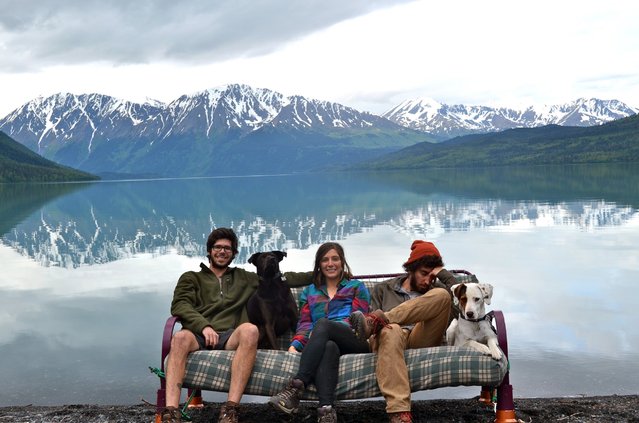
Becca D'Agostine, Andy Fuhrmann and Dafid Fine came up with a unique way to document their road trip by taking selfies on a couch at each location. Here they are seen at Mount Baker, Wash. (Photo by Caters News)

Becca D'Agostine, Andy Fuhrmann and Dafid Fine came up with a unique way to document their road trip by taking selfies on a couch at each location. Here they are seen at Mount Baker, Wash. (Photo by Caters News)
Details
21 Oct 2014 11:55:00
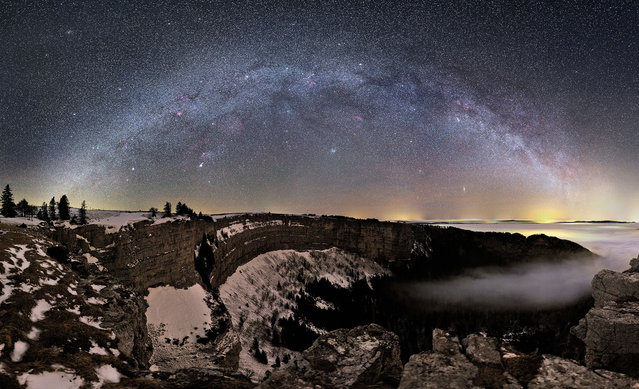
Milky Way over Switzerland

Milky Way over Switzerland

The Milky Way is the galaxy in which Earth is contained. This name derives from its appearance as a dim “milky” glowing band arching across the night sky, in which the naked eye cannot distinguish individual stars. The term “Milky Way” is a translation of the Classical Latin via lactea, from the Hellenistic Greek γαλαξίας κύκλος (pr. galaxías kýklos, “milky circle”). The Milky Way appears like a band because it is a disk-shaped structure being viewed from inside. The fact that this faint band of light is made up of stars was proven in 1610 when Galileo Galilei used his telescope to resolve it into individual stars. In the 1920s, observations by astronomer Edwin Hubble showed that the Milky Way is just one of many galaxies.


Details
20 Jun 2012 10:11:00
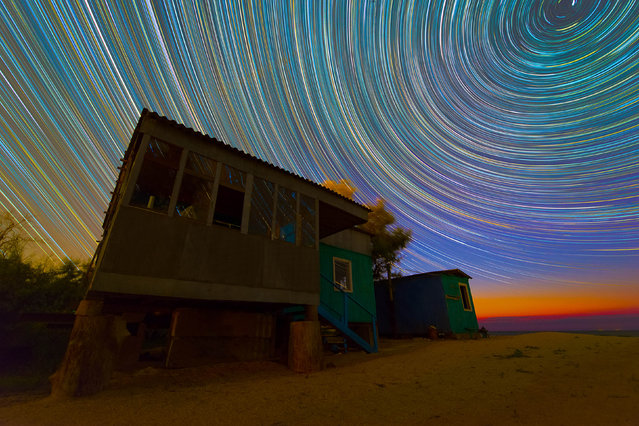
These are the spectacular snaps of swirling star trails which transform the night sky into a kaleidoscope of color. Keen photographer Evgeniy Zaytsev, 24, captured the stunning shots on trips to Crimea, Altai and Murom, Russia. The pictures of circular star trails are formed by merging multiple photos taken over the course of several hours. Here: vibrate, colorful star trails over an abandoned beach house. (Photo by Evgeniy Zaytsev/Caters News)

These are the spectacular snaps of swirling star trails which transform the night sky into a kaleidoscope of color. Keen photographer Evgeniy Zaytsev, 24, captured the stunning shots on trips to Crimea, Altai and Murom, Russia. The pictures of circular star trails are formed by merging multiple photos taken over the course of several hours. Movement of the Earth causes the stars appear in different places in each image. Here: vibrate, colorful star trails over an abandoned beach house. (Photo by Evgeniy Zaytsev/Caters News)
Details
12 Feb 2015 12:50:00
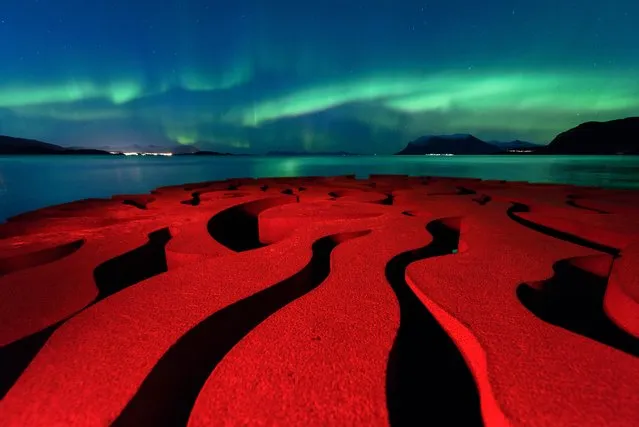
“Seven Magic Points”. The rusty red swirls of the circular, iron sculpture Seven Magic Points in Brattebergan, Norway mirror the rippling aurora above. (Photo by Rune Engebø/Royal Observatory Greenwich’s Astronomy Photographer of the Year 2016/National Maritime Museum)

Gorgeous galaxies and stunning stars make up this selection of pictures from the shortlisted entries for this year’s Insight Astronomy Photographer of the Year award. The winners will be announced on 15 September, and an exhibition of the winning images will be will be displayed in a free exhibition at the Royal Observatory Greenwich’s Astronomy Centre from 17 September. Here: “Seven Magic Points”. The rusty red swirls of the circular, iron sculpture Seven Magic Points in Brattebergan, Norway mirror the rippling aurora above. (Photo by Rune Engebø/Royal Observatory Greenwich’s Astronomy Photographer of the Year 2016/National Maritime Museum)
Details
28 Jul 2016 13:51:00
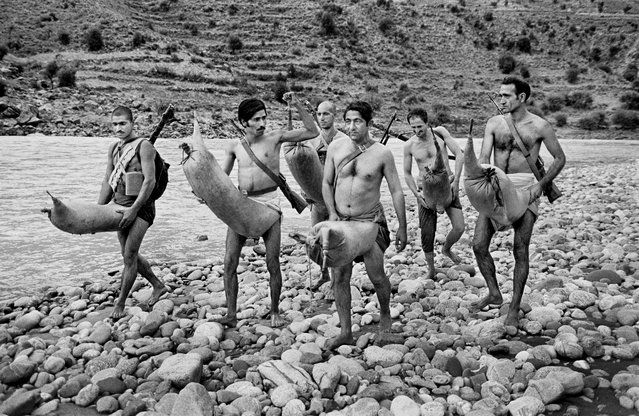
Kunar province, 1980. Armed mujahideen carry animal skins to use as inflatable buoys to cross rapids. (Photo by  Steve McCurry/Taschen/Magnum Photos/The Guardian)

Afghanistan, published by Taschen later July, is a retrospective portfolio of the Magnum photographer Steve McCurry’s most striking images of the country, from 1979 to 2016. Here: Kunar province, 1980. Armed mujahideen carry animal skins to use as inflatable buoys to cross rapids. (Photo by Steve McCurry/Taschen/Magnum Photos/The Guardian)
Details
12 Aug 2017 05:54:00
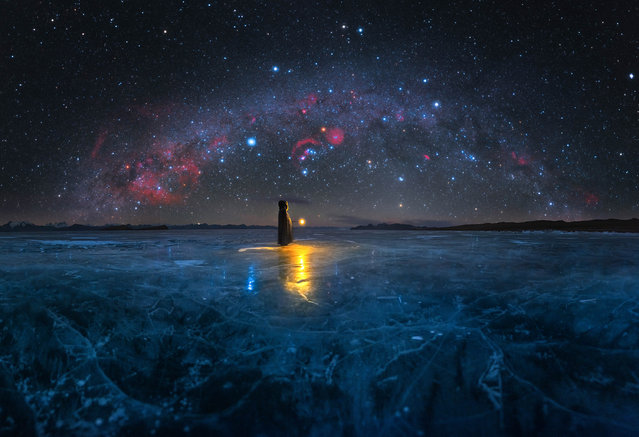
Ice Age – Tibet, China. “This is the Chinese version of the blue ice lake, Pumoungcuo, at an altitude of 5,070 metres (16,600 feet). This lake in Tibet freezes every winter. At night, under the low temperatures of -20C, you can listen to the sound of the ice cracking while capturing the most beautiful winter sky. The blue ice surface and dazzling Orion constellation create a fantasy landscape. I felt so happy to have the stars as my companion on this magical night”. (Photo by Daniel Zafra Portill/Milky Way Photographer of the Year)

Ice Age – Tibet, China. “This is the Chinese version of the blue ice lake, Pumoungcuo, at an altitude of 5,070 metres (16,600 feet). This lake in Tibet freezes every winter. At night, under the low temperatures of -20C, you can listen to the sound of the ice cracking while capturing the most beautiful winter sky. The blue ice surface and dazzling Orion constellation create a fantasy landscape. I felt so happy to have the stars as my companion on this magical night”. (Photo by Daniel Zafra Portill/Milky Way Photographer of the Year)
Details
21 May 2022 05:10:00