Loading...
Done
A vendor sells fruits and nuts at the Green Bazaar in Almaty January 23, 2015. Kazakhstan is spending billions of dollars of its reserves to keep devaluation of its currency gradual and reduce inflationary risks of the sort thrown up in Russia by the rouble's slide, analysts and former central bank officials say. (Photo by Shamil Zhumatov/Reuters)

A vendor sells fruits and nuts at the Green Bazaar in Almaty January 23, 2015. Kazakhstan is spending billions of dollars of its reserves to keep devaluation of its currency gradual and reduce inflationary risks of the sort thrown up in Russia by the rouble's slide, analysts and former central bank officials say. Kazakhstan, Central Asia's largest economy, is closely tied to Russia through trade and, like other ex-Soviet states, has been feeling the pain of the crisis which has driven the rouble down 50 percent against the dollar since the start of 2014. (Photo by Shamil Zhumatov/Reuters)
Details
28 Jan 2015 11:57:00
“The sustainable development goals cannot be met unless waste management is addressed as a priority”, says UK waste management charity Waste Aid. “E-waste is one of the fastest growing categories of the 7-10bn tonnes of waste produced globally every year”, adds director Mike Webster. “In our view, decent waste management is a basic right and we want governments around the world take this issue much more seriously – in 2012 only 0.2% of international aid went on improving solid waste management – it’s just not enough”. (Photo by Kai Loeffelbein/laif Agentur)

Sustainable development goal target 12.5 is to reduce waste. But with a planet increasingly dependent on technology, is that even possible? As of today, over 30m tonnes of electronic waste has been thrown out so far this year, according to the World Counts. Most e-waste is sent to landfills in Asia and Africa where it is recycled by hand, exposing the people who do it to environmental hazards. Kai Loeffelbein’s photographs of e-waste recycling in Guiyu, southern China show what happens to discarded computers. (Photo by Kai Loeffelbein/laif Agentur)
Details
19 Oct 2016 12:14:00
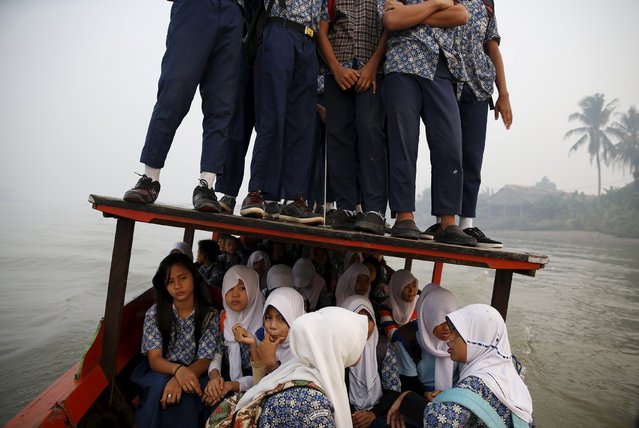
Students stand on the roof of a wooden boat as haze blankets the Musi River while they travel to school in Palembang, on Indonesia's Sumatra island, September 10, 2015. (Photo by Reuters/Beawiharta)

Students stand on the roof of a wooden boat as haze blankets the Musi River while they travel to school in Palembang, on Indonesia's Sumatra island, September 10, 2015. Indonesia is investigating 10 firms over worsening forest fires that have created a blanket of smog over Southeast Asia, threatening them with sanctions if they are found responsible, a government minister said on Tuesday. The thick haze from Indonesia's Sumatra and Kalimantan islands has forced the repeated cancellation of flights in the area and pushed air quality to unhealthy levels in neighbouring Singapore and Malaysia. (Photo by Reuters/Beawiharta)
Details
11 Sep 2015 12:09:00
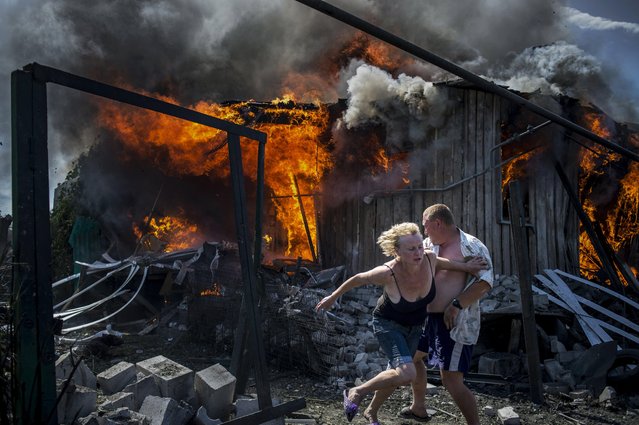
A handout photo made available by the World Press Photo (WPP) organization on 13 February 2017 shows a picture by Rossiya Segodnya photographer Valery Melnikov that won the Long-Term Projects – First Prize award of the 60th annual World Press Photo Contest, it was announced by the WPP Foundation in Amsterdam, The Netherlands on 13 February 2017. Caption: Civilians escape from a fire at a house destroyed by an air attack in the Luhanskaya village. Story: Ordinary people became victims of the conflict between self-proclaimed republics and the official Ukrainian authorities from 2014 onwards in the region of Donbass. Disaster came into their lives unexpectedly. These people were involved in the military confrontation against their will. They experienced the most terrible things: the death of their friends and relatives, destroyed homes and the ruined lives of thousands of people. (Photo by Valery Melnikov/EPA/Rossiya Segodnya/World Press Photo)

A handout photo made available by the World Press Photo (WPP) organization on 13 February 2017 shows a picture by Rossiya Segodnya photographer Valery Melnikov that won the Long-Term Projects – First Prize award of the 60th annual World Press Photo Contest, it was announced by the WPP Foundation in Amsterdam, The Netherlands on 13 February 2017. Caption: Civilians escape from a fire at a house destroyed by an air attack in the Luhanskaya village. (Photo by Valery Melnikov/EPA/Rossiya Segodnya/World Press Photo)
Details
15 Feb 2017 00:06:00
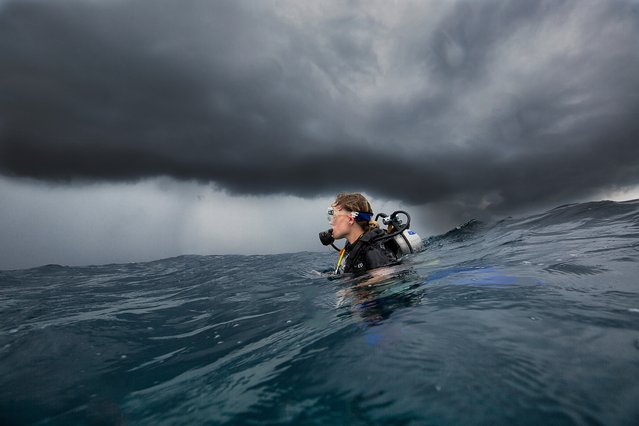
Winner. “This was taken in the South Ari Atolls, Maldives, as the south-west monsoon season was setting in. It features my partner – and dive buddy – Emma after surfacing at the end of the last dive of the day to find 1.5 metre swells and dark monsoon clouds. MICK RYAN, JUDGE: This beautiful portrait of a diver in an ocean swell below a menacing sky stands out this month for its emotional and elemental beauty. It is a reminder that while we may play among nature we are always dwarfed by its power and must be constantly on our guard”. (Photo by Simon Dunn/The Guardian)

Winner. “This was taken in the South Ari Atolls, Maldives, as the south-west monsoon season was setting in. It features my partner – and dive buddy – Emma after surfacing at the end of the last dive of the day to find 1.5 metre swells and dark monsoon clouds. MICK RYAN, JUDGE: This beautiful portrait of a diver in an ocean swell below a menacing sky stands out this month for its emotional and elemental beauty. It is a reminder that while we may play among nature we are always dwarfed by its power and must be constantly on our guard”. (Photo by Simon Dunn/The Guardian)
Details
04 Oct 2016 10:55:00
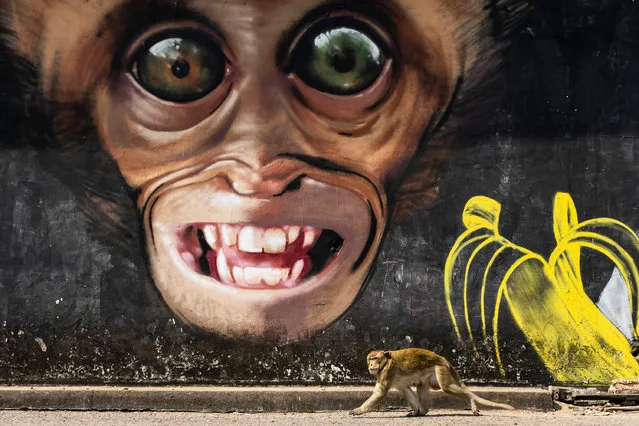
Natural world and wildlife shortlist. Lop Buri in Thailand is home to hundreds of macaques, which local residents consider to be disciples of the Hindu god Hanuman. While some people love them, others fear or even hate them. Despite the inconvenience they often cause, the macaques are generally respected and considered sacred. (Photo by Joan de la Malla/Sony World Photography Awards)

Natural world and wildlife shortlist. Lop Buri in Thailand is home to hundreds of macaques, which local residents consider to be disciples of the Hindu god Hanuman. While some people love them, others fear or even hate them. Despite the inconvenience they often cause, the macaques are generally respected and considered sacred. (Photo by Joan de la Malla/Sony World Photography Awards)
Details
15 Feb 2020 00:05:00
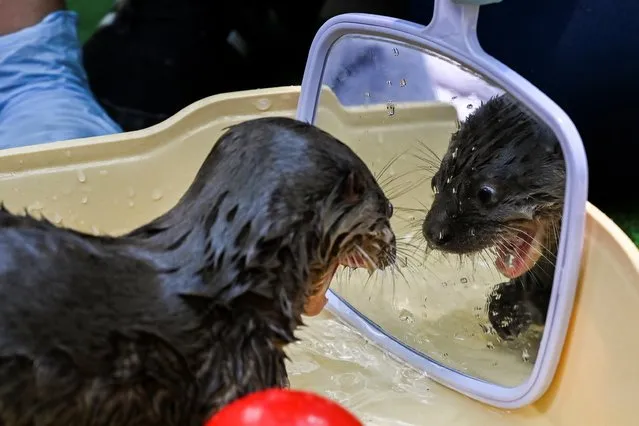
A river otter (lontra longicaudis) of 6-weeks-old looks in the mirror during a bath in the Animal Welfare Unit of the Zoo in Cali, Colombia, on October 22, 2019. The baby otter was found abandoned brought to the Cali Zoo for breeding, for its extensive experience in raising these species. According to the International Union for Conservation of Nature the river otter (lontra longicaudis) are in danger of extinction, because of mining, agriculture, pollution of rivers and housing construction in their habitat. (Photo by Luis Robayo/AFP Photo)

A river otter (lontra longicaudis) of 6-weeks-old looks in the mirror during a bath in the Animal Welfare Unit of the Zoo in Cali, Colombia, on October 22, 2019. The baby otter was found abandoned brought to the Cali Zoo for breeding, for its extensive experience in raising these species. According to the International Union for Conservation of Nature the river otter (lontra longicaudis) are in danger of extinction, because of mining, agriculture, pollution of rivers and housing construction in their habitat. (Photo by Luis Robayo/AFP Photo)
Details
27 Oct 2019 00:03:00
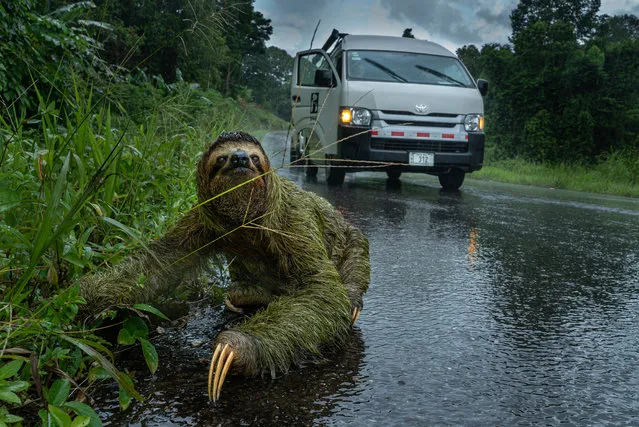
People and Nature category winner: Why did the sloth cross the road? by Andrew Whitworth (Osa Conservation and University of Glasgow), taken in Osa Peninsula, Costa Rica. “I was driving out from the Osa Peninsula, located on the southern Pacific coast of Costa Rica on a dark, stormy day. This female three-toed sloth (Bradypus variegatus) had luckily just about made it across the road, and the drivers of the Toyota on this occasion had spotted her in good time”. (Photo by Andrew Whitworth/2019 British Ecological Society Photography Competition)

People and Nature category winner: Why did the sloth cross the road? by Andrew Whitworth (Osa Conservation and University of Glasgow), taken in Osa Peninsula, Costa Rica. “I was driving out from the Osa Peninsula, located on the southern Pacific coast of Costa Rica on a dark, stormy day. This female three-toed sloth (Bradypus variegatus) had luckily just about made it across the road, and the drivers of the Toyota on this occasion had spotted her in good time”. (Photo by Andrew Whitworth/2019 British Ecological Society Photography Competition)
Details
30 Nov 2019 00:05:00