Loading...
Done
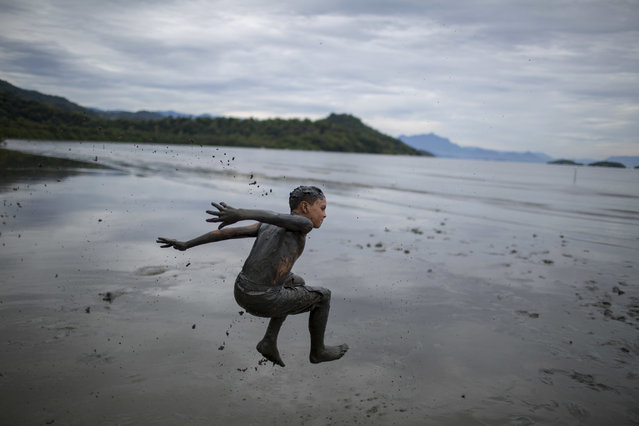
A boy jumps into a pool of mud during the traditional “Bloco da Lama” or “Mud Street” carnival party, in Paraty, Brazil, Saturday, February 25, 2017. Legend has it the “bloco” was born in 1986 after local teens hiking in a nearby mangrove forest smeared themselves with mud to discourage mosquitoes and then wandered through Paraty. The party grew year after year, but revelers eventually were banned from parading in the colonial downtown after shopkeepers complained pristine white walls were stained with the hard-to-remove mud. (Photo by Mauro Pimentel/AP Photo)

A boy jumps into a pool of mud during the traditional “Bloco da Lama” or “Mud Street” carnival party, in Paraty, Brazil, Saturday, February 25, 2017. Legend has it the “bloco” was born in 1986 after local teens hiking in a nearby mangrove forest smeared themselves with mud to discourage mosquitoes and then wandered through Paraty. The party grew year after year, but revelers eventually were banned from parading in the colonial downtown after shopkeepers complained pristine white walls were stained with the hard-to-remove mud. (Photo by Mauro Pimentel/AP Photo)
Details
28 Mar 2017 09:07:00
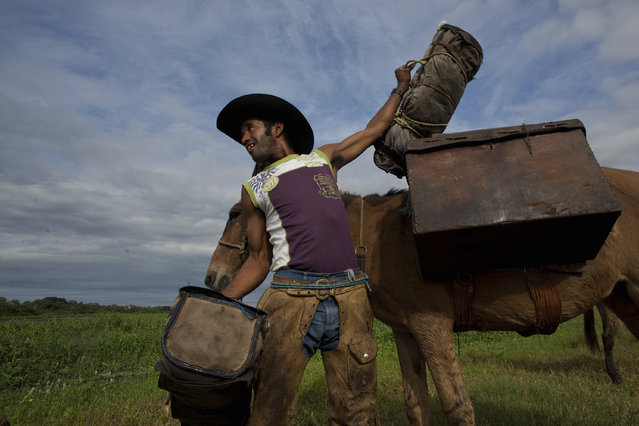
In this May 17, 2017 photo, cowboy cook Odair Batista carries a case with food in Corumba, the Pantanal wetlands of Mato Grosso do Sul state, Brazil. Dressed with leather chaps on top of their jeans, stetson hats and a machete attached to their waists, before setting off, the men finish their breakfast with Terere, an herbal “mate” beverage served ice cold in an ox drinking horn. (Photo by Eraldo Peres/AP Photo)

In this May 17, 2017 photo, cowboy cook Odair Batista carries a case with food in Corumba, the Pantanal wetlands of Mato Grosso do Sul state, Brazil. Dressed with leather chaps on top of their jeans, stetson hats and a machete attached to their waists, before setting off, the men finish their breakfast with Terere, an herbal “mate” beverage served ice cold in an ox drinking horn. (Photo by Eraldo Peres/AP Photo)
Details
12 Jun 2017 09:00:00
Black women in Brazil sit at the intersection of racism and misogyny, and have in recent years been at the forefront of a movement that challenges issues ranging from sexual and domestic violence to police brutality and stereotyping. Kolor Collective considers itself to be a part of this movement and questions expectations imposed on black women with satirical and subversive images, as seen here. (Photo by Kolor Art Collective/The Guardian)

Photographer Pol Kurucz’s vivid collection of photos explores issues faced by black Brazilian women, from political misrepresentation to unrealistic beauty standards. Kolor Collective is a Rio de Janeiro-based creative group that challenges the struggle faced by black women in Brazil through theatrical and provocative art. It was founded in 2015 by Franco-Hungarian photographer Pol Kurucz, who often touches on his own experiences of discrimination to call out sensitive social problems. (Photo by Kolor Art Collective/The Guardian)
Details
28 Dec 2016 07:24:00
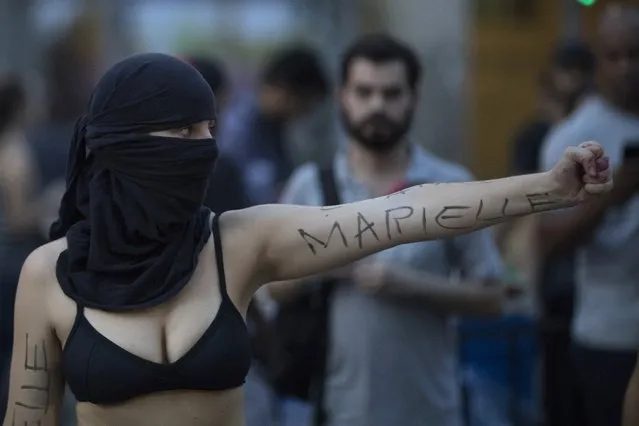
A demonstrator shows her arm with the name "Marielle" written on it, as she performs during a protest against the murder of councilwoman Marielle Franco in Rio de Janeiro, Brazil, Tuesday, March 20, 2018. Franco's murder came just a month after the government put the military in charge of security in Rio, which is experiencing a sharp spike in violence less than two years after hosting the 2016 Summer Olympics. (AP Photo/Leo Correa)

A demonstrator shows her arm with the name “Marielle” written on it, as she performs during a protest against the murder of councilwoman Marielle Franco in Rio de Janeiro, Brazil, Tuesday, March 20, 2018. Franco's murder came just a month after the government put the military in charge of security in Rio, which is experiencing a sharp spike in violence less than two years after hosting the 2016 Summer Olympics. (Photo by Leo Correa/AP Photo)
Details
21 Mar 2018 09:12:00
Sabrina Crespo da Silva removes electrical tape from a client at her Sabrina Bronze rooftop salon, where she offers the service of taping on bikini tops which create crisp tan lines, in the Turano favela of Rio de Janeiro, Brazil, Thursday, January 27, 2022. Even though beaches reopened amid the COVID-19 pandemic, some clients using Sabrina's rooftop service say they are still anxious about returning to the crowded seashore and potentially catching the virus. (Photo by Silvia Izquierdo/AP Photo)

Sabrina Crespo da Silva removes electrical tape from a client at her Sabrina Bronze rooftop salon, where she offers the service of taping on bikini tops which create crisp tan lines, in the Turano favela of Rio de Janeiro, Brazil, Thursday, January 27, 2022. Even though beaches reopened amid the COVID-19 pandemic, some clients using Sabrina's rooftop service say they are still anxious about returning to the crowded seashore and potentially catching the virus. (Photo by Silvia Izquierdo/AP Photo)
Details
29 Jan 2022 07:06:00
Police Cpl. Cristiano de Oliveira offers a hand to police dog “Corporal Oliveira”, at the 17 Military Police Battalion's station, in Rio de Janeiro, Brazil, Thursday, April 7, 2022. Oliveira is one of two rescue dogs that have turned into local mascots and budding online influencers after joining their rescuers' ranks. (Photo by Silvia Izquierdo/AP Photo)

Police Cpl. Cristiano de Oliveira offers a hand to police dog “Corporal Oliveira”, at the 17 Military Police Battalion's station, in Rio de Janeiro, Brazil, Thursday, April 7, 2022. Oliveira is one of two rescue dogs that have turned into local mascots and budding online influencers after joining their rescuers' ranks. (Photo by Silvia Izquierdo/AP Photo)
Details
14 Apr 2022 06:22:00
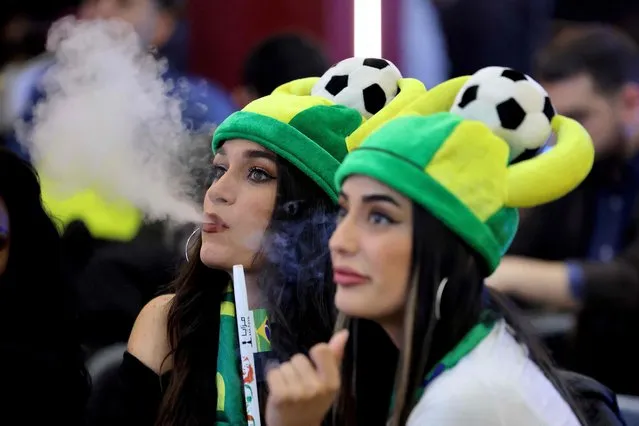
Lebanese women smoke nargileh (water pipe) and watch a streaming broadcast of the FIFA World Cup 2022 group G soccer match between Brazil and Switzerland, at a café-restaurant in the area of Sabtiyeh, north of Beirut, on November 28, 2022. Lebanon being hit hard by the economic crisis, the country did not obtain the rights to broadcast the 2022 World Cup this year, depriving Lebanese fans of the World Cup. (Photo by Joseph Eid/AFP Photo)

Lebanese women smoke nargileh (water pipe) and watch a streaming broadcast of the FIFA World Cup 2022 group G soccer match between Brazil and Switzerland, at a café-restaurant in the area of Sabtiyeh, north of Beirut, on November 28, 2022. Lebanon being hit hard by the economic crisis, the country did not obtain the rights to broadcast the 2022 World Cup this year, depriving Lebanese fans of the World Cup. (Photo by Joseph Eid/AFP Photo)
Details
22 Dec 2022 05:45:00
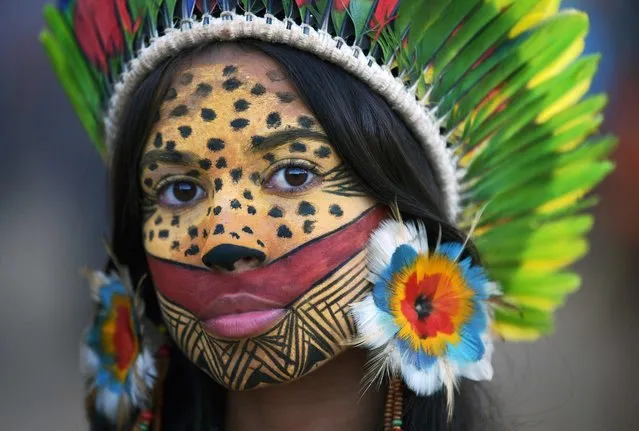
A woman from the Pataxo tribe poses for a photo at an indigenous protest camp on the fourth day of the Terra Livre Indigenous Camp in Brasilia on April 7, 2022. The 10-day annual protest is held by indigenous people from tribes that arrive from all over Brazil, and calls for greater protection of their land and rights. (Photo by Carl de Souza/AFP Photo)

A woman from the Pataxo tribe poses for a photo at an indigenous protest camp on the fourth day of the Terra Livre Indigenous Camp in Brasilia on April 7, 2022. The 10-day annual protest is held by indigenous people from tribes that arrive from all over Brazil, and calls for greater protection of their land and rights. (Photo by Carl de Souza/AFP Photo)
Details
24 Jun 2023 03:41:00