Loading...
Done
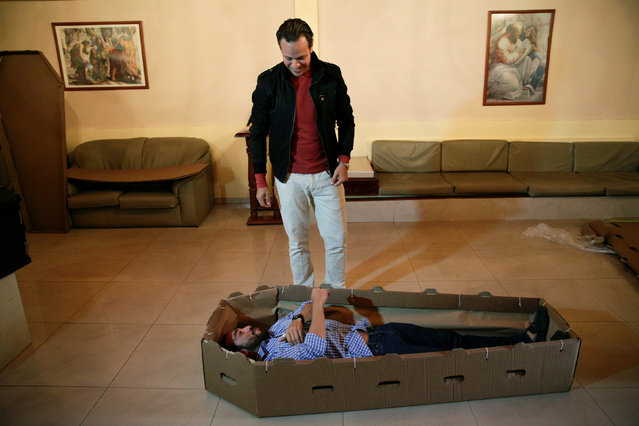
Elio Angulo (bottom C) lies inside a cardboard coffin next to Alejandro Blanchard as they introduce their product to potential customers at a mortuary in Valencia, in the state of Carabobo, Venezuela August 25, 2016. (Photo by Marco Bello/Reuters)

Elio Angulo (bottom C) lies inside a cardboard coffin next to Alejandro Blanchard as they introduce their product to potential customers at a mortuary in Valencia, in the state of Carabobo, Venezuela August 25, 2016. When Venezuelan entrepreneurs Alejandro Blanchard and Elio Angulo decided to create cardboard coffins, they were looking for an ecological selling point to compete against classic wood and brass caskets. Three years on, with the oil-rich country mired in deep economic crisis, their “bio-coffins” are becoming a viable option because of high prices for wooden coffins and shortages of brass ones. (Photo by Marco Bello/Reuters)
Details
27 Aug 2016 11:18:00
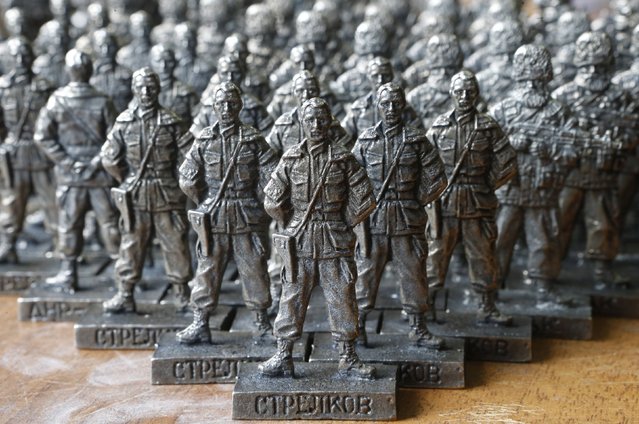
Figurines of former pro-Russian separatist commander Igor Strelkov from the collection entitled “Toy Soldiers of Novorossiya” are on display at a workshop in Moscow August 29, 2014. (Photo by Sergei Karpukhin/Reuters)

Figurines of former pro-Russian separatist commander Igor Strelkov from the collection entitled “Toy Soldiers of Novorossiya” are on display at a workshop in Moscow August 29, 2014. A Moscow-based maker of toy soldiers has sought inspiration for his creations from Ukrainian rebels fighting government troops in the east of Ukraine. Toy soldier maker, Timur Zamilov, displayed his new collection of rebel fighters cast in metal on Friday, before they are due to go on sale. His new collection is entitled “Toy Soldiers of Novorossiya” (New Russia), a reference to regions in eastern Ukraine where pro-Russian separatist fighters want full independence. Zamilov's selection includes models of Cossack soldiers, volunteers, soldiers bearing anti-aircraft missiles and even a miniature of prominent rebel leader Igor Strelkov. (Photo by Sergei Karpukhin/Reuters)
Details
01 Sep 2014 10:21:00
Base jumper Denis Odintsov from Russian leaps from the 300-meters Open Deck of the Malaysia's landmark Kuala Lumpur Tower during the International Tower Jump in Kuala Lumpur on September 27, 2013. Some 103 professional base jumpers from 20 countries are taking part in the annual event. (Photo by Mohd Rasfan/AFP Photo)

Base jumper Denis Odintsov from Russian leaps from the 300-meters Open Deck of the Malaysia's landmark Kuala Lumpur Tower during the International Tower Jump in Kuala Lumpur on September 27, 2013. Some 103 professional base jumpers from 20 countries are taking part in the annual event. (Photo by Mohd Rasfan/AFP Photo)
Details
28 Sep 2013 09:30:00
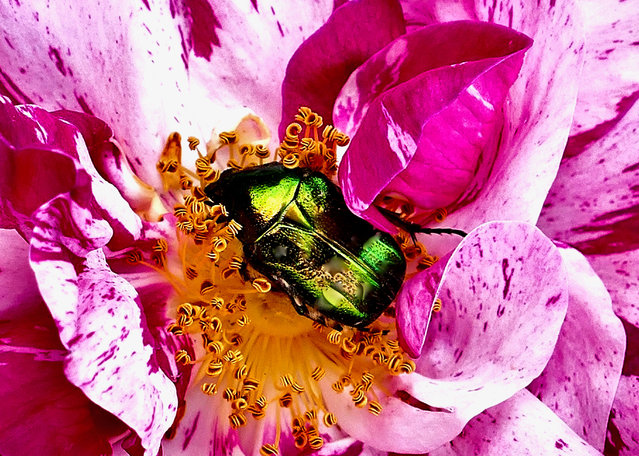
A rose chafer in Oxfordshire, UK on July 8, 2024. The beetles are often seen on flowers in the garden and are sometimes maligned for munching their way through these plants. However, they are an important detritivore as they feed on dead and decaying matter and recycle its nutrients, which makes a helpful addition to any compost. (Photo by Geoffrey Swaine/Rex Features/Shutterstock)

A rose chafer in Oxfordshire, UK on July 8, 2024. The beetles are often seen on flowers in the garden and are sometimes maligned for munching their way through these plants. However, they are an important detritivore as they feed on dead and decaying matter and recycle its nutrients, which makes a helpful addition to any compost. (Photo by Geoffrey Swaine/Rex Features/Shutterstock)
Details
21 Jul 2024 05:04:00
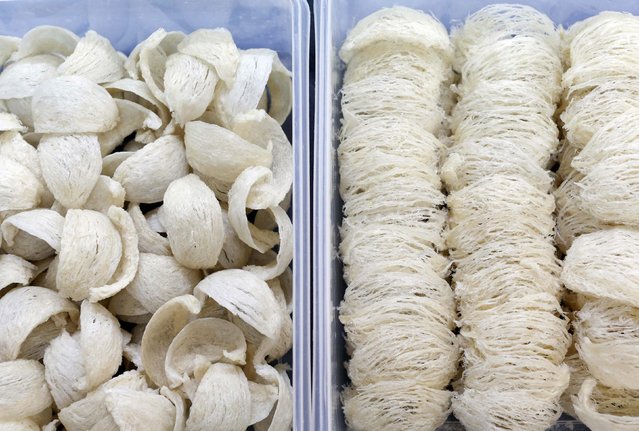
Two styles of cleaned bird's nest, Yan Zhan (L) and Su Zhan (R) await repacking at a processing plant in Kuala Lumpur, February 17, 2015. Prized in China for is alleged health benefits for hundreds of years, nests made from swiftlets' saliva are being mixed into coffee and cereal as the Southeast Asian producers of the delicacy seek to broaden its appeal, and their profit margins. (Photo by Olivia Harris/Reuters)

Two styles of cleaned bird's nest, Yan Zhan (L) and Su Zhan (R) await repacking at a processing plant in Kuala Lumpur, February 17, 2015. Prized in China for is alleged health benefits for hundreds of years, nests made from swiftlets' saliva are being mixed into coffee and cereal as the Southeast Asian producers of the delicacy seek to broaden its appeal, and their profit margins. The nests are among the world's most expensive foods, selling for up to $2,500 a kg and the swiftlets that weave them are indigenous to Indonesia, Malaysia, Thailand and Vietnam. (Photo by Olivia Harris/Reuters)
Details
24 Feb 2015 13:57:00
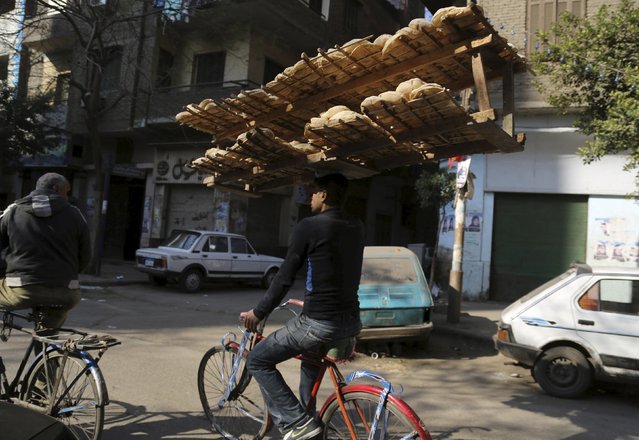
A bakery worker rides a bicycle as he carries fresh bread on his head in Cairo, Egypt, February 9, 2016. (Photo by Asmaa Waguih/Reuters)

A bakery worker rides a bicycle as he carries fresh bread on his head in Cairo, Egypt, February 9, 2016. (Photo by Asmaa Waguih/Reuters)
Details
07 Apr 2016 14:37:00
France's Christian Lavieille and co-pilot Jean-Michel Polato compete with their Proto Dessoude during the first stage of the Dakar Rally 2013 from Lima to Pisco January 5, 2013. (Photo by Jacky Naegelen/Reuters)

France's Christian Lavieille and co-pilot Jean-Michel Polato compete with their Proto Dessoude during the first stage of the Dakar Rally 2013 from Lima to Pisco January 5, 2013. (Photo by Jacky Naegelen/Reuters)
Details
12 Jan 2013 11:08:00
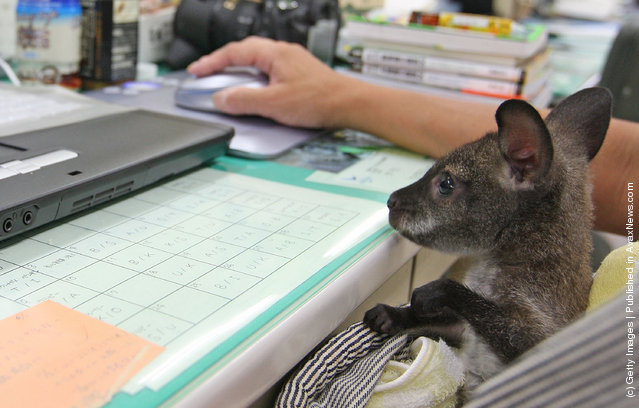
A baby wallaby

“Very small forest-dwelling wallabies are known as pademelons (genus Thylogale) and dorcopsises (genera Dorcopsis and Dorcopsulus). The name wallaby comes from the Eora Aboriginal tribe who were the original inhabitants of the Sydney area. Wallabies are herbivores whose diet consists of a wide range of grasses, vegetables, leaves, and other types of foliage”. – Wikipedia

Photo: A baby wallaby sits in a zoo attendant's lap at Edogawa Natural Zoo on August 4, 2009 in Tokyo, Japan. The staff of the zoo have raised the young wallaby after her mother neglected her. (Photo by Junko Kimura/Getty Images)
Details
07 Sep 2011 13:33:00