Loading...
Done
Otaku In Osaka. Cosplay 2012

The eighth annual Nipponbashi Street Festa stamped Osaka March 20, 2012 (Nipponbashi is Osaka’s geek district – much like Akihabara is for Tokyo). Cosplayers turned up in colourful outfits, dressing as characters from their favourite manga, anime, and video games. The street was closed to cars, and otaku flooded the streets, snapping pics, cosplaying, and hanging out.
Details
25 Apr 2012 14:58:00
Caroline Wozniacki of Denmark serves in her match against Kaia Kanepi of Estonia

Caroline Wozniacki of Denmark serves in her match against Kaia Kanepi of Estonia during day four of the Toray Pan Pacific Open at Ariake Colosseum on September 28, 2011 in Tokyo, Japan. (Photo by Koji Watanabe/Getty Images)
Details
22 Nov 2011 14:17:00
Designer False Eyelashes Remain Popular Japanese Fashion Accessory

An employee wears false eyelashes at the Shu Uemura eyelashes bar in the Omotesando district May 18, 2007 in Tokyo, Japan. 22 different false eyelash designs are available at the eyelashes bar ranging in cost from US$13 to US$43. (Photo by Koichi Kamoshida/Getty Images)
Details
02 Dec 2011 09:07:00
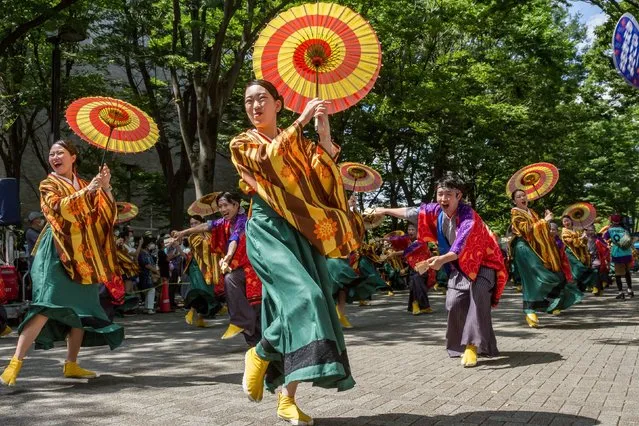
Dancers perform at the Harajuku Omotesando Super Yosakoi Dance festival in Shibuya, Tokyo on August 27, 2022. Super Yosakoi festival, is a two day festival that sees thousands of dancers, in hundreds of teams, energetically perform this unique Japanese dance style that combines traditional and more modern elements of movement and costume. (Photo by Damon Coulter/SOPA Images/Rex Features/Shutterstock)

Dancers perform at the Harajuku Omotesando Super Yosakoi Dance festival in Shibuya, Tokyo on August 27, 2022. Super Yosakoi festival, is a two day festival that sees thousands of dancers, in hundreds of teams, energetically perform this unique Japanese dance style that combines traditional and more modern elements of movement and costume. (Photo by Damon Coulter/SOPA Images/Rex Features/Shutterstock)
Details
07 Sep 2022 05:17:00
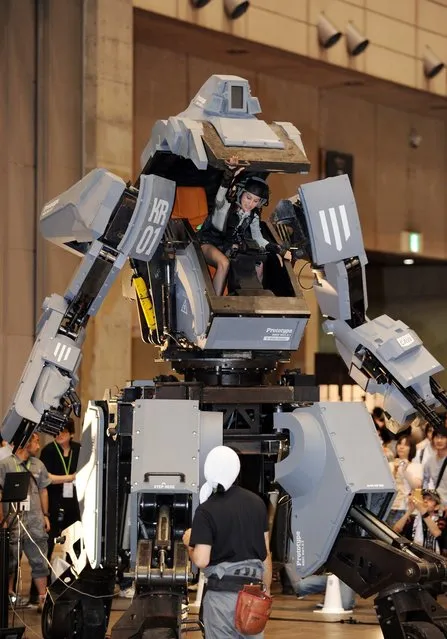
Female “pilot” Anna (C) climbs out the cockpit of Japanese electronics company Suidobashi Heavy Industry's newly unveiled robot “Kuratas” at the Wonder Festival in Chiba, suburban Tokyo on July 29, 2012. The Kuratas robot, which will go on sale with a price tag of one million USD, measures four meters in height, weighs four tons and has four wheeled legs that can either be controlled remotely through the 3G network or by a human seated within the cockpit.

Female pilot Anna climbs out the cockpit of Japanese electronics company Suidobashi Heavy Industry's newly unveiled robot “Kuratas” at the Wonder Festival in Chiba, suburban Tokyo on July 29, 2012. The “Kuratas” robot, which will go on sale with a price tag of one million USD, measures four meters in height, weighs four tons and has four wheeled legs that can either be controlled remotely through the 3G network or by a human seated within the cockpit. (Photo by Yoshikazu Tsuno/AFP Photo)
Details
30 Jul 2012 09:26:00
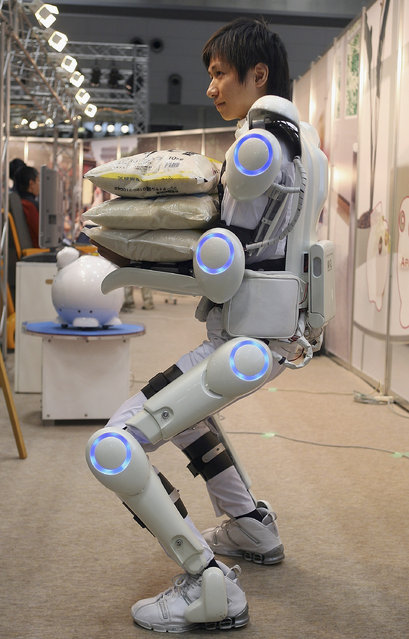
Robot suit "Hybrid Assistive Limb (HAL)" worn by a man developed by University of Tsukuba is seen lifting a 30kg weight during 2005 International Robot Exhibition on November 30, 2005 in Tokyo, Japan. By wearing the power suit, it makes it easier to move and lift heavy things. The Exhibition is on until December 3. (Photo by Koichi Kamoshida)

“A robot suit that can help the elderly or disabled get around was given its global safety certificate in Japan on February 27, 2013, paving the way for its worldwide roll-out”. Photo: Robot suit “Hybrid Assistive Limb (HAL)” worn by a man developed by University of Tsukuba is seen lifting a 30kg weight during 2005 International Robot Exhibition on November 30, 2005 in Tokyo, Japan. By wearing the power suit, it makes it easier to move and lift heavy things. (Photo by Koichi Kamoshida)
Details
11 Mar 2013 11:15:00
Rooftops of solar powered houses are pictured in Ota, 80 km northwest of Tokyo in this October 28, 2008 file photo. One by one, Japan is turning off the lights at the giant oil-fired power plants that propelled it to the ranks of the world's top industrialised nations. With nuclear power in the doldrums after the Fukushima disaster, it's solar energy that is becoming the alternative. (Photo by Yuriko Nakao/Reuters)

Rooftops of solar powered houses are pictured in Ota, 80 km northwest of Tokyo in this October 28, 2008 file photo. One by one, Japan is turning off the lights at the giant oil-fired power plants that propelled it to the ranks of the world's top industrialised nations. With nuclear power in the doldrums after the Fukushima disaster, it's solar energy that is becoming the alternative. Solar power is set to become profitable in Japan as early as this quarter, according to the Japan Renewable Energy Foundation (JREF), freeing it from the need for government subsidies and making it the last of the G7 economies where the technology has become economically viable. (Photo by Yuriko Nakao/Reuters)
Details
24 Nov 2015 08:04:00
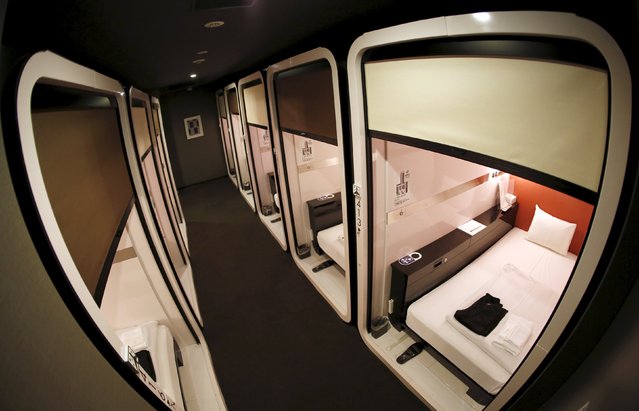
“Business-class” cabins are seen at First Cabin hotel, which was converted from an old office building, in Tokyo, July 3, 2015. Record tourists to Japan are stretching the ability of hotels to accommodate them in a sector constrained by high costs, forcing developers to think out of the box for means to quickly increase lodging options without breaking the bank. (Photo by Toru Hanai/Reuters)

“Business-class” cabins are seen at First Cabin hotel, which was converted from an old office building, in Tokyo, July 3, 2015. Record tourists to Japan are stretching the ability of hotels to accommodate them in a sector constrained by high costs, forcing developers to think out of the box for means to quickly increase lodging options without breaking the bank. (Photo by Toru Hanai/Reuters)
Details
31 Jul 2015 10:57:00