Loading...
Done
Aerial Views by  Ken Hong Leung

H. Leung has been acclaimed since 1952 for his brilliant artistic style. A master of oil on canvas, he achieves a haunting quality in his works that absorbs the viewer’s emotions like an irresistible melody. His brush, like a wand, seems to weave a sense of enchantment. In his landscapes and waterside villages, visions of Shangri-La come to mind, superbly mixed with subtle orchestrations of peacefulness and drama.

Technique is both a creative and expressive force in the art of H. Leung. Distinctively semi-abstract, his images allow the viewer’s eye to supply what is merely suggested. This very involving result adds power not only to the impact of his designs, it increases the joy that owning his works provides.
Details
26 Aug 2012 12:10:00
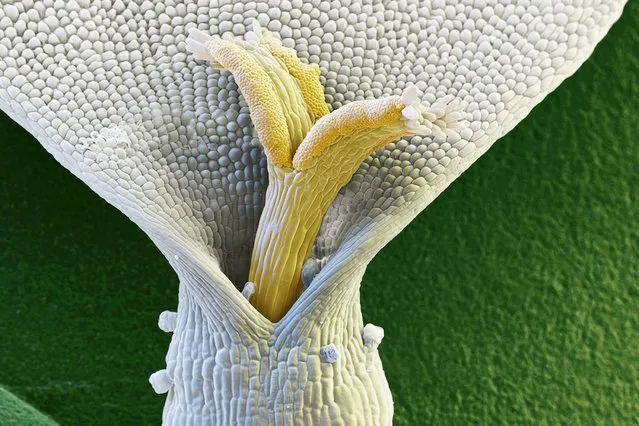
The floret of a Chamomile flower up close and personal. (Photo by Oliver Meckes/Barcroft Media)

These images have been created using a colour scanning electron microscope (SEM) by the award-winning Eye of Science, comprised of snapper Oliver Meckes and biologist Nicole Ottawa. For a decade the pair, based in Reutlingen in the south of Germany, worked with an old SEM they saved from the scrapheap, but for the last five years they have used a £250,000 FEI Quanta Series Field Emission SEM. Oliver said: “Flowers are beautiful in 'normal' view, but when you look closer, some parts get very bizarre and unexpected structures appear – flowers within flowers, worlds within worlds”. Photo: The floret of a Chamomile flower up close and personal. (Photo by Oliver Meckes/Barcroft Media)
Details
26 May 2014 13:51:00
In this Thursday, December 1, 2016 photo, Cat Bigney, part of the Oglala Native American tribe, waits on the shore of the Cannonball river for travelers to arrive by canoe at the Oceti Sakowin camp where people have gathered to protest the Dakota Access oil pipeline in Cannon Ball, N.D. So far, those at the camp have shrugged off the heavy snow, icy winds and frigid temperatures. But if they defy next week's government deadline to abandon the camp, demonstrators know the real deep freeze lies ahead. Life-threatening wind chills and towering snow drifts could mean the greatest challenge is simple survival. (Photo by David Goldman/AP Photo)

In this Thursday, December 1, 2016 photo, Cat Bigney, part of the Oglala Native American tribe, waits on the shore of the Cannonball river for travelers to arrive by canoe at the Oceti Sakowin camp where people have gathered to protest the Dakota Access oil pipeline in Cannon Ball, N.D. So far, those at the camp have shrugged off the heavy snow, icy winds and frigid temperatures. But if they defy next week's government deadline to abandon the camp, demonstrators know the real deep freeze lies ahead. Life-threatening wind chills and towering snow drifts could mean the greatest challenge is simple survival. (Photo by David Goldman/AP Photo)
Details
06 Dec 2016 10:22:00
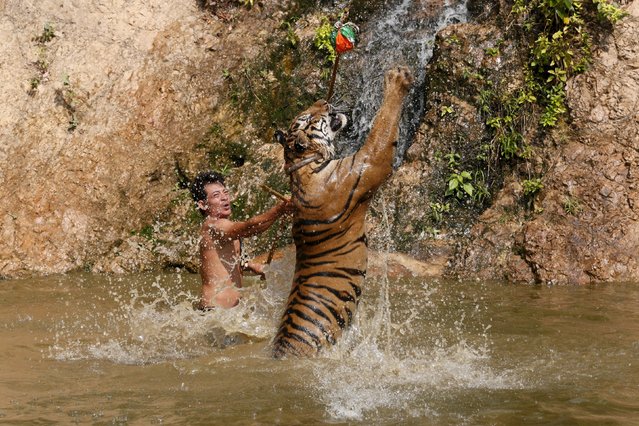
A tiger jumps while being trained at the Tiger Temple in Kanchanaburi province, west of Bangkok, Thailand, February 25, 2016. Thailand's controversial Tiger Temple, dogged for years by talk that it supplies the black market and mistreats its animals, is fighting to keep the big cats after wildlife authorities rejected a bid to extend a zoo licence that expired in 2013. (Photo by Chaiwat Subprasom/Reuters)

A tiger jumps while being trained at the Tiger Temple in Kanchanaburi province, west of Bangkok, Thailand, February 25, 2016. Thailand's controversial Tiger Temple, dogged for years by talk that it supplies the black market and mistreats its animals, is fighting to keep the big cats after wildlife authorities rejected a bid to extend a zoo licence that expired in 2013. The Buddhist temple, home to more than 100 tigers, has been investigated for suspected links to wildlife trafficking and wildlife activists have accused it of illegal breeding of the animals. Thai wildlife authorities have sent ten of the temple's tigers to a wildlife sanctuary. But the temple, which bills itself as a wildlife sanctuary, has denied links to illegal trafficking, and wants to hold on to its tigers. (Photo by Chaiwat Subprasom/Reuters)
Details
29 Feb 2016 11:56:00
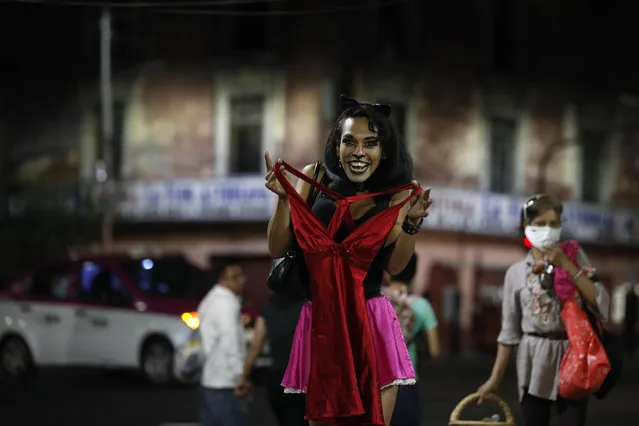
Sеx worker Geraldine, wearing cat make-up, excitedly holds up a dress she is thinking of buying from a street vendor, so that her partner, sitting nearby to keep her company, can see it, as she waits for clients outside the Revolution subway station, in Mexico City, Saturday, March 13, 2021. According to Geraldine, 30, the pandemic has cut clients and increased risks to the sеx workers but has also brought out more assistance for them too, both from dedicated organizations such as the activist group Brigada Callejera or “The Street Brigade” and from individuals who have donated food or clothing. (Photo by Rebecca Blackwell/AP Photo)

Sеx worker Geraldine, wearing cat make-up, excitedly holds up a dress she is thinking of buying from a street vendor, so that her partner, sitting nearby to keep her company, can see it, as she waits for clients outside the Revolution subway station, in Mexico City, Saturday, March 13, 2021. According to Geraldine, 30, the pandemic has cut clients and increased risks to the sеx workers but has also brought out more assistance for them too, both from dedicated organizations such as the activist group Brigada Callejera or “The Street Brigade” and from individuals who have donated food or clothing. (Photo by Rebecca Blackwell/AP Photo)
Details
25 Apr 2021 07:38:00
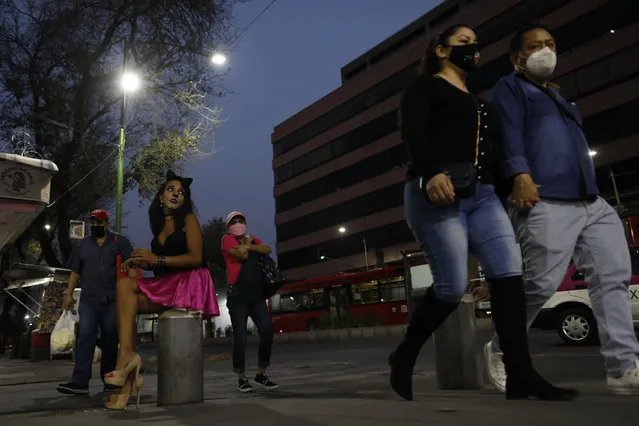
Sеx worker Geraldine wearing cat make-up sits on her usual corner as she waits for clients outside the Revolution subway station, in Mexico City, Saturday, March 13, 2021. Geraldine, 30, a sеx worker since age 15, says many of her regular clients have stopped coming amid the coronavirus pandemic and that seeing new clients presents new health and security risks. She is most concerned about the risk of bringing COVID-19 home to her partner, who has diabetes. (Photo by Rebecca Blackwell/AP Photo)

Sеx worker Geraldine wearing cat make-up sits on her usual corner as she waits for clients outside the Revolution subway station, in Mexico City, Saturday, March 13, 2021. Geraldine, 30, a sеx worker since age 15, says many of her regular clients have stopped coming amid the coronavirus pandemic and that seeing new clients presents new health and security risks. She is most concerned about the risk of bringing COVID-19 home to her partner, who has diabetes. (Photo by Rebecca Blackwell/AP Photo)
Details
24 Jan 2022 05:17:00
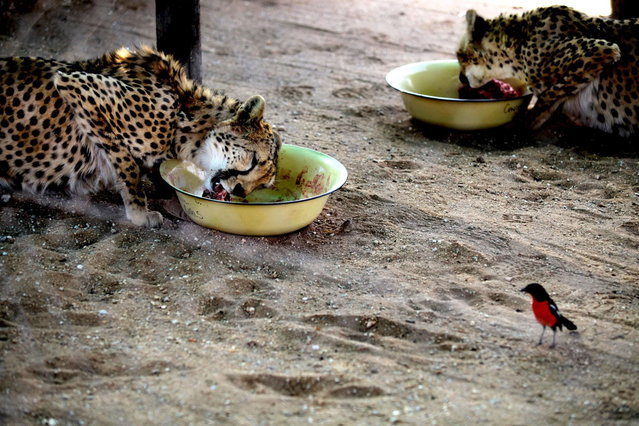
Young cheetahs eat meat at The Cheetah Conservation Fund (CCF) center in Otjiwarongo, Namibia, on August 13, 2013. The CCF started breeding Anatolian livestock dogs to promote cheetah-friendly farming after some 10,000 big cats – the current total worldwide population – were killed or moved off farms in the 1980s.  Up to 1,000 cheetahs were being killed a year, mostly by farmers who saw them as livestock killers. But the use of dogs has slashed losses for sheep and goat farmers and led to less retaliation against the vulnerable cheetah. (Photo by Jennifer Bruce/AFP Photo)

Young cheetahs eat meat at The Cheetah Conservation Fund (CCF) center in Otjiwarongo, Namibia, on August 13, 2013. The CCF started breeding Anatolian livestock dogs to promote cheetah-friendly farming after some 10,000 big cats – the current total worldwide population – were killed or moved off farms in the 1980s. Up to 1,000 cheetahs were being killed a year, mostly by farmers who saw them as livestock killers. But the use of dogs has slashed losses for sheep and goat farmers and led to less retaliation against the vulnerable cheetah. (Photo by Jennifer Bruce/AFP Photo)
Details
29 Aug 2013 10:56:00
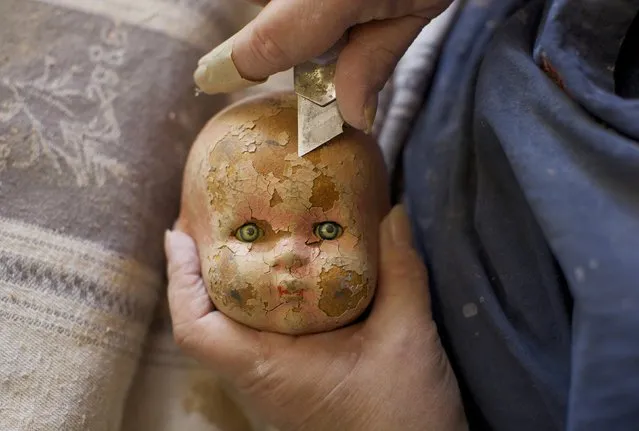
A badly-weathered composition doll, made from compressed wood chip, has its flakey paint cut off before being repaired and repainted by Gail Grainger, a 14-year veteran doll repairer at Sydney's Doll Hospital, August 19, 2014. (Photo by Jason Reed/Reuters)

A badly-weathered composition doll, made from compressed wood chip, has its flakey paint cut off before being repaired and repainted by Gail Grainger, a 14-year veteran doll repairer at Sydney's Doll Hospital, August 19, 2014. Opened in 1913, Sydney's Doll Hospital has worked on millions of dolls, teddy bears and other toys. Behind a toy shop on a busy suburban street in Sydney's south, “doll surgeons” transplant fingers, toes and heads, and repair broken eye sockets in dolls who were the victim of a childhood tantrum or sibling rivalry, sometimes decades ago. (Photo by Jason Reed/Reuters)
Details
26 Aug 2014 10:45:00