Loading...
Done
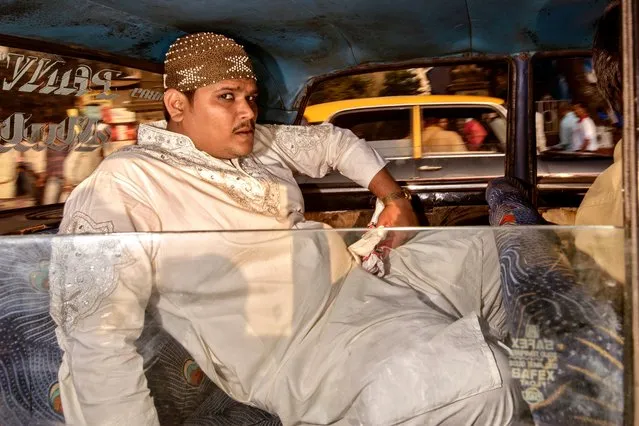
“I’m not scared of breaking the fourth wall”, Wallace has said of the photos where the subject is clearly aware of him taking the shot. “If they are looking at you in a photograph most photographers will think, oh, that’s not a good image. (But) people like to be involved and in the picture. You can see what they are thinking, see them talking”. (Photo by Dougie Wallace/The Guardian)

In Dougie Wallace’s photos of Mumbai taxis, the chatter, yelling, and constant horns of the city are almost audible. A selection of his images is on show at Gayfield Creative Spaces, Edinburgh, as part of the Retina photography festival until 30 July. For four years, the Glasgow-born Wallace focused his photos on one kind of taxi in particular: the Premier Padmini, a 1960s workhorse painted in black and yellow. Locally known as “Kaali-Peeli”, there were once more than 60,000 of them in the Indian city. But thanks to laws restricting pollution, the cars now are fast disappearing from Mumbai’s streets. (Photo by Dougie Wallace/The Guardian)
Details
13 Jul 2016 13:50:00
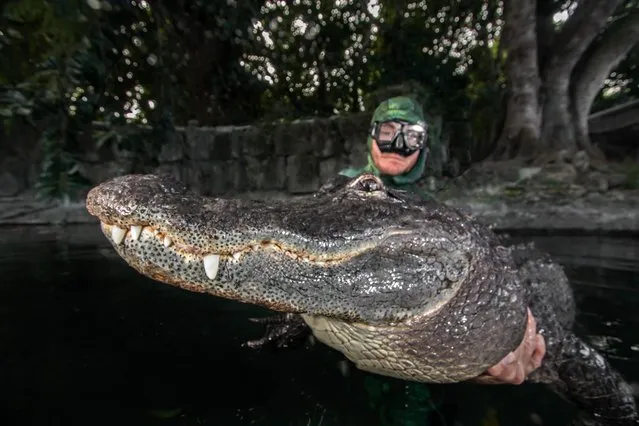
He brings the beast up close and personal to the camera. (Photo by Chris Gillette and Michael Dornellas/Mediadrumworld.com)

The incredible photographs show the three alligators crowding around the man’s head as they look directly at the camera and one even appears to sit on his lap whilst another reptile places a claw on his arm as it swims towards the surface. Photographs taken from above the surface show animal handler, Chris Gillette (29) from Fort Lauderdale, Florida, USA holding an alligator out of the water. The images of Chris were taken by Michael Dornellas at the Everglades Outpost Wildlife Rescue, Florida USA. Here: Mich­ael Dornellas brings the beast up close and personal to the camera. (Photo by Chris Gillette and Michael Dornellas/Mediadrumworld.com)
Details
20 Jan 2017 08:03:00
Elephant

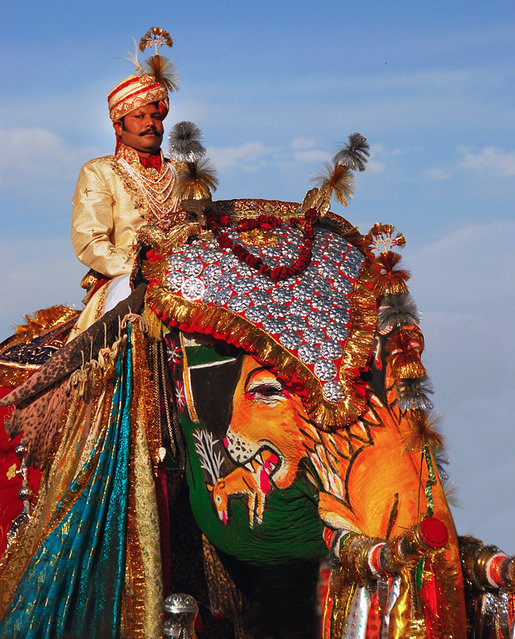
Elephant Festival is a festival celebrated in Jaipur city in Rajasthan state in India. It is held on the day of Holi festival, usually in the month of March.The festival features Elephant polo and Elephant Dance. The Elephant Festival begins with a beautiful procession of bedecked elephants, camels, horses and folk dancers. The owners proudly embellish their elephants with vibrant colors, jhools (saddle cloth) and heavy jewellery. It is quite a treat to see female elephants wearing anklets, which tinkle as they walk. One can see people sprinkling 'gulaal' (colored powder) perched on top of the elephant. The most beautifully decorated elephant is awarded. Elephant polo, Elephant race, the tug-of-war between Elephant and 19 men and women are the featured events of the festival.
Details
30 Apr 2015 16:55:00
Ocean voyage

Do you think that history is a science? Well, not exactly. First, and foremost, history is the state's “legend of wars”, it’s official regalia. Of course, public historians are not interested in scientific truth – quite the opposite. In this respect, any attempt to present a state’s history as altruistic and benevolent as possible is welcomed and encouraged – as opposed to any revisionism attempts that may be more accurate. In this matter, Chinese have surpassed us all – they revised in highly creative manner (but rather shamelessly) the technology already invented by Europeans, a process that resulted in oldest state on the planet. Here is an interesting paradox: ask any sinologist about the Middle Kingdom during second century B.C., and he will describe it to you in such a vivid manner as if he has been living there all his life – but as soon as you will ask him to describe Chinese history in the 19-20th centuries… let's say, his eagerness will be greatly diminished. However, we will discuss China in a different article, and in the meantime we will try to understand how exactly historic “legend of wars” is formed and functions – based on a specific and well-known example. A great example is Ferdinand Magellan's first voyage around the world.
Details
14 Nov 2011 09:11:00
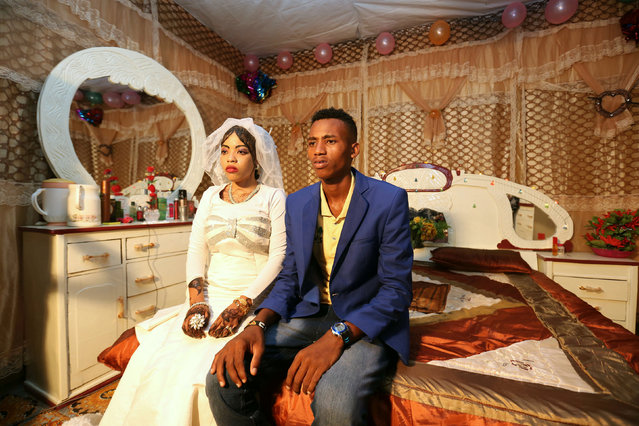
Somali couple Mohamed Noor (L) and Huda Omar pose for a photograph at their makeshift home during their wedding ceremony in Mogadishu's Rajo camp, Somalia August 17, 2016. Having met two years ago, the pair have just married at Rajo camp, where some 400 families live. Most, like Noor's parents, came here in the early 1990s to flee famine. They stayed on as years of conflict ravaged the Horn of Africa nation. As at any wedding, there is plenty of dancing and sweet treats for the young couple as they start married life in Noor's simple home, made of iron and plastic sheets. Noor works as a mason with his father. Others here are builders or sell sweets, nuts and stick toothbrushes to make money. Some beg around the seaside city, which like the rest of Somalia has been gripped by violence since the toppling of dictator Mohamed Siad Barre in 1991. (Photo by Feisal Omar/Reuters)

Somali couple Mohamed Noor (L) and Huda Omar pose for a photograph at their makeshift home during their wedding ceremony in Mogadishu's Rajo camp, Somalia August 17, 2016. Having met two years ago, the pair have just married at Rajo camp, where some 400 families live. Most, like Noor's parents, came here in the early 1990s to flee famine. (Photo by Feisal Omar/Reuters)
Details
14 Sep 2016 10:35:00
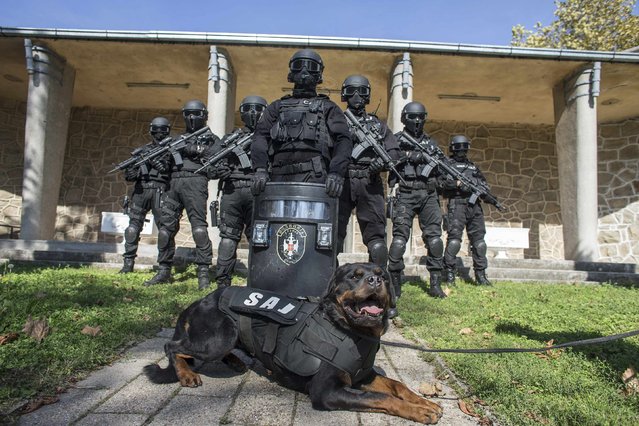
Serbian police officers of the Special Anti-Terrorist Unit pose for a picture in their base outside Belgrade October 8, 2014. (Photo by Marko Djurica/Reuters)

Serbian police officers of the Special Anti-Terrorist Unit pose for a picture in their base outside Belgrade October 8, 2014. When the killing of an unarmed black teenager by a white policeman in Ferguson, Missouri, in August sparked sometimes violent protests, the response of police in camouflage gear and armoured vehicles wielding stun grenades and assault rifles seemed more like a combat operation than a public order measure. Some U.S. police departments have recently acquired U.S. military-surplus hardware from wars abroad, but there are many law enforcers around the world whose rules of engagement also allow the use of lethal force with relatively few restrictions. But for every regulation that gives police wide scope to use firearms, there is another code that sharply limits their use. In Serbia, police may use measures ranging from batons to special vehicles, water cannon and tear gas on groups of people who have gathered illegally and are behaving in a way that is violent or could cause violence, but they may use firearms only when life is endangered. (Photo by Marko Djurica/Reuters)
Details
27 Nov 2014 14:53:00
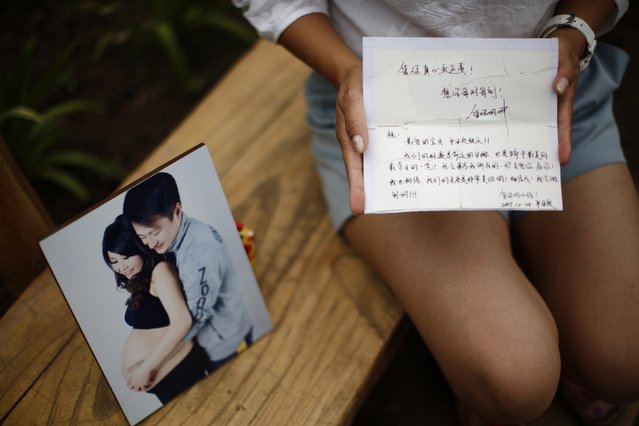
Cheng Liping, whose husband Ju was onboard Malaysia Airlines Flight MH370 which disappeared on March 8, 2014, shows a picture of she and her husband together and an old card with a message given by her husband, at a park near her house where she and her husband used to visit during an interview with Reuters in Beijing July 24, 2014. (Photo by Kim Kyung-Hoon/Reuters)

Cheng Liping, whose husband Ju was onboard Malaysia Airlines Flight MH370 which disappeared on March 8, 2014, shows a picture of she and her husband together and an old card with a message given by her husband, at a park near her house where she and her husband used to visit during an interview with Reuters in Beijing July 24, 2014. Cheng said her life has been totally changed since the incident. Their two little sons, who don't know about this incident, keep asking her when their dad is coming back. Six months after Malaysia Airlines Flight MH370, with 239 mostly Chinese people on board, disappeared about an hour into a routine journey from Kuala Lumpur to Beijing March 8, loved ones of missing passengers derive what comfort they can from what's left behind after the world's greatest aviation mystery. More than two dozen countries have been involved in the air, sea and underwater search for the Boeing 777 but months of sorties failed to turn up any trace – even after narrowing the search area to the southern Indian Ocean – long after batteries on the black box voice and data recorders had gone flat. (Photo by Kim Kyung-Hoon/Reuters)
Details
05 Sep 2014 11:27:00
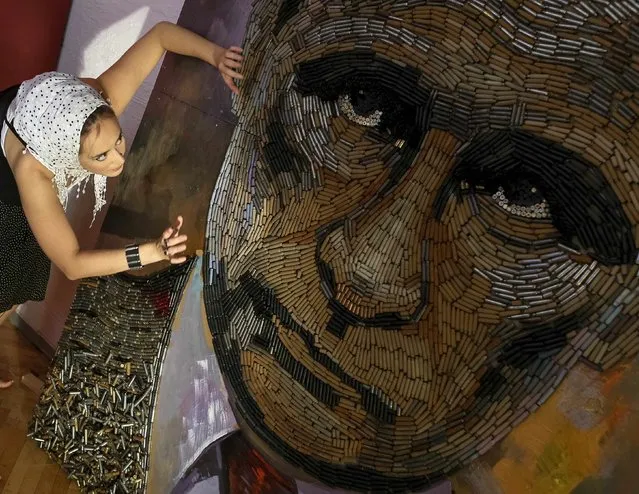
Ukrainian artist Dariya Marchenko works on a portrait of Russian President Vladimir Putin named “The Face of War” which is made out of 5,000 cartridges brought from the frontline in eastern Ukraine, in Kiev, July 23, 2015. The portrait will be presented along with a novel which will tell personal stories of six people involved in this project including Daria's own story and stories of people who helped her to collect shells from the frontline. (Photo by Gleb Garanich/Reuters)

Ukrainian artist Dariya Marchenko works on a portrait of Russian President Vladimir Putin named “The Face of War” which is made out of 5,000 cartridges brought from the frontline in eastern Ukraine, in Kiev, July 23, 2015. The portrait will be presented along with a novel which will tell personal stories of six people involved in this project including Daria's own story and stories of people who helped her to collect shells from the frontline. Daria Marchenko calls her art approach philosophic symbolism where every element has its hidden meaning. In her works cartridges mean human's life that was brutally ended. (Photo by Gleb Garanich/Reuters)
Details
28 Jul 2015 12:44:00