Loading...
Done
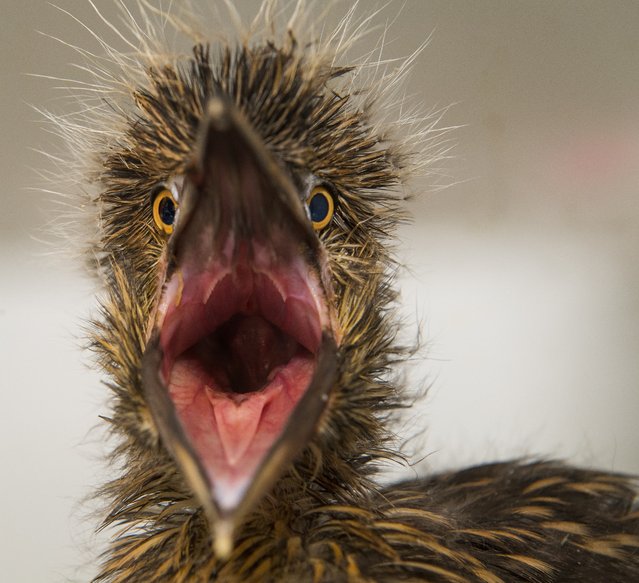
A baby Black-crowned Night Heron squawks in its incubator while being cared for at City Wildlife rescue and rehabilitation center in Washington, DC on May 31, 2017. The heron is one of several that have been brought to CW by the staff at The National Zoo over the past few years. The heron is a native bird and has made an established rookery inside the zoo grounds over a hundred years ago.  Every year at this time, some of the chicks get pushed or fall out of the nest and require human care.  Because the birds are native and not part of the Smithsonian collection, they partnered with CW to rehabilitate the herons for re-release back to the flock inside Zoo. They're reintroduced back to their flock so that they can migrate together in the Fall. The Black-crowned heron usually migrates from the DC area down to southeast North Carolina, some going as far as Jacksonville, FL in winter. The Black-crowned heron is the species of greatest conservation need in the District of Columbia because their numbers are in such rapid decline due to habitat loss. (Photo Linda Davidson/The Washington Post)

A baby Black-crowned Night Heron squawks in its incubator while being cared for at City Wildlife rescue and rehabilitation center in Washington, DC on May 31, 2017. The heron is one of several that have been brought to CW by the staff at The National Zoo over the past few years. (Photo Linda Davidson/The Washington Post)
Details
04 Jun 2017 08:04:00
Lv Mengmeng, who was born in 1995, poses for a photograph in Shanghai August 22, 2014. When asked if she would like siblings, Mengmeng said: “Maybe brothers, because I think they could protect me”. (Photo by Carlos Barria/Reuters)

Reuters Photographer Carlos Barria photographed a person born in each year China's one child policy has been in existence; from a man born in 1979, to a baby born in 2014, and asked them if they would have like to have siblings. Here: Lv Mengmeng, who was born in 1995, poses for a photograph in Shanghai August 22, 2014. When asked if she would like siblings, Mengmeng said: “Maybe brothers, because I think they could protect me”. (Photo by Carlos Barria/Reuters)
Details
06 Oct 2014 08:20:00
“Light From Heaven”. Taken around Mount Bromo, East Java, Indonesia in the morning. Photo location: East Java, Indonesia. (Photo and caption by Pimpin Nagawan/National Geographic Photo Contest)

“Light From Heaven”. Taken around Mount Bromo, East Java, Indonesia in the morning. Photo location: East Java, Indonesia. (Photo and caption by Pimpin Nagawan/National Geographic Photo Contest)

ATTENTION! All pictures are presented in high resolution. To see Hi-Res images – just TWICE click on any picture. In other words, click small picture – opens the BIG picture. Click BIG picture – opens VERY BIG picture.
Details
29 Nov 2013 12:36:00
In this photo provided on Friday Feb. 15, 2013 by World Press Photo, the 2013 World Press Photo of the year by Paul Hansen, Sweden, for Dagens Nyheter, shows two-year-old Suhaib Hijazi and her three-year-old brother Muhammad who were killed when their house was destroyed by an Israeli missile strike. (Photo by Paul Hansen/Dagens Nyheter/AP Photo)

Swedish photographer Paul Hansen won the 2012 World Press Photo award Friday for newspaper Dagens Nyheter with a picture of two Palestinian children killed in an Israeli missile strike being carried to their funeral.

Photo: In this photo provided on Friday February 15, 2013 by World Press Photo, the 2013 World Press Photo of the year by Paul Hansen, Sweden, for Dagens Nyheter, shows two-year-old Suhaib Hijazi and her three-year-old brother Muhammad who were killed when their house was destroyed by an Israeli missile strike. Their father, Fouad, was also killed and their mother was put in intensive care. Fouad's brothers carry his children to the mosque for the burial ceremony as his body is carried behind on a stretcher in Gaza City, Palestinian Territories, November 20, 2012. (Photo by Paul Hansen/Dagens Nyheter/AP Photo)

Details
16 Feb 2013 12:17:00


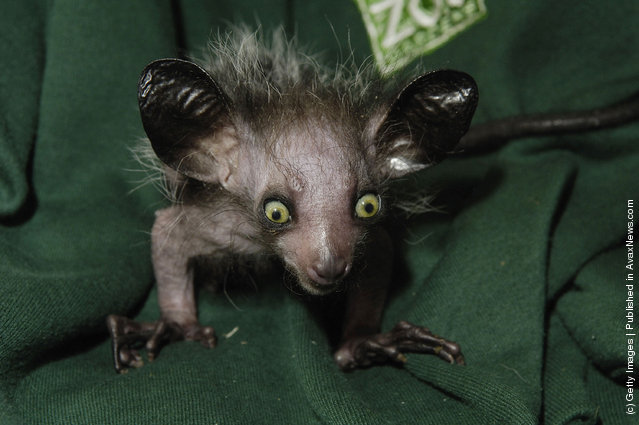
“The aye-aye (Daubentonia madagascariensis) is a lemur, a strepsirrhine primate native to Madagascar that combines rodent-like teeth and a special thin middle finger to fill the same ecological niche as a woodpecker. It is the world's largest nocturnal primate, and is characterized by its unusual method of finding food; it taps on trees to find grubs, then gnaws holes in the wood and inserts its narrow middle finger to pull the grubs out. The only other animal species known to find food in this way is the striped possum. From an ecological point of view the aye-aye fills the niche of a woodpecker as it is capable of penetrating wood to extract the invertebrates within”. – Wikipedia

Photo: In this handout image from Bristol Zoo is seen the first captive bred aye-aye in the UK named “Kintana” (meaning star in Malagasy) April 15, 2005 at Bristol Zoo Gardens, England. The zoo announced today only the second baby aye-aye to be hand-reared in the world (the first was in Jersey Zoo) and has now made his first public appearance since his birth on 11 February 2005. (Photo by Rob Cousins/Bristol Zoo via Getty Images)
Details
13 Apr 2011 13:33:00
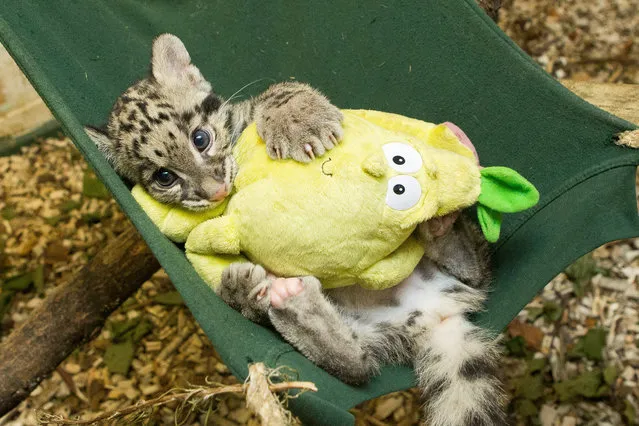
Nimbus, the 2 month old clouded leopard cub, who was hand reared at the home of curator Jamie Craig. Photographed sitting in her hammock at Cotswold Wildlife Park, Burford, Oxfordshire, UK on September 2014. (Photo by SWNS/ABACAPress)

Nimbus, the 2 month old clouded leopard cub, who was hand reared at the home of curator Jamie Craig. Photographed sitting in her hammock at Cotswold Wildlife Park, Burford, Oxfordshire, UK on September 2014. Jamie Craig the curator of the Cotswold Wildlife park has hand reared the baby clouded leopard in his family bathroom after he was rejected by his mother. Now two months old Nimbus is been fed a cat milk replacement diet by bottle and is given soft toys to play with. It is hoped that the leopard will re-join others at the park and eventually join their breeding program. (Photo by SWNS/ABACAPress)
Details
03 Oct 2014 11:43:00
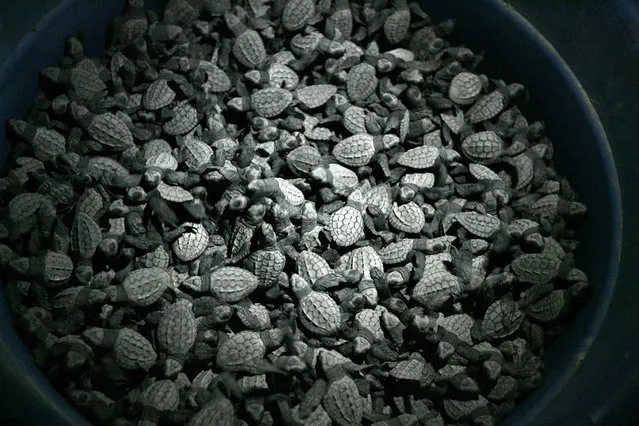
Olive Ridley turtle hatchlings (Lepidochelys olivacea) sit in baskets and trays at the turtle camp La Gloria, before their release into the ocean in Tomatlan November 15, 2013. (Photo by Alejandro Acosta/Reuters)

Olive Ridley turtle hatchlings (Lepidochelys olivacea) sit in baskets and trays at the turtle camp La Gloria, before their release into the ocean in Tomatlan November 15, 2013. Twenty years ago, Mexico's government implemented ecological plans to protect the sea turtles from being hunted for their leather and meat and established conservation areas and a pay system for local residents to protect turtle nests. Millions of baby turtles hatch on the shores in November and December, according to an environmental group. It is estimated that in 2012, there were 20 million newborns. Hatching season is still underway, but officials say they expect there will be even more turtles born this year. (Photo by Alejandro Acosta/Reuters)
Details
25 Nov 2013 08:54:00
Skoda Giant vRS Man-Pram

Skoda is celebrating the launch of the Octavia vRS, so company unveiled the ultimate baby buggy, dubbed the ‘vRS Mega Man-Pram’ – a high performance vehicle that has been designed to provide the ultimate baby transportation experience. the company gave a team of engineers the task of bringing the same qualities that go into the car to other everyday objects. These included the vRS Man-Pram and were highlighted in a new ad launching the third-generation Octavia vRS.
Details
02 Jan 2014 15:41:00