Italian swimmer Federica Pellegrini poses with a Barbie doll, in Verona, Italy, in this undated handout image. (Photo by Mattel/Petra Rajnicova/Handout via Reuters)
United States' Abby Dahlkemper, left, and Netherlands' Lieke Martens fall while fighting for the ball during a women's quarterfinal soccer match at the 2020 Summer Olympics, Friday, July 30, 2021, in Yokohama, Japan. (Photo by Silvia Izquierdo/AP Photo)
Anicka Newell, of Canada, does a handstand ahead of the final of the women's pole vault at the 2020 Summer Olympics, Thursday, August 5, 2021, in Tokyo. (Photo by Matthias Schrader/AP Photo)
A pro-Russian rebel guards a captured former Ukrainian Army checkpoint outside Vuhlehirsk, Donetsk region, eastern Ukraine, Thursday, February 5, 2015. The rebels have closed in around the town in a strategy they triumphantly refer to as the Debaltseve cauldron. Separatists recently burst through government lines in the rural settlement of Vuhlehirsk. (Photo by Vadim Braydov/AP Photo)
241543903 (a.k.a “Heads in Freezers”) is a numerical keyword associated with a photo meme that involves people taking pictures with their heads in the freezer & sharing them online. By tagging a series of image files with a cryptic number, a high level of search engine optimization can be easily achieved. As a result, typing “241543903” into image search engines like Google Images successfully yields pages after pages of pictures showing people’s heads in freezers.
In 2009, David Horvitz started the “Heads in Freezers” meme. Participants took photos of their heads in freezers, tagged them with “241543903” and uploaded them to social media sites like Tumblr.
Riot police walk past burning garbage containers during heavy clashes with demonstrators during a 24-hour strike on March 29, 2012 in Barcelona, Spain. Spanish workers staged a general strike to protest the government's latest labour reforms, which are designed to help Spain lower its deficit within EU limits. (Photo by David Ramos/Getty Images)
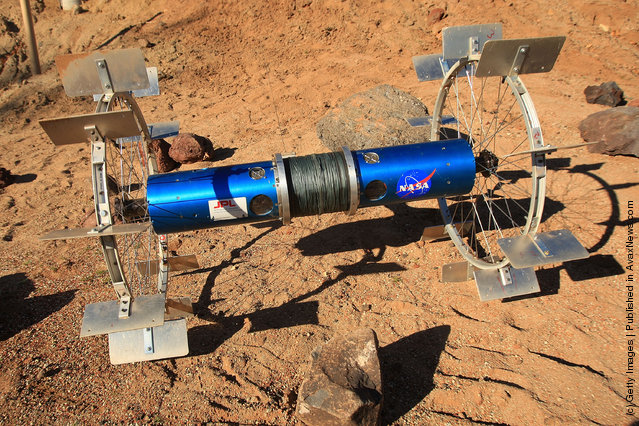
Axel, a research prototype rover for exploring the Moon, Mars and other planets, is remotely driven over rocks as engineers from Jet Propulsion (JPL) and grad students from Caltech (California Institute of Technology) demonstrate its mobile over the steep and rocky grounds of the JPL Mars Yard on January 14, 2009 in Pasadena, California. The rover is capable of descending cliffs or into craters and returning by a cable tethered to its starting point. Development of the Axel rover is a point effort funded by NASA Exploration Systems Mission Directorate (ESMD) and lead by Principal Investigator Issa Newnas and Co-Investigator and Caltech professor of mechanical engineering bio engineering Joel Burdick. (Photo by David McNew/Getty Images)