Big waves approach the beach of Nazare, Portugal, Tuesday, March 26, 2024. The high waves were caused by strong winds at one of the world's most popular surf spots. (Photo by Michael Probst/AP Photo)
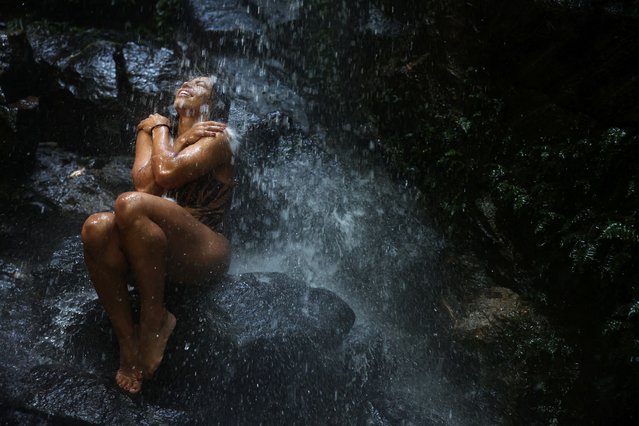
Anda Oliveira, 34, enjoys a waterfall in the Tijuca National Park, one of the world's biggest urban forests, marking the World Water Day in Rio de Janeiro, Brazil on March 15, 2024. (Photo by Pilar Olivares/Reuters)
A woman poses for a photo in front of an installation to promote the film “Godzilla Minus One”, which won the Oscar for best visual effects at the Academy Awards in Los Angeles, outside a popular shopping centre and official development in the Hibiya area of Tokyo on March 11, 2024. (Photo by Richard A. Brooks/AFP Photo)
Drag queen Brigitte Bandit performs during the Fight the Trump Takeover, one of several held across the nation against Texas Republicans’ efforts to redraw the state's 38 congressional districts, at the State Capitol in Austin, Texas on August 16, 2025. (Photo by Nuri Vallbona/Reuters)
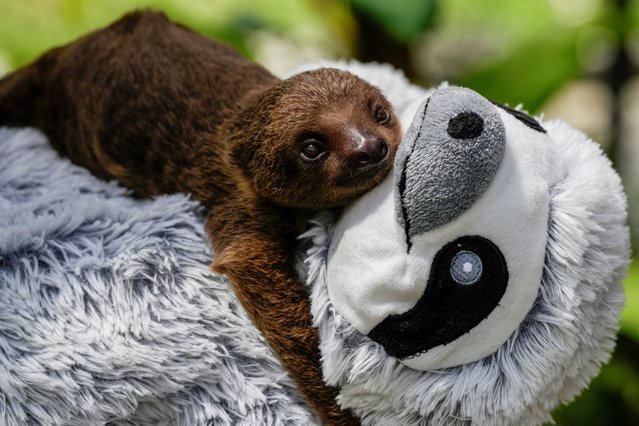
A one-and-a-half-month-old orphaned two-toed sloth clings a sloth plush toy at the Panamerican Conservation Association (APPC) during a conservation activity for International Sloth Day, in Panama City, Panama, on October 19, 2025. (Photo by Enea Lebrun/Reuters)
Dancers pose for a photo as they prepare during Festival Cilung or “Love the Environment” Festival, where boats made from recycled materials, mostly plastic bottles, sail on the Ciliwung River, one of the most polluted rivers in the world, to raise public awareness about river pollution, in Jakarta, Indonesia, on September 28, 2025. (Photo by Willy Kurniawan/Reuters)
“The giant clam, Tridacna gigas (known as pā’ua in Cook Islands Māori), is the largest living bivalve mollusc. T. gigas is one of the most endangered clam species. It was mentioned as early as 1825 in scientific reports. One of a number of large clam species native to the shallow coral reefs of the South Pacific and Indian oceans, they can weigh more than 200 kilograms (440 lb) measure as much as 120 cm (47 in) across, and have an average lifespan in the wild of 100 years or more”. – Wikipedia
Photo: Tridacna Gigas, or Giant Clams spew water as a traditional fisherman passes by a small sanctuary on January 23, 2004 near Bolinao in the Northern Philippines. The clams, prime builders for coral reefs and providing shelter for spawning fish and other marine life, are exposed by low tides in the sanctuary. Overfishing and pollution throughout the country are not only threatening food security, but are also starting to choke one of the few working clam sanctuaries in the world. (Photo by David Greedy/Getty Images)
Isabel Schmalenbach, an environmental scientist with the Helgoland Biological Institute (Biologische Anstalt Helgoland), part of the Alfred Wegener Institute for Polar and Marine Research, holds a one-year old baby European lobster (Homarus gammarus) raised at the institute on August 3, 2013 on Helgoland Island, Germany. Later in the day Schmalenbach and her colleagues released a total of 415 one-year old lobsters into the North Sea as part of an effort to repopulate the lobster population around Helgoland (also called Heligoland). In the 19th century local fishermen caught up to 80,000 lobsters a year in the surrounding waters, combined with the heavy allied bombing of the island during and after World War II, as well as other environmental factors, decimated the lobster population. (Photo by Sean Gallup)