Loading...
Done
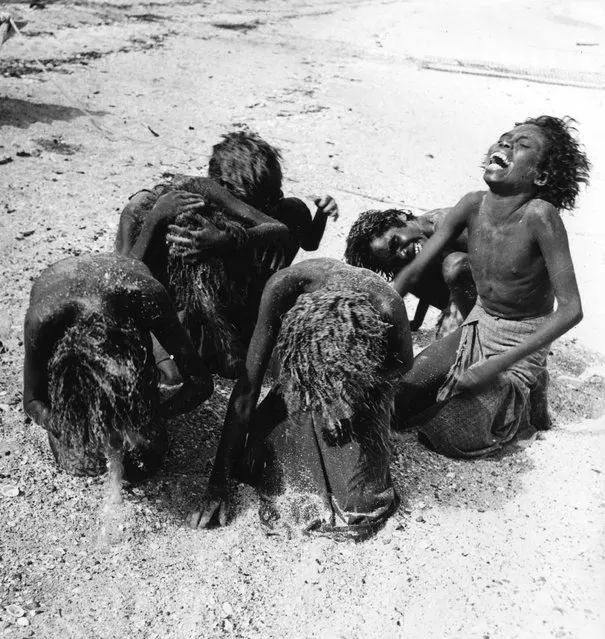
1st January 1950:  Aboriginal women washing their hair with sand at Arnhem land in the Northern Territory of Australia.  (Photo by Three Lions/Getty Images)

“Australian Aborigines are those people regarded as indigenous to the Australian continent. In the High Court of Australia, Australian Aborigines have been specifically identified as a group of people who share, in common, biological ancestry back to the original occupants of the continent”. – Wikipedia

Photo: Aboriginal women washing their hair with sand at Arnhem land in the Northern Territory of Australia. 1st January 1950. (Photo by Three Lions)
Details
02 Feb 2014 07:29:00
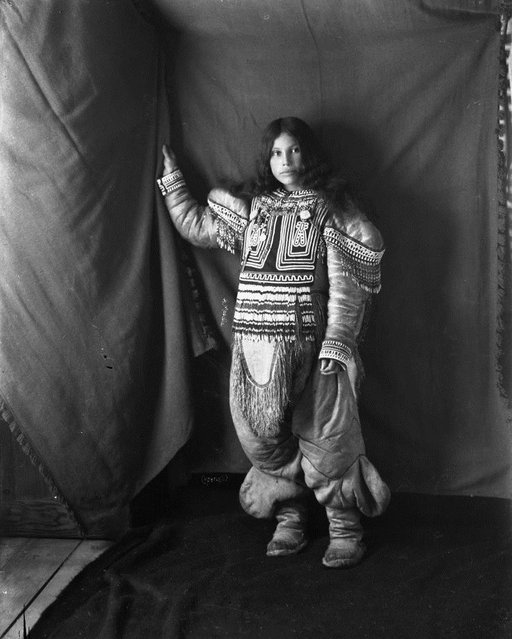
Moodie was born in 1854 in Toronto, and after a move to England she met and married John Douglas Moodie in 1878, and had six children. Here: Inuit woman, Kootucktuck, in her beaded attigi. Fullerton Harbour, Nunavut, February 1905. (Photo by Geraldine Moodie/The Guardian)

Geraldine Moodie overcame harsh conditions to become western Canada’s first professional female photographer, capturing beautiful images in the country’s most remote regions. An exhibition, “North of Ordinary: The Arctic Photographs of Geraldine and Douglas Moodie”, is at Glenbow, Calgary, 18 February – 10 September. Here: Inuit woman, Kootucktuck, in her beaded attigi. Fullerton Harbour, Nunavut, February 1905. (Photo by Geraldine Moodie/The Guardian)
Details
17 Feb 2017 00:04:00
Contestants for the Miss World grand final perform in colourful costumes during a dress rehearsal in Sanya, Hainan province, China, 18 December 2015. (Photo by How Hwee Young/EPA)

Contestants for the Miss World grand final perform in colourful costumes during a dress rehearsal in Sanya, Hainan province, China, 18 December 2015. (Photo by How Hwee Young/EPA)
Details
21 Dec 2015 08:05:00
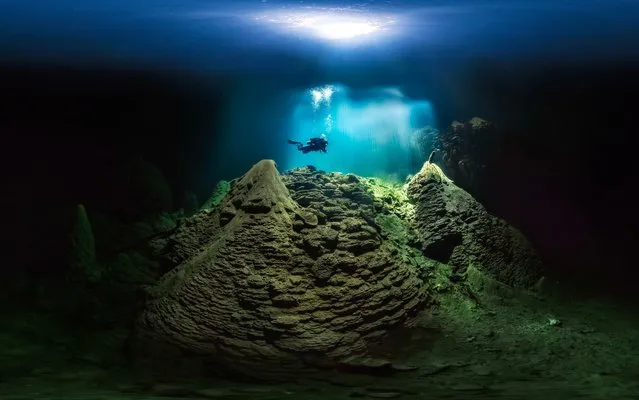
Cave Diver, Anhumas Abyss, Bonito, Brazil: The Anhumas Abyss is an underground cavern with a crystal-clear lake below, more than 260 feet (79 m) deep. A visitor must enter through a narrow opening at the top of the chamber and rappel into the cave. Snorkeling and scuba diving in the lake reveal amazing scenery. Distinctive, conical limestone stalagmites and stalactites occupy the lake and the surrounding area, some reaching 65 feet (20 m) high. “One must rappel about 235 feet (72 m) to get down into this deep lake. The photo was taken at a depth of 50 feet (15 m). It was a challenge to create the image because of the high contrast, plus the diver could not see into the darkness, making communication impossible”. (Photo by Marcio Cabral/Nature’s Best Photography Awards 2017)

Cave Diver, Anhumas Abyss, Bonito, Brazil: The Anhumas Abyss is an underground cavern with a crystal-clear lake below, more than 260 feet (79 m) deep. A visitor must enter through a narrow opening at the top of the chamber and rappel into the cave. Snorkeling and scuba diving in the lake reveal amazing scenery. Distinctive, conical limestone stalagmites and stalactites occupy the lake and the surrounding area, some reaching 65 feet (20 m) high. (Photo by Marcio Cabral/Nature’s Best Photography Awards 2017)
Details
26 Oct 2017 08:10:00
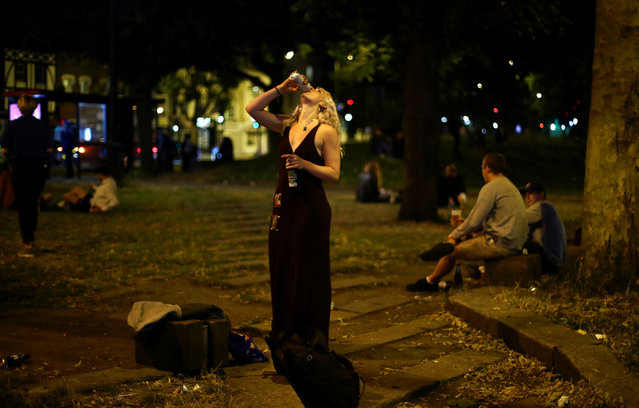
A woman drinks at a bars area in Clapham, after the reopening of commercial activities following the outbreak of the coronavirus disease (COVID-19), in London, Britain, July 4, 2020. (Photo by Hannah McKay/Reuters)

A woman drinks at a bars area in Clapham, after the reopening of commercial activities following the outbreak of the coronavirus disease (COVID-19), in London, Britain, July 4, 2020. (Photo by Hannah McKay/Reuters)
Details
06 Jul 2020 00:07:00
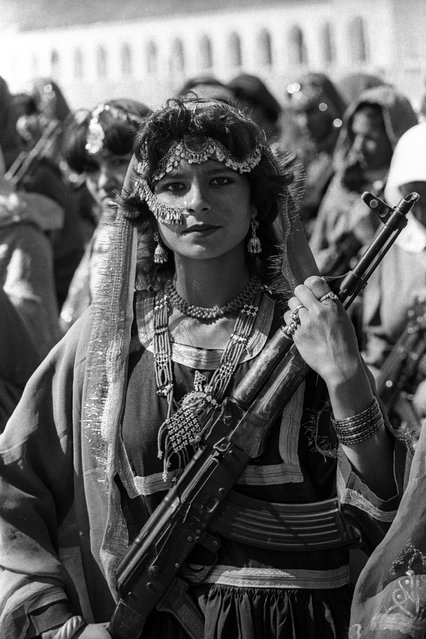
A female rebel in Kabul, Afghanistan, circa 1979. Photo taken at a parade in Kabul in honor of the pro-Communist Saur Revolution. She was from the women’s battalion of the people’s militia (one of the anti-imperial groups that participated in the coup d’etat). (Photo by Viktor Khabarov)

A female rebel in Kabul, Afghanistan, circa 1979. Photo taken at a parade in Kabul in honor of the pro-Communist Saur Revolution. She was from the women’s battalion of the people’s militia (one of the anti-imperial groups that participated in the coup d’etat). (Photo by Viktor Khabarov)
Details
02 Apr 2019 00:03:00
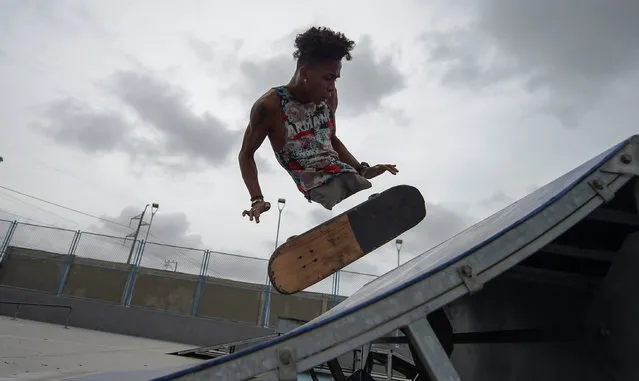
Venezuelan migrant and rap singer, Alfonso Mendoza aka "Alca", 25, practice with his skateboard in a park in Barranquilla, Colombia on September 28, 2018. Alca -who arrived in Colombia nine months ago due to the crisis in his country- was born without legs and changed the wheelchair for a skateboard. At present, he is an example of overcoming adversity, practicing extreme sports, singing rap and giving conferences to young people in vulnerable situations. (Photo by Raul Arboleda/AFP Photo)

Venezuelan migrant and rap singer, Alfonso Mendoza aka “Alca”, 25, practice with his skateboard in a park in Barranquilla, Colombia on September 28, 2018. Alca -who arrived in Colombia nine months ago due to the crisis in his country- was born without legs and changed the wheelchair for a skateboard. At present, he is an example of overcoming adversity, practicing extreme sports, singing rap and giving conferences to young people in vulnerable situations. (Photo by Raul Arboleda/AFP Photo)
Details
07 Oct 2018 00:07:00
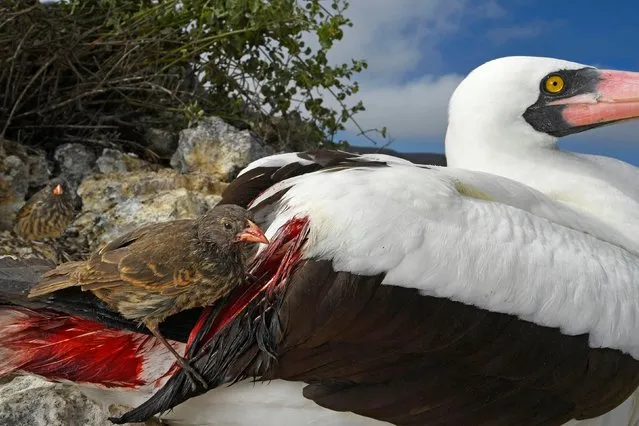
Bloodthirsty by Thomas P Peschak, Germany/South Africa — winner, Behaviour: birds. When rations run short on Wolf Island, in the remote northern Galápagos, the sharp-beaked ground finches become vampires. Their sitting targets are Nazca boobies and other large birds. The finches rely on a scant diet of seeds and insects, which regularly dries up, so they drink blood to survive. ‘I’ve seen more than half a dozen finches drinking from a single Nazca booby,’ says Tom. Rather than leave their nests the boobies tolerate the vampires, and the blood loss doesn’t seem to cause permanent harm. (Photo by Thomas P Peschak/2018 Wildlife Photographer of the Year)

Bloodthirsty by Thomas P. Peschak, Germany/South Africa — winner, Behaviour: birds. When rations run short on Wolf Island, in the remote northern Galápagos, the sharp-beaked ground finches become vampires. Their sitting targets are Nazca boobies and other large birds. The finches rely on a scant diet of seeds and insects, which regularly dries up, so they drink blood to survive. ‘I’ve seen more than half a dozen finches drinking from a single Nazca booby,’ says Tom. Rather than leave their nests the boobies tolerate the vampires, and the blood loss doesn’t seem to cause permanent harm. (Photo by Thomas P. Peschak/2018 Wildlife Photographer of the Year)
Details
19 Oct 2018 00:05:00