Loading...
Done
British singer and songwriter Ella Eyre performing on stage at Capital's Summertime Ball 2022 at Wembley Stadium in London, United Kingdom on June 12, 2022. (Photo by David Fisher/Rex Features/Shutterstock)

British singer and songwriter Ella Eyre performing on stage at Capital's Summertime Ball 2022 at Wembley Stadium in London, United Kingdom on June 12, 2022. (Photo by David Fisher/Rex Features/Shutterstock)
Details
13 Jun 2022 04:35:00


“Kumbh Mela is a mass Hindu pilgrimage in which Hindus gather at the Ganges river. The normal Kumbh Mela is celebrated every 3 years, the Ardh (half) Kumbh Mela is celebrated every six years at Haridwar and Prayag, the Purna (complete) Kumbh takes place every twelve years, at four places (Prayag (Allahabad), Haridwar, Ujjain, and Nashik). The Maha (great) Kumbh Mela which comes after 12 “Purna Kumbh Melas”, or 144 years, is held at Allahabad.

The last Ardh Kumbh Mela was held over a period of 45 days beginning in January 2007, more than 70 million Hindu pilgrims took part in the Ardh Kumbh Mela at Prayag, and on January 15, the most auspicious day of the festival of Makar Sankranti, more than 5 million participated. The previous Maha Kumbh Mela, held in 2001, was attended by around 60 million people, making it at the time the largest gathering anywhere in the world in recorded history”. – Wikipedia

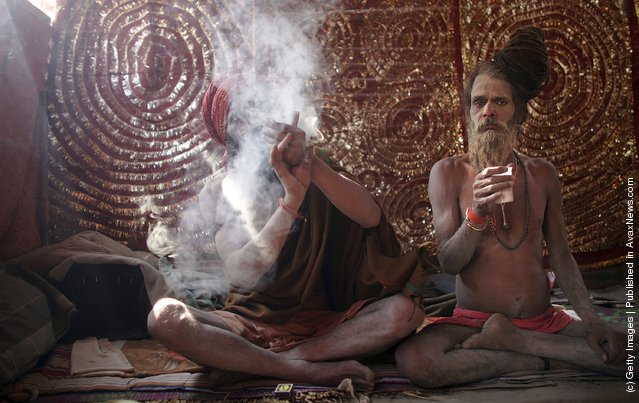
Photo: Sadhus (holy men) smoke at their camp near the ritual site at Sangam, the confluence of the Ganges, Yamuna and mythical Saraswati rivers during the Ardh Kumbh Mela festival (Half Pitcher festival) January 18, 2007 in Allahabad, India. Millions of Hindu pilgrims have flocked to the largest religious gathering in the world which lasts for 45 days in northern India. The festival commemorates the mythical conflict between gods and demons over a pitcher filled with the “nectar of immortality”. Devotees believe that taking a holy dip in the Ganges at this time washes away their sins and paves the path to salvation. (Photo by Mario Tama/Getty Images)

Details
30 Jun 2011 10:27:00
A view of one of the dioramas contained inside iron boxes as part of the “S.A.C.R.E.D” installation by Chinese artist Ai Weiwei during a media preview at the cathedral in Cuenca, Spain, July 21, 2016. (Photo by Susana Vera/Reuters)

A view of one of the dioramas contained inside iron boxes as part of the “S.A.C.R.E.D” installation by Chinese artist Ai Weiwei during a media preview at the cathedral in Cuenca, Spain, July 21, 2016. Ai Weiwei has reproduced scenes of his incarceration for a new art installation, a series of almost life-size dioramas – encased in steel boxes – showing his life in jail. (Photo by Susana Vera/Reuters)
Details
26 Jul 2016 10:25:00
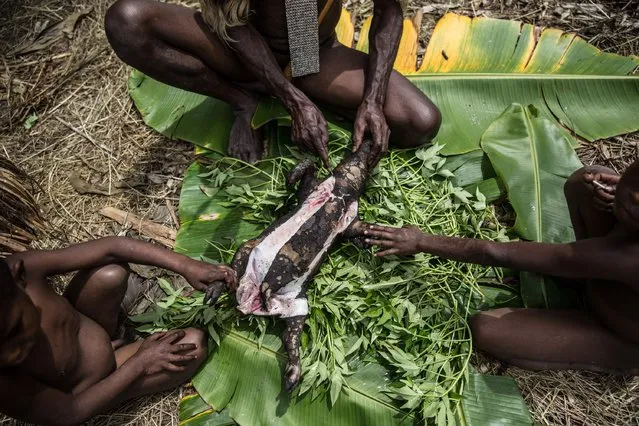
A man from the Dani tribe cuts the head of a pig after cooked by traditional way which is use burned hot stones at Obia Village on August 9, 2014 in Wamena, Papua, Indonesia. The stone-age Dani tribe live a traditional existence in the Baliem Valley, which is situated 1600 metres above sea level in the heart of the Cyclops Mountains. (Photo by Agung Parameswara/Getty Images)

A man from the Dani tribe cuts the head of a pig after cooked by traditional way which is use burned hot stones at Obia Village on August 9, 2014 in Wamena, Papua, Indonesia. The stone-age Dani tribe live a traditional existence in the Baliem Valley, which is situated 1600 metres above sea level in the heart of the Cyclops Mountains. (Photo by Agung Parameswara/Getty Images)
Details
14 Aug 2014 10:30:00
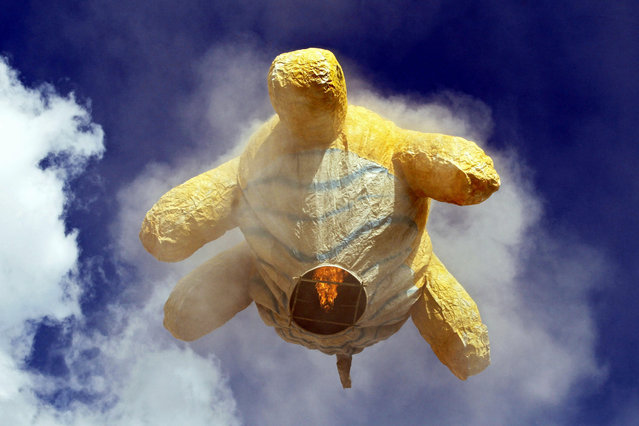
A hot air balloon in tortoise shape flies in the air during the Tazaungdaing air balloon festival in Pyin Oo Lwin, Myanmar, 25 November 2015. During the festival, hot air balloons made of multicolored papers and hung with paper lanterns, fireworks and fire sticks are exploded in mid-air. (Photo by Hein Htet/EPA)

A hot air balloon in tortoise shape flies in the air during the Tazaungdaing air balloon festival in Pyin Oo Lwin, Myanmar, 25 November 2015. During the festival, hot air balloons made of multicolored papers and hung with paper lanterns, fireworks and fire sticks are exploded in mid-air. (Photo by Hein Htet/EPA)
Details
26 Nov 2015 08:07:00
Residents (R to L) Luiza, Janubie, Leiticia and Lucas sit beneath an overpass near their houses in an impoverished area in the unpacified Complexo da Mare slum complex, one of the largest “favela” complexes in Rio de Janeiro. (Photo by Mario Tama/Getty Images)
Residents (R to L) Luiza, Janubie, Leiticia and Lucas sit beneath an overpass near their houses in an impoverished area in the unpacified Complexo da Mare slum complex, one of the largest “favela” complexes in Rio, on March 18, 2014 in Rio de Janeiro, Brazil. (Photo by Mario Tama/Getty Images)
Details
21 Mar 2014 06:07:00


A man cries in a graveyard during the funeral of Nasser Ali Afglio, a young Libyan rebel killed during battle with government troops loyal to Libyan ruler Moammar Gaddafi April 19, 2011 in Misrata, Libya. The graveyard where Nasser was buried has hundreds of simple concrete graves; many dozens are those that have been killed during the last two months of fighting in the besieged town. Thousands of civilians are trapped in Misrata as fighting continues between Libyan government forces that have surrounded the city and anti-government rebels there. (Photo by Chris Hondros/Getty Images)
Details
22 Apr 2011 08:22:00
Dorothy Bradley (left), photographed for LIFE magazine article on obesity, 1949. (Photo by Martha Holmes/Time & Life Pictures)

“The most serious health problem in the U.S. today is obesity.” Sounds familiar, doesn’t it? But that pronouncement about obesity’s primacy in the hierarchy of national health problems is not new. Rather, it’s the opening line to a remarkable article published 60 years ago in LIFE magazine. This photographs made by Martha Holmes to illustrate that March 1954 article, titled “The Plague of Overweight.” Photo: Dorothy Bradley (left), photographed for LIFE magazine article on obesity, 1949. (Photo by Martha Holmes/Time & Life Pictures)
Details
11 Apr 2013 11:42:00