Loading...
Done
Participant Andreea Teodorescu, 17, races on a snowboard during the Bikini Race contest held at Arena Platos Paltinis winter resort, near Sibiu city, 275 km north from Bucharest, Romania, 04 March 2018. The Bikini Race is a timed show on the slopes, at the sixth edition, for women dressed only in swimmsuits and some winter accessories. (Photo by Mircea Rosca/EPA/EFE)

Participant Andreea Teodorescu, 17, races on a snowboard during the Bikini Race contest held at Arena Platos Paltinis winter resort, near Sibiu city, 275 km north from Bucharest, Romania, 04 March 2018. The Bikini Race is a timed show on the slopes, at the sixth edition, for women dressed only in swimmsuits and some winter accessories. (Photo by Mircea Rosca/EPA/EFE)
Details
05 Mar 2018 08:39:00
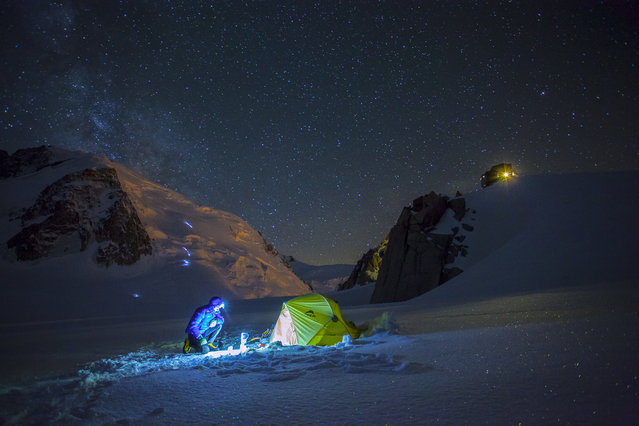
“A snapshot from mountaineer's life”. Have you ever wondered how does a mountaineer's day start? (Photo and caption by Kamil Tamiola/National Geographic Traveler Photo Contest)

“A snapshot from mountaineer's life”. Have you ever wondered how does a mountaineer's day start? I will give you a hint: you wake up at 3 am, set the stove, wake up your partner, pretend it is warm, quickly consume a high-calorie breakfast, watch your friends slowly ascending the icy slopes of your dream summit with their tiny head torches glimmering against perfectly blue ice, and hope for the good weather. One would ask: why all this trouble? The answer is easy: for the love of the adventure and the unknown. Location: Chamonix, Haute Savoye, France. (Photo and caption by Kamil Tamiola/National Geographic Traveler Photo Contest)

ATTENTION! All pictures are presented in high resolution. To see Hi-Res images – just TWICE click on any picture. In other words, click small picture – opens the BIG picture. Click BIG picture – opens VERY BIG picture.
Details
27 Jun 2013 12:47:00
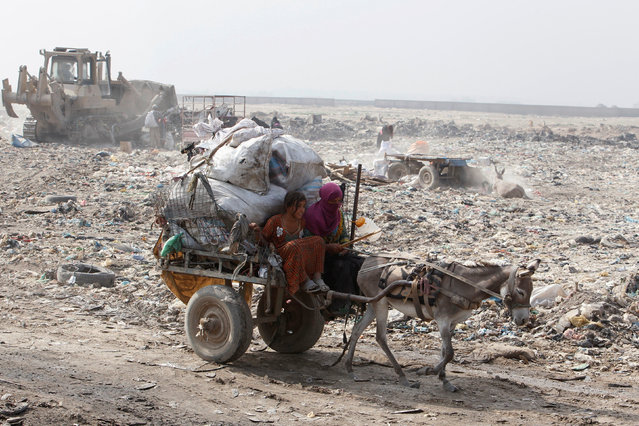
Garbage pickers collect ride on donkey cart while looking for recyclable materials at a rubbish dump in the outskirts of Baghdad, Iraq, August 23, 2016. Despite its huge untapped oil and gas reserves and steadily rising oil output and revenue, 23 percent of the population live below the poverty line, according to the Ministry of Planning. Eg, for 12-year-old Mohammed, life in Sadr City means long days during his school holidays scrabbling through the refuse in the scorching summer heat before selling his daily haul to a middleman. He sells each kilogram (2.2 lb) of plastic bottles or soda cans for 250 Iraqi dinars (around 20 U.S. cents), earning between 2,000 to 4,000 dinars ($1.50–$3) a day. A International Labor Organization report listing dangerous jobs in which children are engaged across the world mentioned collecting garbage as one of the activities in which minors risked suffering violence and injury. (Photo by Khalid al Mousily/Reuters)

Garbage pickers collect ride on donkey cart while looking for recyclable materials at a rubbish dump in the outskirts of Baghdad, Iraq, August 23, 2016. Despite its huge untapped oil and gas reserves and steadily rising oil output and revenue, 23 percent of the population live below the poverty line, according to the Ministry of Planning. (Photo by Khalid al Mousily/Reuters)
Details
24 Aug 2016 11:52:00


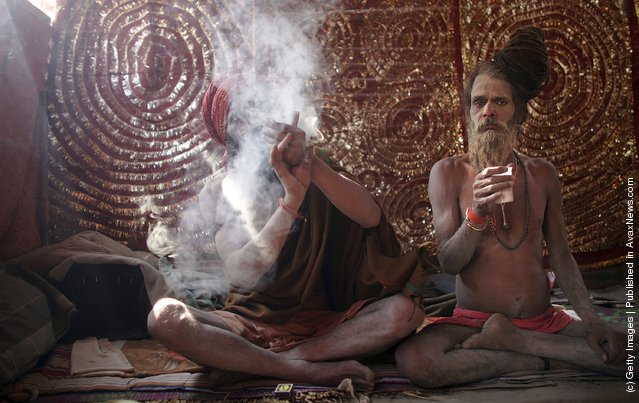
“Kumbh Mela is a mass Hindu pilgrimage in which Hindus gather at the Ganges river. The normal Kumbh Mela is celebrated every 3 years, the Ardh (half) Kumbh Mela is celebrated every six years at Haridwar and Prayag, the Purna (complete) Kumbh takes place every twelve years, at four places (Prayag (Allahabad), Haridwar, Ujjain, and Nashik). The Maha (great) Kumbh Mela which comes after 12 “Purna Kumbh Melas”, or 144 years, is held at Allahabad.

The last Ardh Kumbh Mela was held over a period of 45 days beginning in January 2007, more than 70 million Hindu pilgrims took part in the Ardh Kumbh Mela at Prayag, and on January 15, the most auspicious day of the festival of Makar Sankranti, more than 5 million participated. The previous Maha Kumbh Mela, held in 2001, was attended by around 60 million people, making it at the time the largest gathering anywhere in the world in recorded history”. – Wikipedia

Photo: Sadhus (holy men) smoke at their camp near the ritual site at Sangam, the confluence of the Ganges, Yamuna and mythical Saraswati rivers during the Ardh Kumbh Mela festival (Half Pitcher festival) January 18, 2007 in Allahabad, India. Millions of Hindu pilgrims have flocked to the largest religious gathering in the world which lasts for 45 days in northern India. The festival commemorates the mythical conflict between gods and demons over a pitcher filled with the “nectar of immortality”. Devotees believe that taking a holy dip in the Ganges at this time washes away their sins and paves the path to salvation. (Photo by Mario Tama/Getty Images)

Details
30 Jun 2011 10:27:00
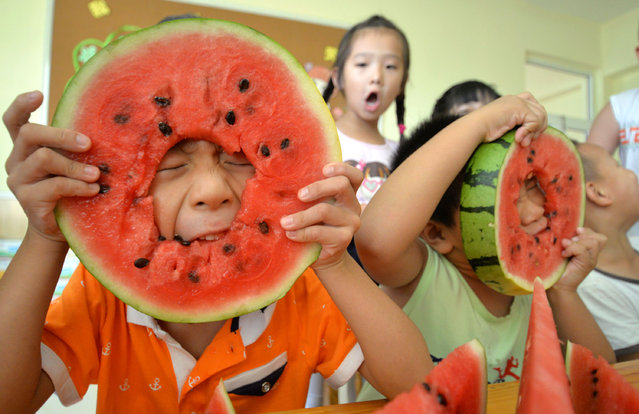
Children eat watermelons to meet the “beginning of autumn” at a kindergarten in Handan, China on August 7, 2015. Chinese tradition to eat watermelons or peaches before that day symbolises “biting away summer”. The solar term ‘beginning of autumn’ falls on 8 August this year. (Photo by Xinhua/REX Shutterstock)

Children eat watermelons to meet the “beginning of autumn” at a kindergarten in Handan, China on August 7, 2015. Chinese tradition to eat watermelons or peaches before that day symbolises “biting away summer”. The solar term ‘beginning of autumn’ falls on 8 August this year. (Photo by Xinhua/REX Shutterstock)
Details
11 Aug 2015 14:29:00
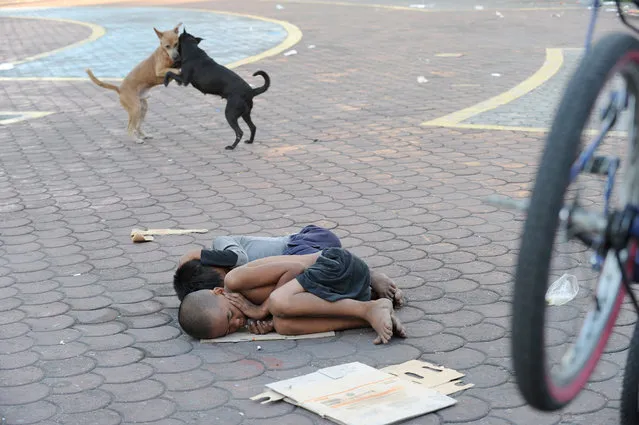
This photo taken November 10, 2015 shows homeless street children sleeping in a park in Manila. The Philippines has swept 20,000 homeless from the streets, cancelled hundreds of flights and declared public holidays in Manila to ensure a safe and efficient summit of 21 world leaders next week, officials say. (Photo by Jay Directo/AFP Photo)

This photo taken November 10, 2015 shows homeless street children sleeping in a park in Manila. The Philippines has swept 20,000 homeless from the streets, cancelled hundreds of flights and declared public holidays in Manila to ensure a safe and efficient summit of 21 world leaders next week, officials say. (Photo by Jay Directo/AFP Photo)
Details
28 Nov 2015 08:06:00
Serbian police officers of the Special Anti-Terrorist Unit pose for a picture in their base outside Belgrade October 8, 2014. (Photo by Marko Djurica/Reuters)

Serbian police officers of the Special Anti-Terrorist Unit pose for a picture in their base outside Belgrade October 8, 2014. When the killing of an unarmed black teenager by a white policeman in Ferguson, Missouri, in August sparked sometimes violent protests, the response of police in camouflage gear and armoured vehicles wielding stun grenades and assault rifles seemed more like a combat operation than a public order measure. Some U.S. police departments have recently acquired U.S. military-surplus hardware from wars abroad, but there are many law enforcers around the world whose rules of engagement also allow the use of lethal force with relatively few restrictions. But for every regulation that gives police wide scope to use firearms, there is another code that sharply limits their use. In Serbia, police may use measures ranging from batons to special vehicles, water cannon and tear gas on groups of people who have gathered illegally and are behaving in a way that is violent or could cause violence, but they may use firearms only when life is endangered. (Photo by Marko Djurica/Reuters)
Details
27 Nov 2014 14:53:00
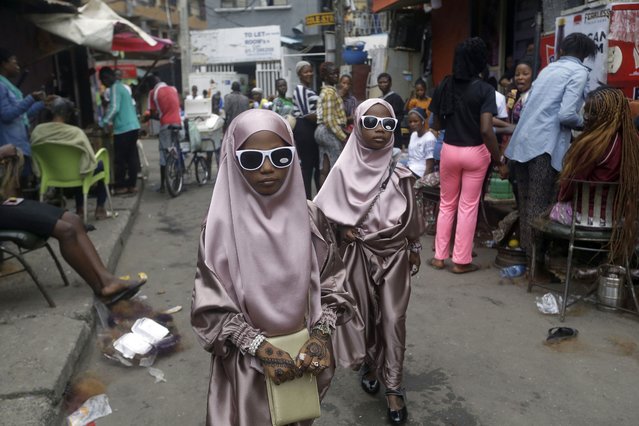
Muslim girls are seen after prayers, in Lagos, Nigeria, Friday, July 31, 2020. Small groups of pilgrims performed one of the final rites of the Islamic hajj on Friday as Muslims worldwide marked the start of the Eid al-Adha holiday amid a global pandemic that has impacted nearly every aspect of this year's pilgrimage and celebrations. The last days of hajj coincide with the four-day Eid al-Adha, or “Feast of Sacrifice”, in which Muslims slaughter livestock and distribute the meat to the poor. (Photo by Sunday Alamba/AP Photo)

Muslim girls are seen after prayers, in Lagos, Nigeria, Friday, July 31, 2020. Small groups of pilgrims performed one of the final rites of the Islamic hajj on Friday as Muslims worldwide marked the start of the Eid al-Adha holiday amid a global pandemic that has impacted nearly every aspect of this year's pilgrimage and celebrations. The last days of hajj coincide with the four-day Eid al-Adha, or “Feast of Sacrifice”, in which Muslims slaughter livestock and distribute the meat to the poor. (Photo by Sunday Alamba/AP Photo)
Details
14 Aug 2020 00:01:00