Loading...
Done
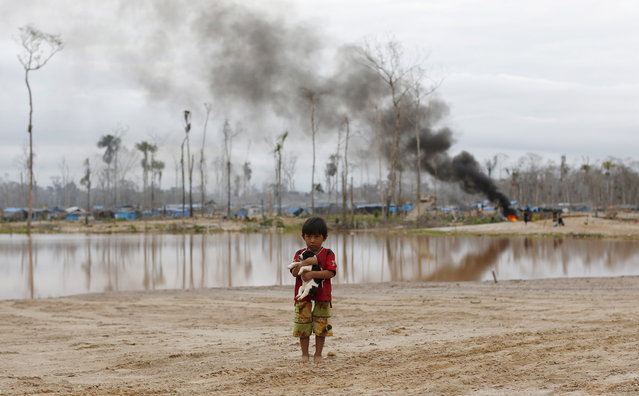
A boy carries a dog as he stands after a Peruvian police operation to destroy illegal gold mining camps in a zone known as Mega 14, in the southern Amazon region of Madre de Dios July 14, 2015. Peruvian police razed dozens of illegal gold mining camps at the edge of an Amazonian nature reserve this week, part of a renewed bid to halt the spread of wildcatting in a remote rainforest region. (Photo by Janine Costa/Reuters)

A boy carries a dog as he stands after a Peruvian police operation to destroy illegal gold mining camps in a zone known as Mega 14, in the southern Amazon region of Madre de Dios July 14, 2015. Peruvian police razed dozens of illegal gold mining camps at the edge of an Amazonian nature reserve this week, part of a renewed bid to halt the spread of wildcatting in a remote rainforest region. (Photo by Janine Costa/Reuters)
Details
18 Jul 2015 12:29:00
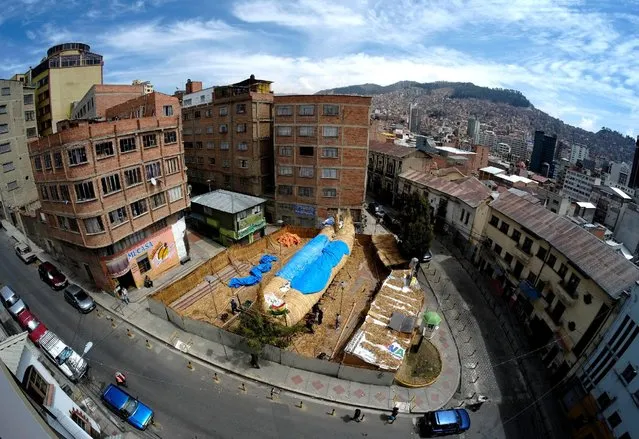
Aerial view of the “Viracocha III”, a boat made only from the totora reed, as it is being prepared to cross the Pacific from Chile to Australia on an expected six-month journey, La Paz, Bolivia, October 19, 2016. An expedition in a boat made only of reeds crafted by indigenous Bolivians is getting ready to cross the Pacific from South America to Australia, in a fresh attempt to prove that ancient mariners were capable of making the journey. Phil Buck, a 51-year-old explorer from the United States, already has led two similar expeditions and will captain the “Viracocha III” set to depart from northern Chile in February on an expected six-month journey. (Photo by David Mercado/Reuters)

Aerial view of the “Viracocha III”, a boat made only from the totora reed, as it is being prepared to cross the Pacific from Chile to Australia on an expected six-month journey, La Paz, Bolivia, October 19, 2016. An expedition in a boat made only of reeds crafted by indigenous Bolivians is getting ready to cross the Pacific from South America to Australia, in a fresh attempt to prove that ancient mariners were capable of making the journey. (Photo by David Mercado/Reuters)
Details
20 Oct 2016 10:53:00
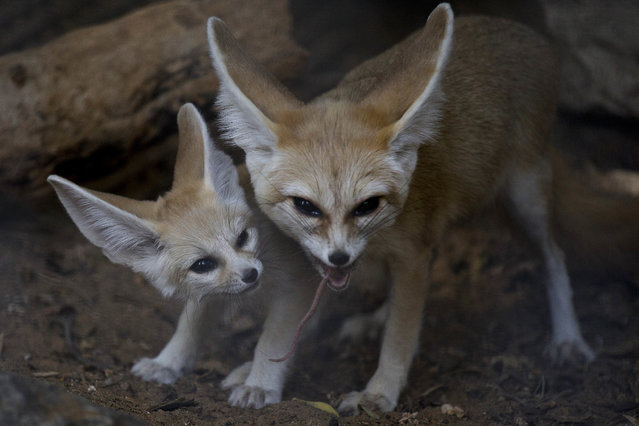
A 6-week old Fennec fox, the smallest species of foxes, and a native to the Sahara desert in Africa, looks as its mother eats in the Ramat Gan Safari Park near Tel Aviv, Israel, Sunday, November 6, 2016. Sagit Horowitz, the safari spokeswoman said four Fennec foxes were born about six weeks ago. (Photo by Ariel Schalit/AP Photo)

A 6-week old Fennec fox, the smallest species of foxes, and a native to the Sahara desert in Africa, looks as its mother eats in the Ramat Gan Safari Park near Tel Aviv, Israel, Sunday, November 6, 2016. Sagit Horowitz, the safari spokeswoman said four Fennec foxes were born about six weeks ago. (Photo by Ariel Schalit/AP Photo)
Details
13 Nov 2016 10:00:00
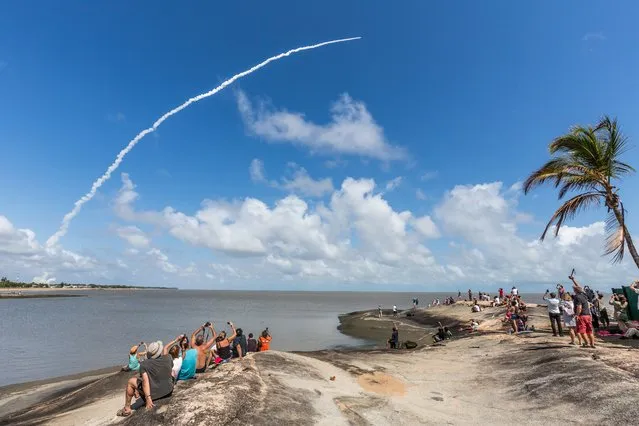
People take photos as an Ariane 5 space rocket with a payload of four Galileo satellites lifts off from ESA's European Spaceport in Kourou, French Guiana, on November 17, 2016. Ariane 5 successfully launched on November 17 four satellites which will be part of the Galileo global satellite navigation system. (Photo by Jody Amiet/AFP Photo)

People take photos as an Ariane 5 space rocket with a payload of four Galileo satellites lifts off from ESA's European Spaceport in Kourou, French Guiana, on November 17, 2016. Ariane 5 successfully launched on November 17 four satellites which will be part of the Galileo global satellite navigation system. (Photo by Jody Amiet/AFP Photo)
Details
18 Nov 2016 15:38:00
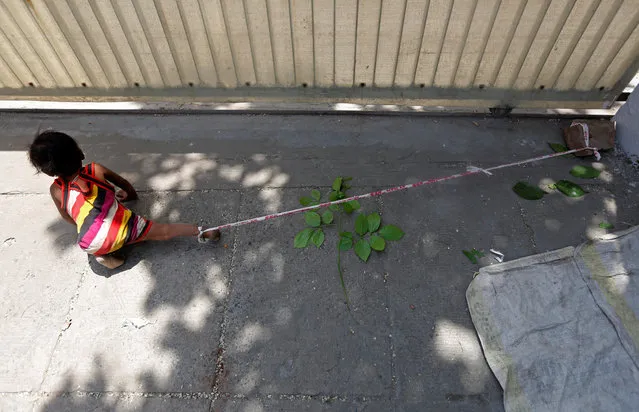
Barrier tape is tied around 15-month-old Shivani's ankle to prevent her from running away, while her mother Sarta Kalara works at a construction site nearby, in Ahmedabad, India, April 19, 2016. Kalara says she has no option but to tether her daughter Shivani to a stone despite her crying, while she and her husband work for 250 rupees ($3.8) each a shift digging holes for electricity cables in the city of Ahmedabad. There are about 40 million construction workers in India, at least one in five of them women, and the majority poor migrants who shift from site to site, building infrastructure for India's booming cities. Across the country it is not uncommon to see young children rolling in the sand and mud as their parents carry bricks or dig for new roads or luxury houses. (Photo by Amit Dave/Reuters)

Barrier tape is tied around 15-month-old Shivani's ankle to prevent her from running away, while her mother Sarta Kalara works at a construction site nearby, in Ahmedabad, India, April 19, 2016. Kalara says she has no option but to tether her daughter Shivani to a stone despite her crying, while she and her husband work for 250 rupees ($3.8) each a shift digging holes for electricity cables in the city of Ahmedabad. There are about 40 million construction workers in India, at least one in five of them women, and the majority poor migrants who shift from site to site, building infrastructure for India's booming cities. Across the country it is not uncommon to see young children rolling in the sand and mud as their parents carry bricks or dig for new roads or luxury houses. (Photo by Amit Dave/Reuters)
Details
14 Dec 2016 07:39:00
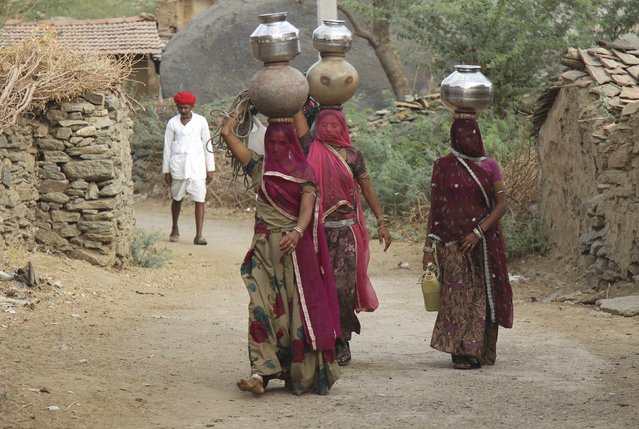
Women carry pitchers filled with drinking water in Devmali village in the desert state of Rajasthan, India, June 16, 2016. (Photo by Himanshu Sharma/Reuters)

Women carry pitchers filled with drinking water in Devmali village in the desert state of Rajasthan, India, June 16, 2016. (Photo by Himanshu Sharma/Reuters)
Details
19 Jun 2016 10:16:00
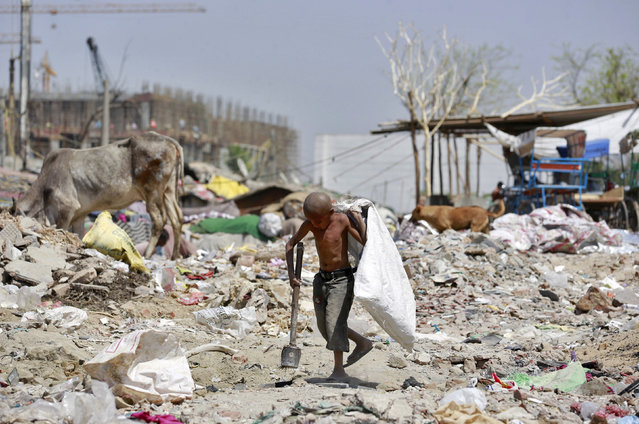
A boy looks for scrap metal using an improvised magnetic tool near a construction site in New Delhi, India, March 21, 2016. (Photo by Cathal McNaughton/Reuters)

A boy looks for scrap metal using an improvised magnetic tool near a construction site in New Delhi, India, March 21, 2016. (Photo by Cathal McNaughton/Reuters)
Details
09 Jul 2016 09:50:00
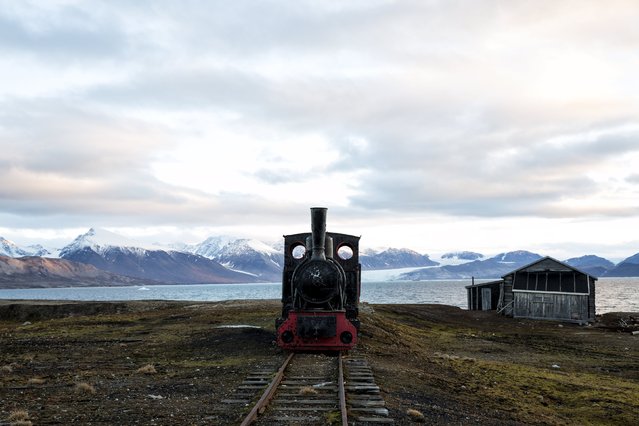
An old locomotive train that was used for transporting coal is preserved as a monument at Ny-Alesund, in Svalbard, Norway, October 11, 2015. (Photo by Anna Filipova/Reuters)

An old locomotive train that was used for transporting coal is preserved as a monument at Ny-Alesund, in Svalbard, Norway, October 11, 2015. A Norwegian chain of islands just 1,200 km (750 miles) from the North Pole is trying to promote new technologies, tourism and scientific research in a shift from high-polluting coal mining that has been a backbone of the remote economy for decades. (Photo by Anna Filipova/Reuters)
Details
29 Jan 2016 13:19:00