Loading...
Done
A woman holds up an umbrella and license plates, one that reads “love”, during violent protests between riot police and demonstrators in the Causeway Bay district of Hong Kong on October 1, 2019. The city observes the National Day holiday to mark the 70th anniversary of communist China's founding Strife-torn Hong Kong on October 1 marked the 70th anniversary of communist China's founding with defiant “Day of Grief” protests and fresh clashes with police as pro-democracy activists ignored a ban and took to the streets across the city. (Photo by Nicolas Asfouri/AFP Photo)

A woman holds up an umbrella and license plates, one that reads “love”, during violent protests between riot police and demonstrators in the Causeway Bay district of Hong Kong on October 1, 2019. The city observes the National Day holiday to mark the 70th anniversary of communist China's founding Strife-torn Hong Kong on October 1 marked the 70th anniversary of communist China's founding with defiant “Day of Grief” protests and fresh clashes with police as pro-democracy activists ignored a ban and took to the streets across the city. (Photo by Nicolas Asfouri/AFP Photo)
Details
03 Oct 2019 00:05:00
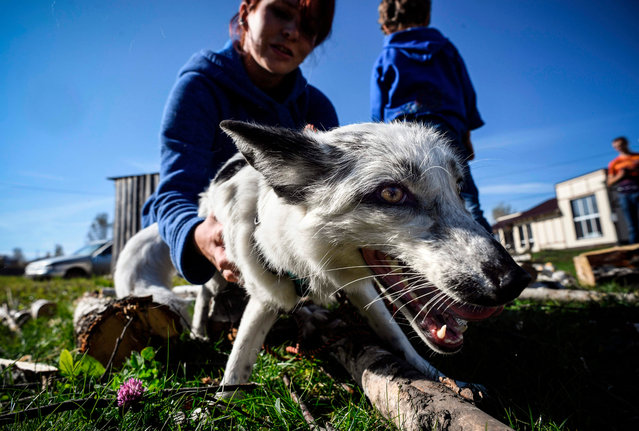
Tatyana Abramova, 33, plays with her home fox Plombir at her countryside house outside Siberian city of Novosibirsk on September 12, 2020. The official start of the Soviet experiment to better understand the domestication of animals by humans began in 1959, and was initiated by geneticists Dmitri Beliaiev and Lioudmila Trout on a farm in Akademgorodok, the scientific center of excellence in Siberia. Their primary objective was to domesticate foxes, to understand how the ancestor of wolves, another canine, evolved into a loyal and loving dog. And understand what this domestication tells us about the genetic evolution of species. (Photo by Alexander Nemenov/AFP Photo)

Tatyana Abramova, 33, plays with her home fox Plombir at her countryside house outside Siberian city of Novosibirsk on September 12, 2020. The official start of the Soviet experiment to better understand the domestication of animals by humans began in 1959, and was initiated by geneticists Dmitri Beliaiev and Lioudmila Trout on a farm in Akademgorodok, the scientific center of excellence in Siberia. Their primary objective was to domesticate foxes, to understand how the ancestor of wolves, another canine, evolved into a loyal and loving dog. And understand what this domestication tells us about the genetic evolution of species. (Photo by Alexander Nemenov/AFP Photo)
Details
25 Oct 2020 00:05:00
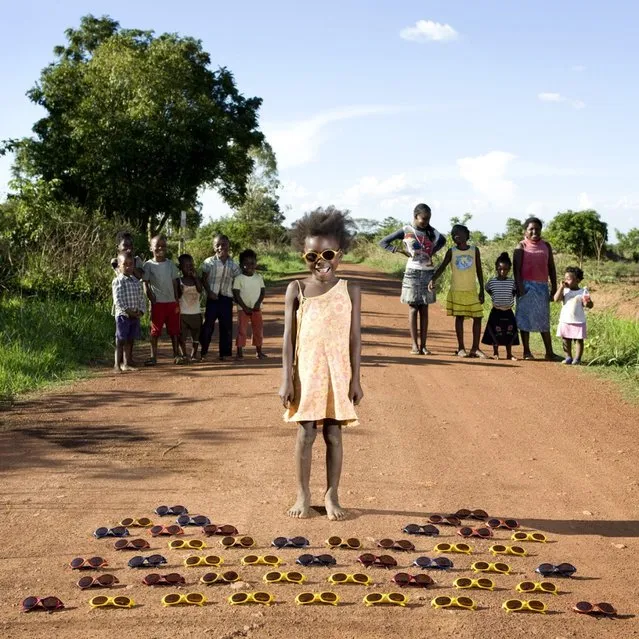
Maudy – Kalulushi, Zambia. Maudy was born in a hut in a small village close to Kalulushi, in Zambia. She grew up playing in the street with the other children in the village, who all attend the same school, where students ages 3 to 10 years old are in the same class. The village has no shops, restaurants or hotels, and just a few children are lucky enough to have toys. Maudy and her friends found a box full of sunglasses on the street, which quickly became their favorite toys. “Toy Stories” project. (Gabriele Galimberti)

Maudy – Kalulushi, Zambia. Maudy was born in a hut in a small village close to Kalulushi, in Zambia. She grew up playing in the street with the other children in the village, who all attend the same school, where students ages 3 to 10 years old are in the same class. The village has no shops, restaurants or hotels, and just a few children are lucky enough to have toys. Maudy and her friends found a box full of sunglasses on the street, which quickly became their favorite toys. “Toy Stories” project. (Photo and caption by Gabriele Galimberti)
Details
05 Dec 2013 07:54:00
Somali couple Mohamed Noor (L) and Huda Omar pose for a photograph at their makeshift home during their wedding ceremony in Mogadishu's Rajo camp, Somalia August 17, 2016. Having met two years ago, the pair have just married at Rajo camp, where some 400 families live. Most, like Noor's parents, came here in the early 1990s to flee famine. They stayed on as years of conflict ravaged the Horn of Africa nation. As at any wedding, there is plenty of dancing and sweet treats for the young couple as they start married life in Noor's simple home, made of iron and plastic sheets. Noor works as a mason with his father. Others here are builders or sell sweets, nuts and stick toothbrushes to make money. Some beg around the seaside city, which like the rest of Somalia has been gripped by violence since the toppling of dictator Mohamed Siad Barre in 1991. (Photo by Feisal Omar/Reuters)

Somali couple Mohamed Noor (L) and Huda Omar pose for a photograph at their makeshift home during their wedding ceremony in Mogadishu's Rajo camp, Somalia August 17, 2016. Having met two years ago, the pair have just married at Rajo camp, where some 400 families live. Most, like Noor's parents, came here in the early 1990s to flee famine. (Photo by Feisal Omar/Reuters)
Details
14 Sep 2016 10:35:00
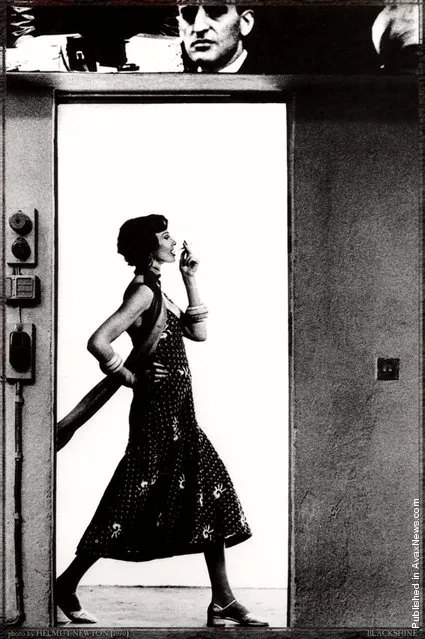
Photographers: Helmut Newton

“Newton was born in Berlin, the son of Klara “Claire” (Marquis) and Max Neustädter, a button factory owner. His family was Jewish. Newton attended the Heinrich-von-Treitschke-Realgymnasium and the American School in Berlin. Interested in photography from the age of 12 when he purchased his first camera, he worked for the German photographer Yva (Elsie Neulander Simon) from 1936. The increasingly oppressive restrictions placed on Jews by the Nuremberg laws meant that his father lost control of the factory in which he manufactured buttons and buckles; he was briefly interned in a concentration camp on “Kristallnacht”, November 9, 1938, which finally compelled the family to leave Germany. Newton's parents fled to South America. He was issued with a passport just after turning 18, and left Germany on December 5, 1938. At Trieste he boarded the “Conte Rosso” (along with about 200 others escaping the Nazis) intending to journey to China. After arriving in Singapore he found he was able to remain there, first and briefly as a photographer for the Straits Times and then as a portrait photographer”. – Wikipedia

Photo: Sigourney Weaver by Helmut Newton, 1995.
Details
08 Apr 2012 13:49:00
Professional pilot and remote control plane enthusiast Bob Rembert prepares to start the propeller of a 1/4 scale Edge 540 remote control, gas powered plane. “I wanted to fly since I was 10 years old. I love it so much. And I can do stuff with the model airplanes I can't do with the real planes”, said Rembert. (Photo by Bill Ingram/The Palm Beach Post)

The R.C. Bush Pilots club was started in 1981, for those who enjoy flying radio control (RC) model planes. It’s one of the largest clubs in Florida, and calls Phil Wherry Field in West Palm Beach home. Photo: Professional pilot and remote control plane enthusiast Bob Rembert prepares to start the propeller of a 1/4 scale Edge 540 remote control, gas powered plane. (Photo by Bill Ingram/The Palm Beach Post)
Details
01 Jun 2015 14:38:00
During the recession and looking for work she began sketching birds on the inside of books, seeing the practice as a creative way to mutate the pages into something fresh. Bluebird drawing on an AT&T bill. (Photo by Paula Swisher/Caters News)

“Artist Paula Swisher has come up with a quirky way of lessening the stress of household bills - by doodling highly intricate birds on each one. Swisher, 37, has drawn hundreds of birds in her lifetime and puts her love of ornithology down to the nature walks she went on as a youngster. Looking for work during the recession, she began sketching birds on the inside of books, seeing the practice as a creative way to mutate the pages into something fresh. But now she's made the transition from books to bills – while admittedly making a playful commentary on the predatory banking businesses”. – Caters News. (Photo by Paula Swisher/Caters News)
Details
02 May 2014 11:36:00
A pro-government Sierra Leonean fighter bites a bullet as he takes position in no man's land 2 km ahead of Rogberi junction where evidence of executed UN troops were found after heavy fighting between government troops and RUF rebels 100 km north east of Freetown, Sierra Leone, May 23, 2000. (Photo by Yannis Behrakis/Reuters)

Yannis Behrakis, one of Reuters' most decorated and best-loved photographers, has passed away after a long battle with cancer. He was 58. Here: A pro-government Sierra Leonean fighter bites a bullet as he takes position in no man's land 2 km ahead of Rogberi junction where evidence of executed UN troops were found after heavy fighting between government troops and RUF rebels 100 km north east of Freetown, Sierra Leone, May 23, 2000. (Photo by Yannis Behrakis/Reuters)
Details
06 Mar 2019 00:05:00