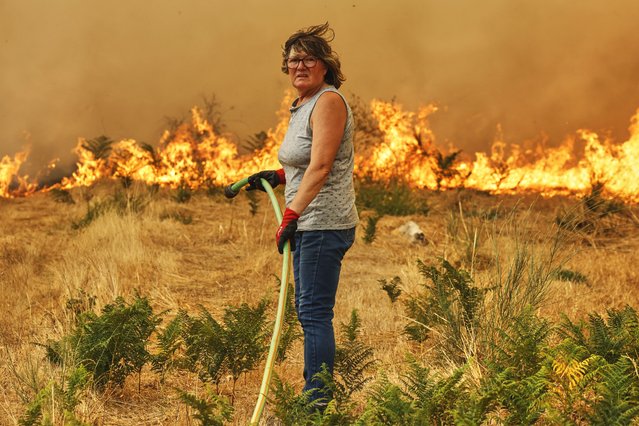
A woman with a hose tries to put out the fire during a wildfire in Santa Baia De Montes, northwestern Spain, Thursday, August 14, 2025. (Photo by Lalo R. Villar/AP Photo)
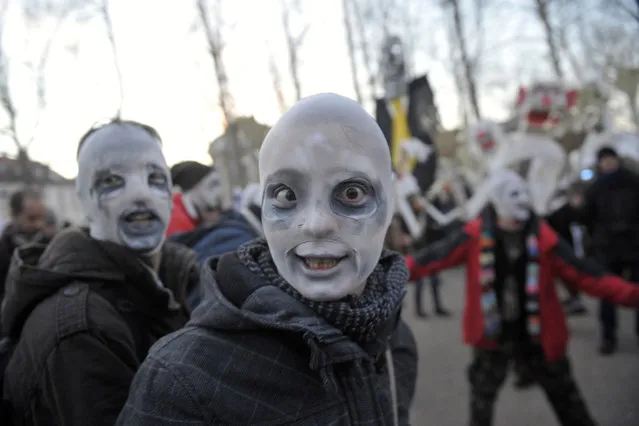
Protesters wearing masks perform during anti-austerity and anti-graft protests in Ljubljana, Slovenia, on January 11, 2013. More than 5,000 Slovenians gathered in the center of Ljubljana on Friday to protest against a corruption scandal that threatens to bring down the government. Slovenia's anti-corruption commission said earlier this week that Prime Minister Janez Jansa had been unable to explain the source of some of his income in recent years. (Photo by Srdjan Zivulovic/Reuters via The Atlantic)
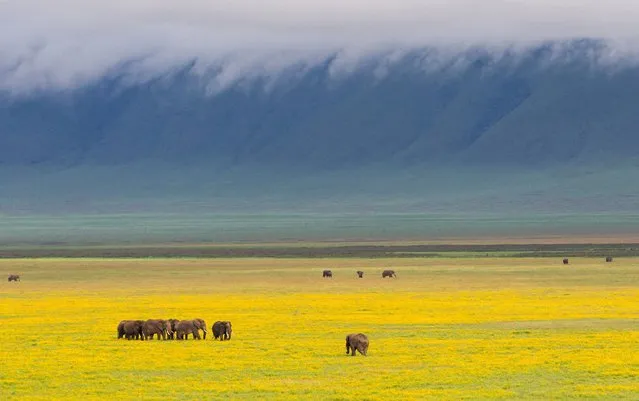
Ngorongoro Crater (Tanzania). At 610m deep and 260 sq km, this is the largest unflooded caldera in the world. A blue-green vision from above it's a haven for engangered wildlife and Maasai livestock. The crater was formed three million years ago when a giant volcano, which could have been as high as Kilimanjaro, exploded and collapsed. The caldera formed the concentric fractures in the crust cracked down to a magma reservoir deep underground. (Photo by John Bryant/Getty Images)
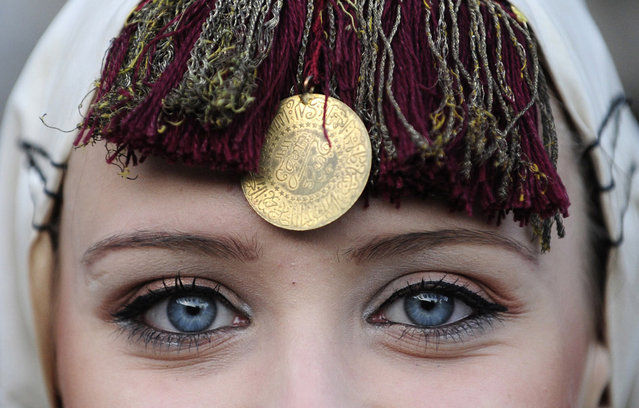
Women dressed in folk costumes take part in a traditional wedding ceremony in the village of Galicnik, west of Macedonia's capital Skopje, July 12, 2014. The Galicnik Wedding, a three-day traditional Macedonian wedding celebration held each “Petrovden” or St. Peter's Day, involves traditional customs, costumes, and rituals and dances that have been passed down over the centuries. (Photo by Ognen Teofilovski/Reuters)
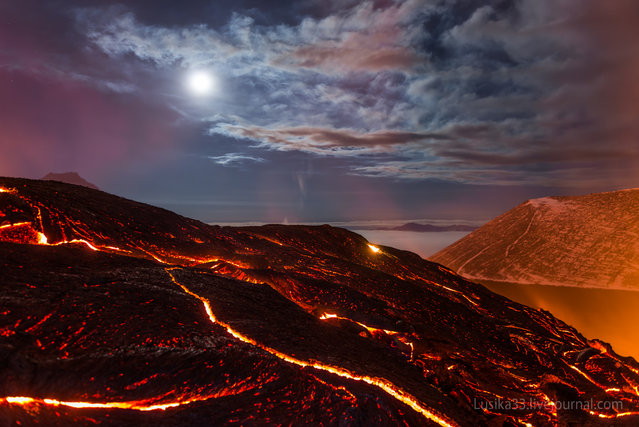
Take a look at this stunning photo of Tolbachik, an active volcanic complex on the Kamchatka Peninsula in far eastern Russia. Lava fountains and rivers ran through the area for months after the eruption began with the opening of two Tolbachik fissures in November of 2012. In the midst of this activity, photographers Luda and Andrey (lusika33) took a trip down to see that stunning hell valley on earth. (Photo by lusika33)
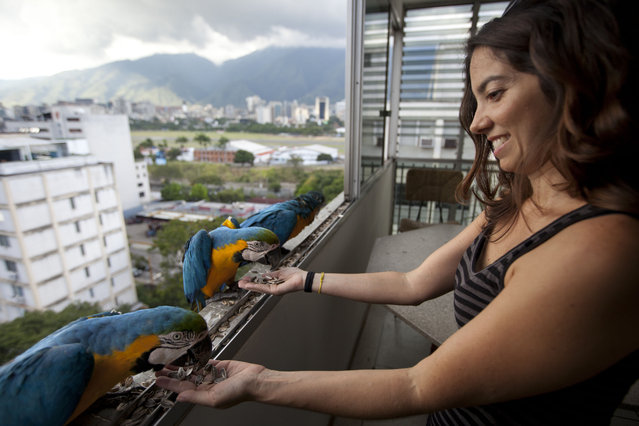
Vanessa Silva, 38, feeds macaws that fly to her apartment window every day looking for food, in Caracas, Venezuela, on November 24, 2014. A group of gold-and-royal blue birds poked their heads through Silva’s window, as if saying “I’m here, is anyone home?” “I’d seen them flying when I was down on the street, and I thought ‘Oh how pretty,’” the 38-year-old said, a macaw eating out of her hand. (Photo by Ariana Cubillos/AP Photo)
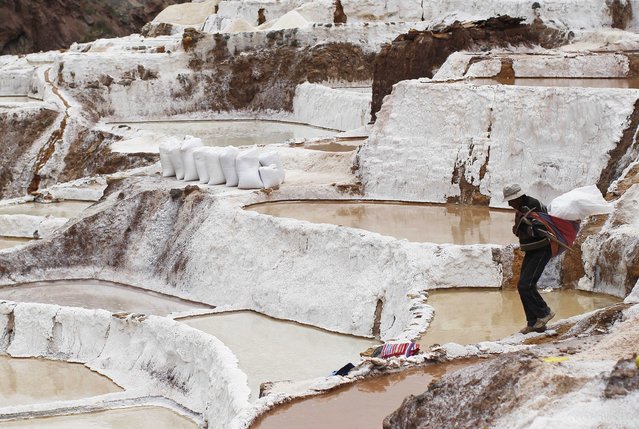
A worker carries a bag of salt after collecting it from a pond at the Maras mines in Cuzco December 3, 2014. Salt has been obtained in Maras since pre-Incan times by evaporating highly salty local subterranean stream water. The water is intricately channelled through constructions, flowing gradually down onto several hundred ancient terraced ponds. From each pond, a local member of the mine cooperative can produce 150 to 200 kilos per month which can be sold in the markets at $0.34 per kilogram, according to miners. (Photo by Enrique Castro-Mendivil/Reuters)
“Body blading (also known as buggy rollin') is an extreme sport that involves descending down a slope while wearing a flexible aerodynamic plastic roller suit that has wheels on the feet, knees, torso, and arms. This suit was created by Jean-Yves Blondeau, and he is one of the premier body bladers. Body blading is similar to roller blading, and in fact a body blader often starts out using the rollers on their feet in the same fashion as roller blades in order to gain initial speed, but then the rider generally assumes a position laying on the stomach facing down the hill. A body blader is capable of reaching very high speeds. Maneuverability is achieved by moving the body into various positions to change direction”. – Wikipedia
Photo: French designer Jean-Yves Blondeau demonstrates his “Buggy Rollin” suit during a performance on August 16, 2007 in Beijing, China. Blondeau is able to roll along in any position and can achieve high speeds wearing the suit. (Photo by China Photos/Getty Images)