Loading...
Done
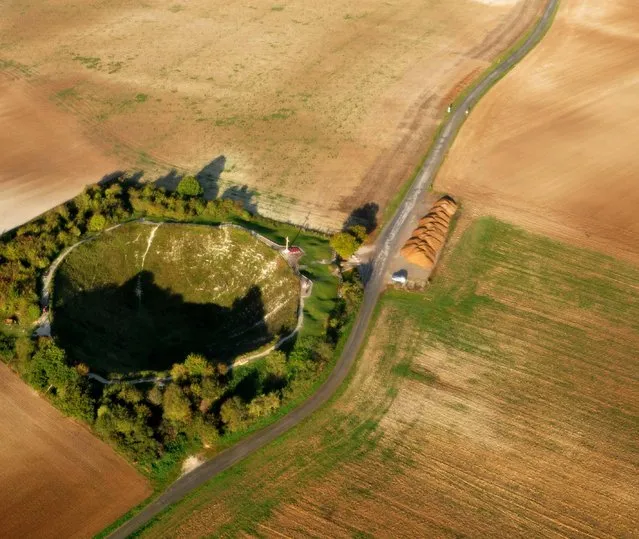
Lochnagar Crater Somme In France

It is amazing how much the humanity can change the face of the earth. Not only can it create huge craters, which look a lot like craters from meteors, they leave a big enough impact that it can be seen from space. Though this crater, caused by a massive explosion on 1 July 1916, looks large, being 90 feet deep and 300 feet across; it is nowhere big enough to be viewed for space. A common misconception is that the Great Wall of China can be seen from space. In reality, however, it is impossible. Not only is it of the same color as the earth near it, it is also not that wide. Deforestation, on the other hand, can be clearly seen from space. Also, at night, all the lights that the large cities produce are also very visible.
Details
17 Nov 2014 12:48:00
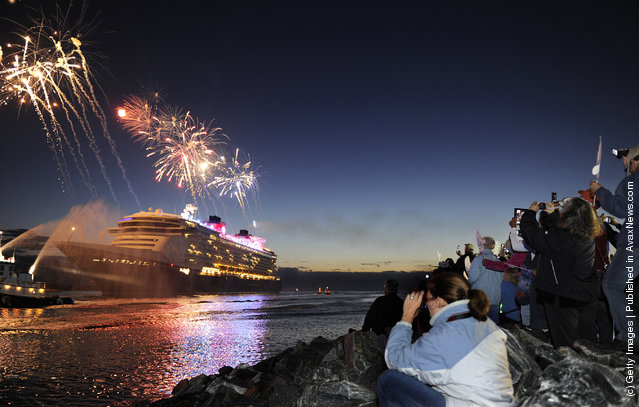
Fireworks light the morning sky March 6, 2012 as the Disney Fantasy, the newest Disney Cruise Line ship, arrives in her home port of Port Canaveral, Florida after traveling nearly 4,700 miles across the Atlantic Ocean from Bremerhaven, Germany

Fireworks light the morning sky March 6, 2012 as the Disney Fantasy, the newest Disney Cruise Line ship, arrives in her home port of Port Canaveral, Florida after traveling nearly 4,700 miles across the Atlantic Ocean from Bremerhaven, Germany. The 4,000-passenger Disney Fantasy will welcome guests on her maiden voyage on March 31, 2012, sailing seven-night cruises to the Caribbean and Disney's private island Castaway Cay, from Port Canaveral. (Photo by Todd Anderson/Disney Parks via Getty Images)
Details
07 Mar 2012 11:33:00
Russian trio Serebro

“Serebro (Серебро, Silver) are a Russian trio, formed in Moscow, Russia in 2006. Serebro is currently one of the most popular Russian bands. They are also famously known as the band who finished third in the Eurovision Song Contest 2007 in Helsinki with the song “Song #1”. On 30 July 2011, Serebro premiered their eighth single, “Mama Lover” at Europa Plus Live. It is their third official English language release after “Song #1” and “Like Mary Warner”. On 15 September 2011, the music video for “Mama Luba” (Russian version of “Mama Lover”) was released”. – Wikipedia

Photo: Russian trio «Serebro», 2008
Details
30 Sep 2011 11:56:00
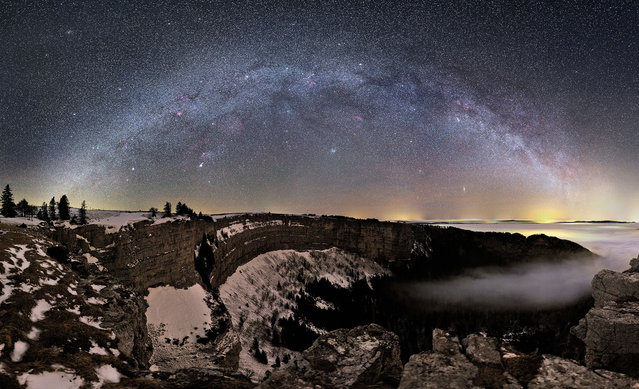
Milky Way over Switzerland

Milky Way over Switzerland

The Milky Way is the galaxy in which Earth is contained. This name derives from its appearance as a dim “milky” glowing band arching across the night sky, in which the naked eye cannot distinguish individual stars. The term “Milky Way” is a translation of the Classical Latin via lactea, from the Hellenistic Greek γαλαξίας κύκλος (pr. galaxías kýklos, “milky circle”). The Milky Way appears like a band because it is a disk-shaped structure being viewed from inside. The fact that this faint band of light is made up of stars was proven in 1610 when Galileo Galilei used his telescope to resolve it into individual stars. In the 1920s, observations by astronomer Edwin Hubble showed that the Milky Way is just one of many galaxies.


Details
20 Jun 2012 10:11:00
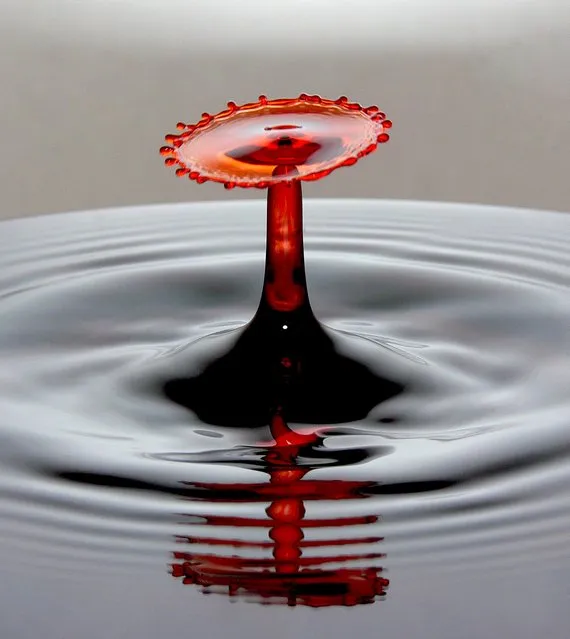
Waterdrop Sculptures by Josh Fancher

“I'm Josh Fancher, a 21 year old with an avid interest in photography, including macro, nature and wildlife, night photography, landscapes, cityscapes and architectural photography. Inspired by the beautiful and amazing water drop photography of Martin Waugh, I started doing water drop collisions in December of 2007. I use a 105mm Micro Nikkor lens for water drops, along with a pair of Nikon SB 600 flashes. I recently got a StopShot system (Nov 2009), which makes timing a lot easier. Before then, timing was manual, with an eye dropper, eye-hand coordination, and a lot of patience” – Josh Fancher. (Photo by Josh Fancher)
Details
19 Aug 2012 10:30:00


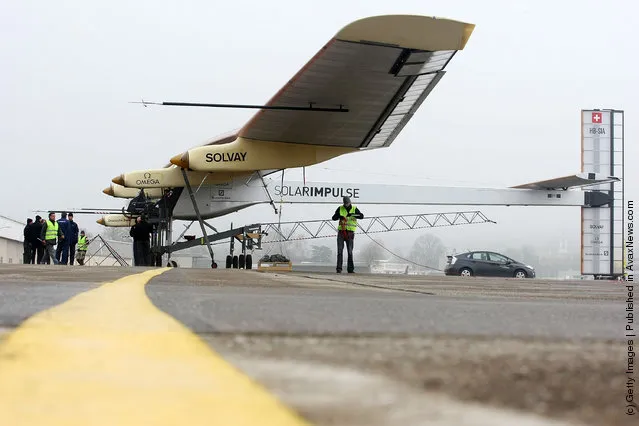
“Solar Impulse is a European long-range solar powered plane project being undertaken by Bertrand Piccard and André Borschberg. The project eventually hopes to succeed in the first circling of the earth with a piloted fixed-wing aircraft using only solar power. The first aircraft, bearing the Swiss aircraft registration code of HB-SIA, is a single-seater, capable of taking off under its own power, and intended to remain airborne up to 36 hours. This aircraft first flew an entire diurnal solar cycle, including nearly 9 hours of night flying, in a 26-hour flight on 7–8 July 2010”. – Wikipedia


Photo: Workers prepare the Solar Impulse airplane HB-SIA for a first runway test on November 19, 2009 in Dubendorf, Switzerland. Solar Impulse chairman Bertrand Piccard, psychatrist and aeronaut, who made the first non-stop round-the-world balloon flight, and CEO and former fighter pilot Andrй Borschberg plan a round-the-world flight, driven only by solar energy, for 2012. (Photo by Johannes Simon/Getty Images)
Details
16 May 2011 08:13:00
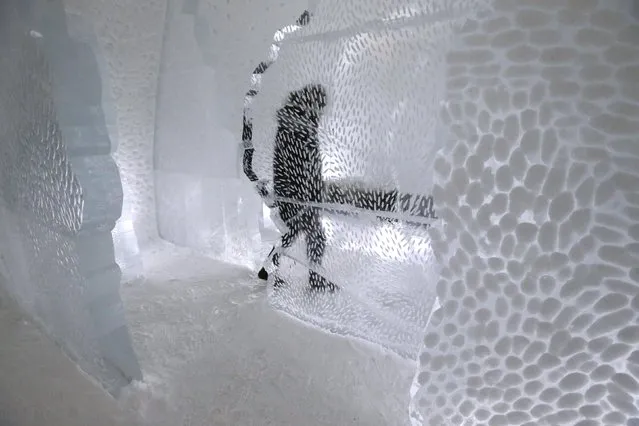
A man walks into a room in the Ice hotel in Jukkasjarvi, Sweden, December 16, 2015. (Photo by Ints Kalnins/Reuters)

In Jukkasjärvi, a village a few miles east of Kiruna, the proprietors of one hotel begin planning for a winter ice festival in March. That’s when they begin collecting some 5,000 tons of ice from the River Torne in order to prepare the Icehotel, the world’s coolest place to stay. Options for overnight stay include snow rooms, ice rooms, art suites, and the Northern Lights room, all of which range from about $300 to $900 per night. But the deluxe suite’s the only way to go. These rooms come with a critical amenity: heated ensuite bathrooms and saunas. Here: A man walks into a room in the Ice hotel in Jukkasjarvi, Sweden, December 16, 2015. (Photo by Ints Kalnins/Reuters)
Details
18 Dec 2015 08:02:00
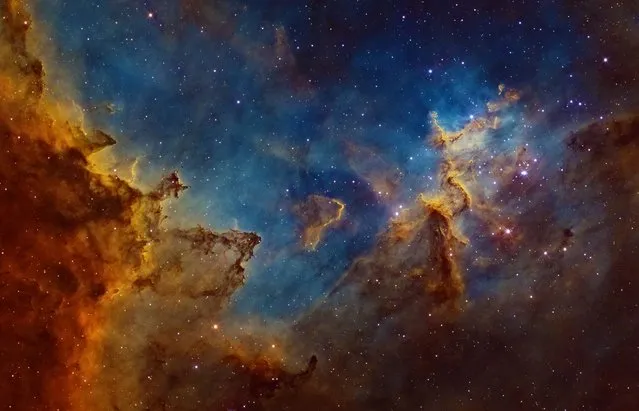
Centre of the Heart Nebula by Ivan Eder (Hungary). Situated 7500 light years away in the ‘W’-shaped constellation of Cassiopeia, the Heart Nebula is a vast region of glowing gas, energized by a cluster of young stars at its centre. The image depicts the central region, where dust clouds are being eroded and moulded into rugged shapes by the searing cosmic radiation. (Photo by Ivan Eder)

The competition, which is run by the Royal Observatory Greenwich in association with BBC Sky at Night Magazine, is now in its sixth year and has received over 2,500 entries. Photo: Centre of the Heart Nebula by Ivan Eder (Hungary). Situated 7500 light years away in the “W”-shaped constellation of Cassiopeia, the Heart Nebula is a vast region of glowing gas, energized by a cluster of young stars at its centre. The image depicts the central region, where dust clouds are being eroded and moulded into rugged shapes by the searing cosmic radiation. (Photo by Ivan Eder)
Details
03 Jul 2014 11:59:00