Loading...
Done
A picture made available on 13 May 2016 shows A Tiwa girl performing her traditional dance as they celebrated the Wanchuwa festival in Karbi Anglong District of Assam state, India, 11 May 2016. Wanchuwa is one of the most important festivals of the Tiwa tribal community living in the hills as it is related with agriculture which is the mainstay of their economy. Tiwas pray for a bountiful harvest during this festival and to protect their crops from pest and other natural calamities. (Photo by EPA/Stringer)

A picture made available on 13 May 2016 shows A Tiwa girl performing her traditional dance as they celebrated the Wanchuwa festival in Karbi Anglong District of Assam state, India, 11 May 2016. Wanchuwa is one of the most important festivals of the Tiwa tribal community living in the hills as it is related with agriculture which is the mainstay of their economy. Tiwas pray for a bountiful harvest during this festival and to protect their crops from pest and other natural calamities. Tiwa is a major tribe of Assam state who practice Jhum or shifting cultivation for their living in the hills. (Photo by EPA/Stringer)
Details
14 May 2016 11:45:00
RT-2PM2 Topol-M TEL with presumably Yars system transport-launch container

“March 19, 2012 was the first rehearsal for the Victory Day Parade at the training ground in Alabino (near Moscow, Moscow Military District). Since the end of February troops and vehicles from various units and formations of the Armed Forces began arriving to Alabino training ground. The first rehearsal included only military vehicles. During the ride the average speed of vehicles is 12 km/h, the distance depending on the type of vehicle from 12 to 15 meters”. – Vitaly Kuzmin
Details
15 Apr 2012 12:50:00
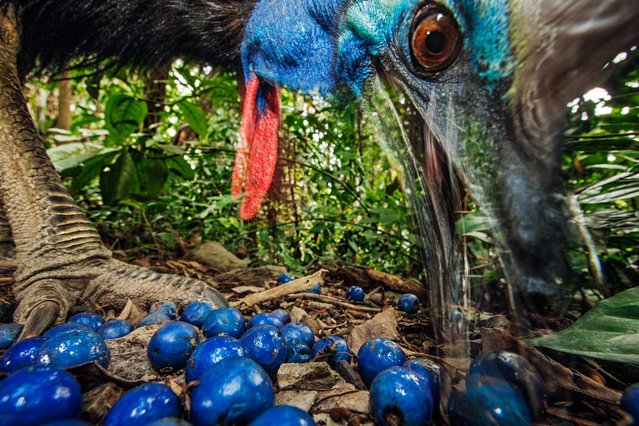
“Cassowaries are large, flightless birds related to emus and (more distantly) to ostriches, rheas, and kiwis”, writes Olivia Judson in the September issue of National Geographic magazine. (Photo by Christian Ziegler/National Geographic)

“Cassowaries are large, flightless birds related to emus and (more distantly) to ostriches, rheas, and kiwis”, writes Olivia Judson in the September issue of National Geographic magazine. How large? People-size: Adult males stand well over five foot five and top 110 pounds. Females are even taller, and can weigh more than 160 pounds. Dangerous when roused, they’re shy and peaceable when left alone. But even birds this big and tough are prey to habitat loss. The dense New Guinea and Australia rain forests where they live have dwindled. Today cassowaries might number 1,500 to 2,000. And because they help shape those same forests – by moving seeds from one place to another – “if they vanish”, Judson writes, “the structure of the forest would gradually change” too. (Photo by Christian Ziegler/National Geographic)
Details
06 Jan 2014 12:21:00
Racegoers react as they leave after the second day of the Grand National meeting at Aintree, northern England April 5, 2013. (Photo by Nigel Roddis/Reuters)

Racegoers react as they leave after the second day of the Grand National meeting at Aintree, northern England April 5, 2013. (Photo by Nigel Roddis/Reuters)

ATTENTION: VISUAL COVERAGE OF SCENES OF INJURY AND DEATH

P.S. All pictures are presented in high resolution. To see Hi-Res images – just TWICE click on any picture. In other words, click small picture – opens the BIG picture. Click BIG picture – opens VERY BIG picture (if available; this principle works anywhere on the site AvaxNews)
Details
06 Apr 2013 11:31:00
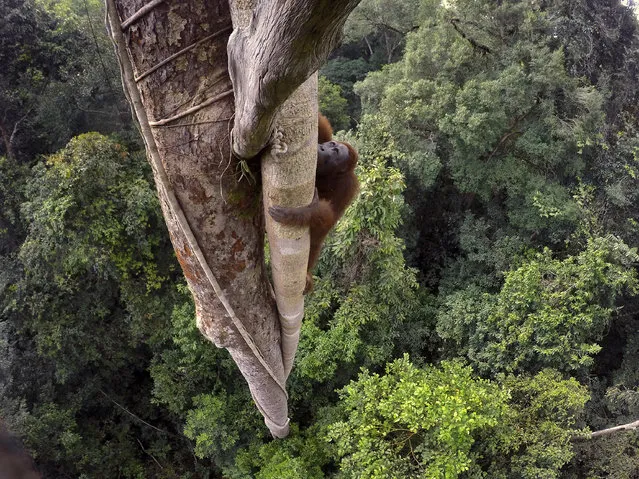
“Tough Times for Orangutans”. Nature, first prize stories. Tim Laman, USA. Location: West Kalimantan, Indonesia. A Bornean orangutan climbs over 30 meters up a tree in the rain forest of Gunung Palung National Park, West Kalimantan, Indonesia, August 12, 2015. The lives of wild orangutans are brought to light. Threats to these orangutans from fires, the illegal animal trade and loss of habitat due to deforestation have resulted in many orphan orangutans ending up at rehabilitation centers. (Photo by Tim Laman/World Press Photo Contest)

“Tough Times for Orangutans”. Nature, first prize stories. Tim Laman, USA. Location: West Kalimantan, Indonesia. A Bornean orangutan climbs over 30 meters up a tree in the rain forest of Gunung Palung National Park, West Kalimantan, Indonesia, August 12, 2015. The lives of wild orangutans are brought to light. Threats to these orangutans from fires, the illegal animal trade and loss of habitat due to deforestation have resulted in many orphan orangutans ending up at rehabilitation centers. (Photo by Tim Laman/World Press Photo Contest)
Details
19 Feb 2016 13:06:00
The crowd watches as stunt pilots Melissa Pemberton, Jurgis Kairys and Skip Stewart of The Immortals fly past pyrotechnics as they perform at The Australian International Airshow on March 1, 2015 in Avalon, Australia. (Photo by Scott E. Barbour/Getty Images)

The crowd watches as stunt pilots Melissa Pemberton, Jurgis Kairys and Skip Stewart of The Immortals fly past pyrotechnics as they perform at The Australian International Airshow on March 1, 2015 in Avalon, Australia. (Photo by Scott E. Barbour/Getty Images)
Details
11 May 2015 12:05:00
A woman walks past a giant Pac-Man in Tokyo's Shinjuku area, Wednesday, August 12, 2015. The three-meter (about nine feet and 10 inches)-tall Pac-Man and other video game characters, made of Lego bricks, were on display to promote the upcoming movie “Pixels”. (Photo by Ken Aragaki/AP Photo)

A woman walks past a giant Pac-Man in Tokyo's Shinjuku area, Wednesday, August 12, 2015. The three-meter (about nine feet and 10 inches)-tall Pac-Man and other video game characters, made of Lego bricks, were on display to promote the upcoming movie “Pixels”. (Photo by Ken Aragaki/AP Photo)
Details
13 Aug 2015 12:35:00
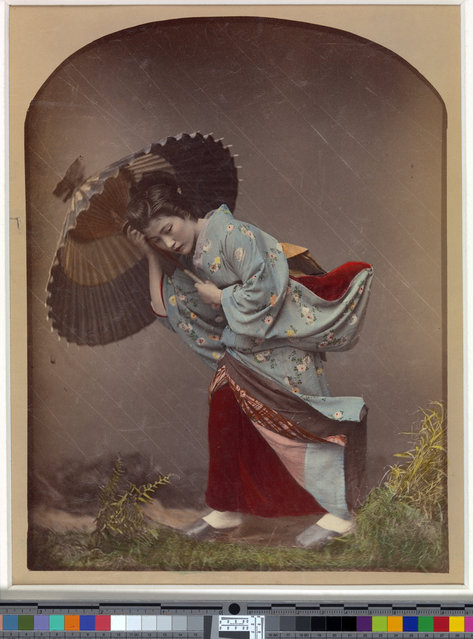
“Woman with Umbrella in Rain” by Raimund von Stillfried. Artist: Kusakabe Kimbei (Japanese, 1841–1934), 1870s. (Photo courtesy of The Metropolitan Museum of Art)

“Woman with Umbrella in Rain” by Raimund von Stillfried. Artist: Kusakabe Kimbei (Japanese, 1841–1934), 1870s. Commercial photography studios in Meiji-era Japan were renowned for the subtlety and refinement of their coloring techniques. This hand-tinted image of a young woman caught in a heavy rainstorm achieved its naturalistic effect by knitting together multiple strands of artifice: the greenery in the foreground was a studio prop; the flaps of the kimono were suspended by thin wires to create the impression of a strong wind; and long, diagonal marks were made on the negative to suggest streaks of rain. (Photo courtesy of The Metropolitan Museum of Art)
Details
12 May 2013 10:13:00