Loading...
Done
Kawakanih Yawalapiti, 9, Upper Xingu region of Mato Grosso, Brazil, 2018: Kawakanih lives with her tribe, the Yawalapiti, in Xingu national park, a preserve in the Amazon basin of Brazil. The Yawalapiti collect seeds to preserve species unique to their ecosystem, which lies between the rain forest and savannah. Kawakanih’s diet is simple, consisting mainly of fish, cassava, porridge, fruit and nuts. “It takes five minutes to catch dinner”, says Kawakanih. “When you’re hungry, you just go to the river with your net”. (Photo by Gregg Segal/The Guardian)

Photographer Gregg Segal travelled the world to document children and the food they eat in a week. Partly inspired by the increasing problems of childhood obesity, he tracked traditional regional diets as yet unaffected by globalisation, and ironically, found that the healthiest diets were often eaten by the least well off. (Photo by Gregg Segal/The Guardian)
Details
03 Jul 2019 00:03:00
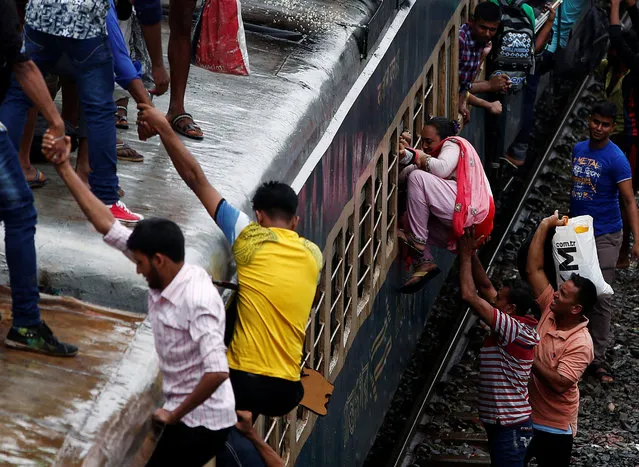
People try to board an overcrowded passenger train as they travel home to celebrate Eid al-Fitr festival, which marks the end of the Muslim holy fasting month of Ramadan, at a railway station in Dhaka, Bangladesh, July 5, 2016. (Photo by Adnan Abidi/Reuters)

People try to board an overcrowded passenger train as they travel home to celebrate Eid al-Fitr festival, which marks the end of the Muslim holy fasting month of Ramadan, at a railway station in Dhaka, Bangladesh, July 5, 2016. (Photo by Adnan Abidi/Reuters)
Details
06 Jul 2016 16:03:00
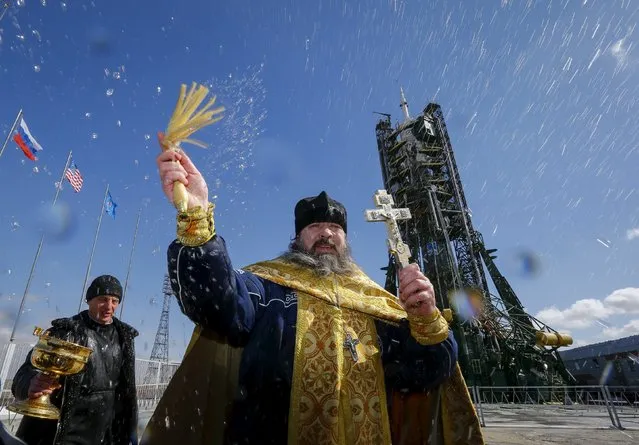
An Orthodox priest conducts a blessing in front of the Soyuz TMA-20M for the next International Space Station (ISS) crew, comprised of Jeff Williams of the U.S. and Oleg Skriprochka and Alexey Ovchinin of Russia, at the launchpad at the Baikonur cosmodrome, Kazakhstan, March 17, 2016, ahead of its launch scheduled on March 19. (Photo by Shamil Zhumatov/Reuters)

An Orthodox priest conducts a blessing in front of the Soyuz TMA-20M for the next International Space Station (ISS) crew, comprised of Jeff Williams of the U.S. and Oleg Skriprochka and Alexey Ovchinin of Russia, at the launchpad at the Baikonur cosmodrome, Kazakhstan, March 17, 2016, ahead of its launch scheduled on March 19. (Photo by Shamil Zhumatov/Reuters)
Details
18 Mar 2016 12:13:00
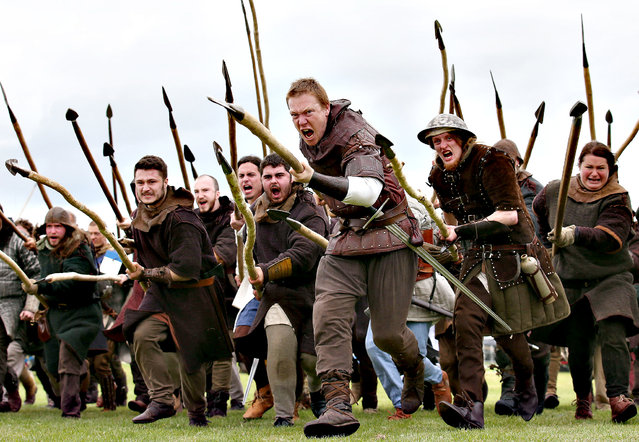
Robert The Bruce's army from The Clanranald Trust during a rehearsal for the Battle of Bannockburn re-enactment performance which will be staged at the Bannockburn Live Event in Bannockburn, the 700th anniversary of the battle, on June 27, 2014. (Photo by Andrew Milligan/PA Wire)

Robert The Bruce's army from The Clanranald Trust during a rehearsal for the Battle of Bannockburn re-enactment performance which will be staged at the Bannockburn Live Event in Bannockburn, the 700th anniversary of the battle, on June 27, 2014. (Photo by Andrew Milligan/PA Wire)
Details
28 Jun 2014 13:36:00
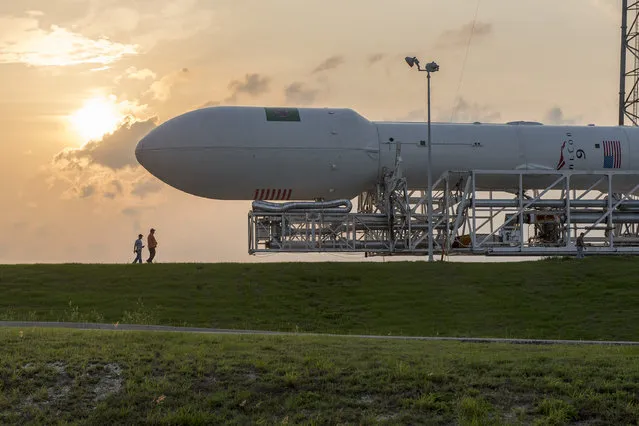
In this handout provided by the National Aeronautics and Space Administration (NASA), SpaceX's Falcon 9 is moved to the launch pad prior to the rocket's Thales Alenia Space launch attempt on April 26, 2015 in Cape Canaveral, Florida. (Photo by NASA via Getty Images)

In this handout provided by the National Aeronautics and Space Administration (NASA), SpaceX's Falcon 9 is moved to the launch pad prior to the rocket's Thales Alenia Space launch attempt on April 26, 2015 in Cape Canaveral, Florida. (Photo by NASA via Getty Images)
Details
05 Jun 2017 07:25:00
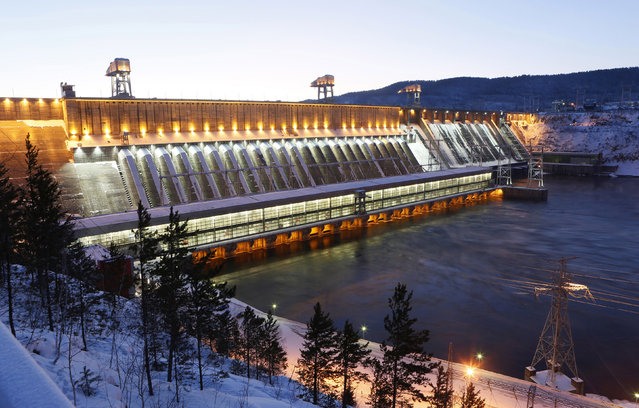
A general view shows the Krasnoyarsk hydro-electric power station on the Yenisei River near the Siberian city of Krasnoyarsk, Russia, January 13, 2016. The power plant, owned by EuroSibEnergo company, part of En+ Group, with a generating capacity of 6,000 megawatt (MW), has a ferro-concrete dam 124-metres high and 1065-metres long and is the second largest Russian hydroelectric power station. About 85% of the energy generated is intended for the Rusal Krasnoyarsk aluminium smelter, according to representatives of the power station. (Photo by Ilya Naymushin/Reuters)

A general view shows the Krasnoyarsk hydro-electric power station on the Yenisei River near the Siberian city of Krasnoyarsk, Russia, January 13, 2016. The power plant, owned by EuroSibEnergo company, part of En+ Group, with a generating capacity of 6,000 megawatt (MW), has a ferro-concrete dam 124-metres high and 1065-metres long and is the second largest Russian hydroelectric power station. About 85% of the energy generated is intended for the Rusal Krasnoyarsk aluminium smelter, according to representatives of the power station. (Photo by Ilya Naymushin/Reuters)
Details
16 Jan 2016 08:03:00
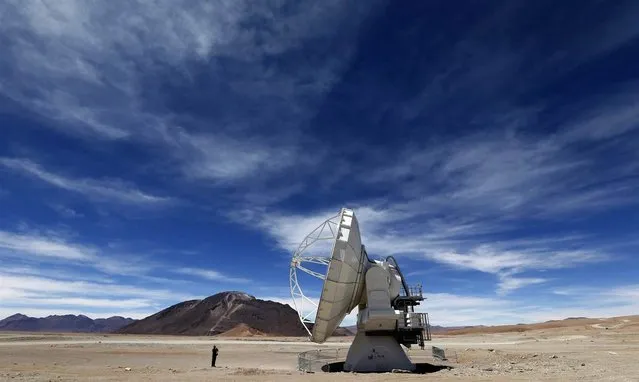
A man takes a photo of a radio antenna that's part of the Atacama Large Milimeter Array Observatory on March 12, 2013 at Llano de Chajnantor, about 43 miles (70 kilometers) from San Pedro de Atacama, Chile. The $1.5 billion ALMA facility, which had its official inauguration on March 13, is considered the world's most expensive ground-based observatory. (Photo by Felipe Trueba/EPA)

A man takes a photo of a radio antenna that's part of the Atacama Large Milimeter Array Observatory on March 12, 2013 at Llano de Chajnantor, about 43 miles (70 kilometers) from San Pedro de Atacama, Chile. The $1.5 billion ALMA facility, which had its official inauguration on March 13, is considered the world's most expensive ground-based observatory. (Photo by Felipe Trueba/EPA)
Details
03 Apr 2013 09:25:00
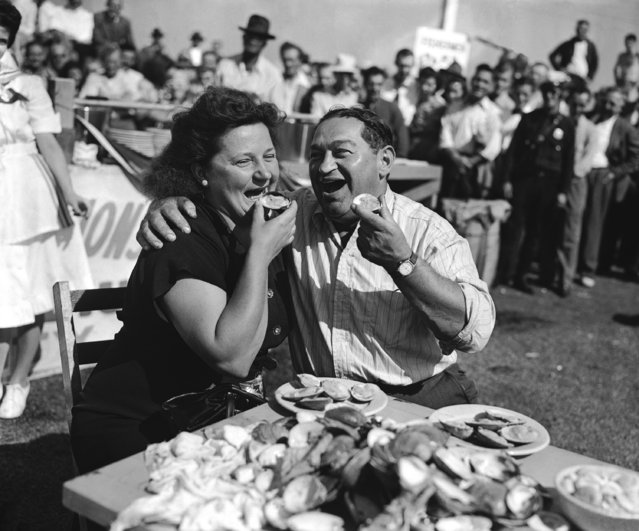
Catherine Hollis of Chester, Pa., and Izzy Weintraub of Atlantic City eat Cherrystone clams at Atlantic City's annual clam-eating contest September 16, 1946. They finished 96 and 66 clams respectively in 20 minutes. (Photo by Sam Myers/AP Photo)

Catherine Hollis of Chester, Pa., and Izzy Weintraub of Atlantic City eat Cherrystone clams at Atlantic City's annual clam-eating contest September 16, 1946. They finished 96 and 66 clams respectively in 20 minutes. (Photo by Sam Myers/AP Photo)
Details
06 Feb 2018 07:17:00