Loading...
Done
Waterdrop Sculptures by Josh Fancher

“I'm Josh Fancher, a 21 year old with an avid interest in photography, including macro, nature and wildlife, night photography, landscapes, cityscapes and architectural photography. Inspired by the beautiful and amazing water drop photography of Martin Waugh, I started doing water drop collisions in December of 2007. I use a 105mm Micro Nikkor lens for water drops, along with a pair of Nikon SB 600 flashes. I recently got a StopShot system (Nov 2009), which makes timing a lot easier. Before then, timing was manual, with an eye dropper, eye-hand coordination, and a lot of patience” – Josh Fancher. (Photo by Josh Fancher)
Details
19 Aug 2012 10:30:00
Powerlifting Pastor Kevin Fast

Kevin Fast, 51, holds several Guinness World Records including the heaviest plane pulled by a man and has lifted 22 women with his back. The Reverend Dr Kevin Fast is officially God's gift to powerlifting after being named as the world's strongest priest. The Canadian pastor, 51, has been performing incredible stunts of heavy lifting for years after being inspired by 19th Century strongman Louis Cyr. He holds several Guinness World Records including the heaviest aircraft pulled by a man, which weighed in at a whopping 189 tonnes, heaviest truck pulled by an arm wrestling move, heaviest vehicle pulled over 100ft and the longest duration holding 500kg with the shoulders.
Details
06 Oct 2014 17:10:00
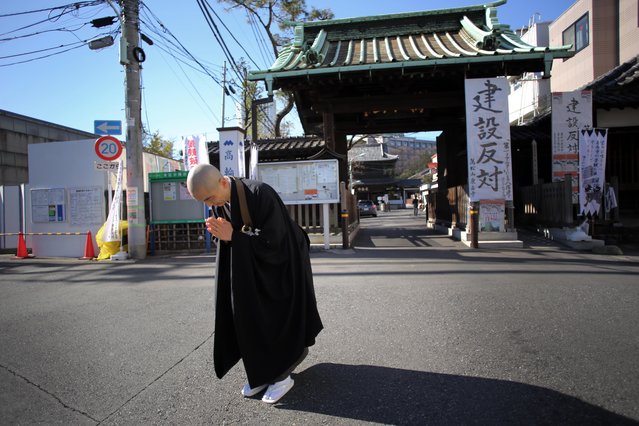
In this January 8, 2015 photo, a monk Kenmyo Muta bows at the condominium construction site and the gate of Sengakuji temple in Tokyo. (Photo by Eugene Hoshiko/AP Photo)

In this January 8, 2015 photo, a monk Kenmyo Muta bows at the condominium construction site and the gate of Sengakuji temple in Tokyo. The “47 ronin” samurai who inspired the long-loved saga of loyalty and honor eulogized in films, books and plays are fighting a new kind of battle in urban Japan. An apartment complex is going up next to the curved tile-roofed Sengakuji temple where the three-century-old graves of the ronin, or masterless samurai, lie. The banner reads: “We only hope to protect landscape of Sengakuji temple”. (Photo by Eugene Hoshiko/AP Photo)
Details
16 Jan 2015 13:01:00
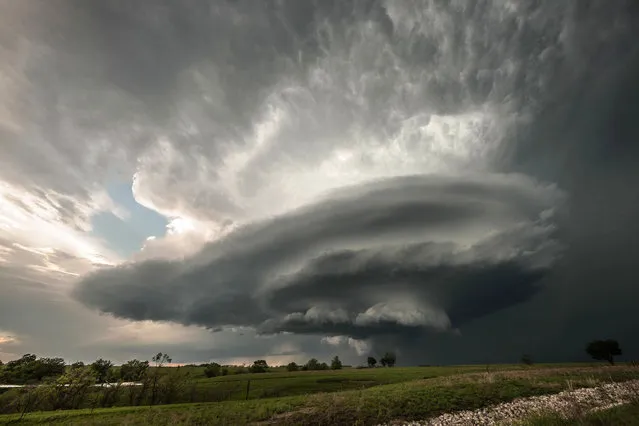
The rotating updraft base of a supercell thunderstorm, and a rear flank downdraft containing rain and hail, backlit by the setting sun, on May 10, 2014, in Climax, Kansas, United States. To most of us, dark clouds on the horizon usually means rain – but here in Kansas, they can also signal the start of a supercell. The huge formations, also known as rotating thunderstorms, are among the most powerful weather phenomenon found over land. (Photo by Stephen Locke/Barcroft Media)

The rotating updraft base of a supercell thunderstorm, and a rear flank downdraft containing rain and hail, backlit by the setting sun, on May 10, 2014, in Climax, Kansas, United States. To most of us, dark clouds on the horizon usually means rain – but here in Kansas, they can also signal the start of a supercell. The huge formations, also known as rotating thunderstorms, are among the most powerful weather phenomenon found over land. They can occur anywhere where the conditions are right, but are normally found in more arid climates. These awe-inspiring supercells were captured south of Climax city by storm chaser Stephen Locke. (Photo by Stephen Locke/Barcroft Media)
Details
18 Jul 2014 12:01:00
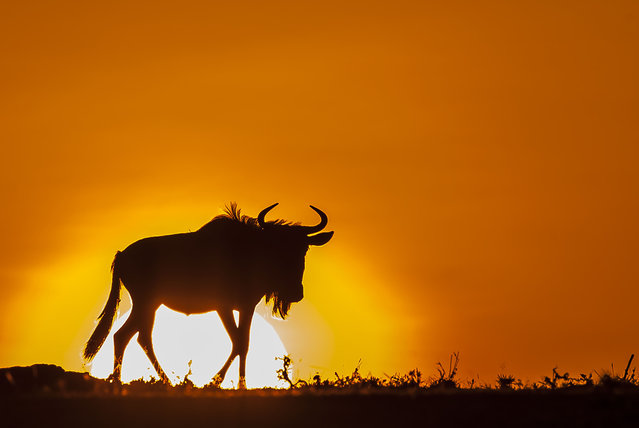
A blue wildebeest moves through grassland at dawn with the sun in the background in Mara Naboisho Conservancy, Kenya, Africa. (Photo by Renato Granieri/Caters News/Ardea)

These images show off some of the world's most majestic creatures silhouetted against the beautiful rising and setting sun. The vibrant pictures feature a variety of animals in the wild and were taken by a host of photographers at locations around the world. The striking images all have one thing in common: the photographers' awe-inspiring ability to perfectly capture the silhouettes of earth's beautiful creatures. Here: a blue wildebeest moves through grassland at dawn with the sun in the background in Mara Naboisho Conservancy, Kenya, Africa. (Photo by Renato Granieri/Caters News/Ardea)
Details
02 Sep 2015 11:12:00
Kawakanih Yawalapiti, 9, Upper Xingu region of Mato Grosso, Brazil, 2018: Kawakanih lives with her tribe, the Yawalapiti, in Xingu national park, a preserve in the Amazon basin of Brazil. The Yawalapiti collect seeds to preserve species unique to their ecosystem, which lies between the rain forest and savannah. Kawakanih’s diet is simple, consisting mainly of fish, cassava, porridge, fruit and nuts. “It takes five minutes to catch dinner”, says Kawakanih. “When you’re hungry, you just go to the river with your net”. (Photo by Gregg Segal/The Guardian)

Photographer Gregg Segal travelled the world to document children and the food they eat in a week. Partly inspired by the increasing problems of childhood obesity, he tracked traditional regional diets as yet unaffected by globalisation, and ironically, found that the healthiest diets were often eaten by the least well off. (Photo by Gregg Segal/The Guardian)
Details
03 Jul 2019 00:03:00


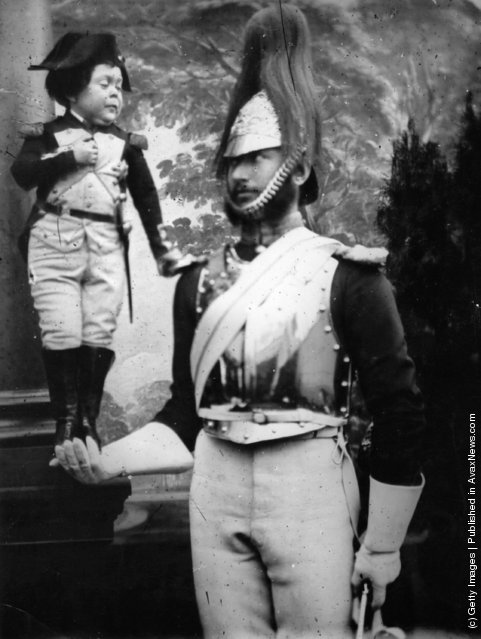
“Tom Thumb is a character of English folklore. The History of Tom Thumb was published in 1621, and has the distinction of being the first fairy tale printed in English. Tom is no bigger than his father's thumb, and his adventures include being swallowed by a cow, tangling with giants, and becoming a favourite of King Arthur. The earliest allusions to Tom occur in various 16th century works such as Reginald Scot's Discovery of Witchcraft (1584) where Tom is cited as one of the supernatural folk employed by servant maids to frighten children”. – Wikipedia

Photo: Portrait of the dwarf, Tom Thumb standing on the hand of a Guardsman. Charles Sherwood Stratton (1838 – 1883) was nicknamed General Tom Thumb by P T Barnum, the circus owner. (Photo by London Stereoscopic Company/Getty Images). Circa 1875
Details
24 Mar 2011 10:16:00


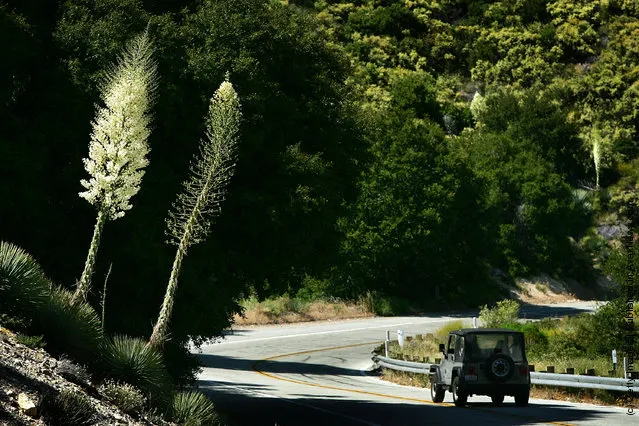
“Yucca is a genus of perennial shrubs and trees in the agave family, Agavaceae. Its 40-50 species are notable for their rosettes of evergreen, tough, sword-shaped leaves and large terminal panicles of white or whitish flowers. They are native to the hot and dry (arid) parts of North America, Central America, South America, and the Caribbean. Early reports of the species were confused with the cassava (Manihot esculenta). Consequently, Linnaeus mistakenly derived the generic name from the Carib word for the latter, yuca. It is also colloquially known in the midwest United States as “Ghosts in the graveyard”, as it is commonly found growing in rural graveyards and when in bloom the flowers appear as an apparition floating.” – Wikipedia

Photo: A yucca standing among flowers bursts forth a very large stalk of flowers as a heavy wildflower bloom on June 21, 2005 in the Angeles National Forest northwest of La Canada, California. (Photo by David McNew/Getty Images)
Details
29 Mar 2011 07:31:00