Loading...
Done
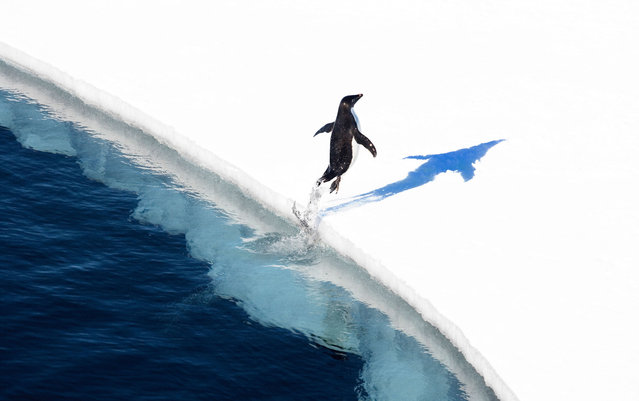
This undated handout photo received from the Antarctic Ocean Alliance on October 28, 2016 shows a adelie penguin jumping onto the ice in the Ross Sea in Antarctica. The world's largest marine reserve aimed at protecting the pristine wilderness of Antarctica will be created after a “momentous” agreement was finally reached on October 28, 2016 with Russia dropping its long-held opposition. A remote and largely pristine stretch of ocean off Antarctica received international protection on Friday, becoming the world's largest marine reserve as a broad coalition of countries came together to protect 598,000 square miles of water. The new marine protected area in the Ross Sea was created by a unanimous decision of the international body that oversees the waters around Antarctica – the Commission for the Conservation of Antarctic Marine Living Resources – and was announced at the commission's annual meeting in Tasmania. The commission comprises 24 countries, including the United States, and the European Union. (Photo by John Weller/AFP Photo/Antarctic Ocean Alliance)

This undated handout photo received from the Antarctic Ocean Alliance on October 28, 2016 shows a adelie penguin jumping onto the ice in the Ross Sea in Antarctica. The world's largest marine reserve aimed at protecting the pristine wilderness of Antarctica will be created after a “momentous” agreement was finally reached on October 28, 2016 with Russia dropping its long-held opposition. (Photo by John Weller/AFP Photo/Antarctic Ocean Alliance)
Details
29 Oct 2016 11:43:00
An employee in protective gears sprays disinfectant at the main exhibition tank at the Sea World at Jaya Ancol Dream Park as it is closed for public in the wake of coronavirus outbreak in Jakarta, Indonesia, Saturday, March 14, 2020. Indonesia's capital city announced a lockdown of all tourist destinations and entertainment spots as well as the closing all of its public schools for the next 14 days amid the global outbreak. For most people, the new coronavirus causes only mild or moderate symptoms. For some it can cause more severe illness. (Photo by Dita Alangkara/AP Photo)

An employee in protective gears sprays disinfectant at the main exhibition tank at the Sea World at Jaya Ancol Dream Park as it is closed for public in the wake of coronavirus outbreak in Jakarta, Indonesia, Saturday, March 14, 2020. Indonesia's capital city announced a lockdown of all tourist destinations and entertainment spots as well as the closing all of its public schools for the next 14 days amid the global outbreak. For most people, the new coronavirus causes only mild or moderate symptoms. For some it can cause more severe illness. (Photo by Dita Alangkara/AP Photo)
Details
18 Apr 2020 00:01:00
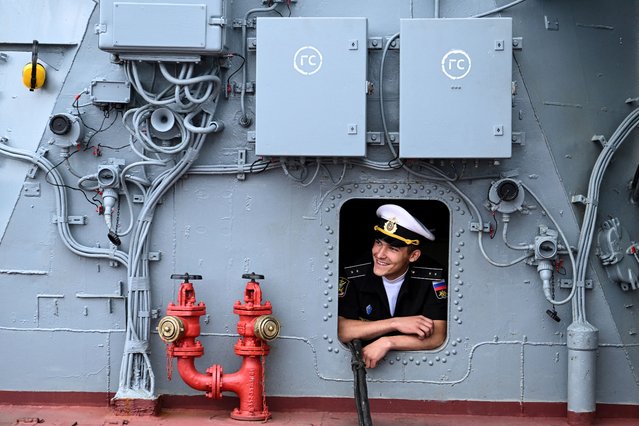
A sailor of the Marshal Shaposhnikov anti-submarine destroyer takes part in the “Vostok-2022” military exercises at the Peter the Great Gulf of the Sea of Japan outside the city of Vladivostok on September 5, 2022. The Vostok 2022 military exercises, involving several Kremlin-friendly countries including China, takes place from September 1-7 across several training grounds in Russia's Far East and in the waters off it. Over 50,000 soldiers and more than 5,000 units of military equipment, including 140 aircraft and 60 ships, are involved in the drills. (Photo by Kirill Kudryavtsev/AFP Photo)

A sailor of the Marshal Shaposhnikov anti-submarine destroyer takes part in the “Vostok-2022” military exercises at the Peter the Great Gulf of the Sea of Japan outside the city of Vladivostok on September 5, 2022. The Vostok 2022 military exercises, involving several Kremlin-friendly countries including China, takes place from September 1-7 across several training grounds in Russia's Far East and in the waters off it. Over 50,000 soldiers and more than 5,000 units of military equipment, including 140 aircraft and 60 ships, are involved in the drills. (Photo by Kirill Kudryavtsev/AFP Photo)
Details
16 Sep 2022 05:09:00
In this handout photo released by Kooperativ Telegram Channel, flames and smoke rise from the scene after a warplane crashed into a residential area in Yeysk, Russia, Monday, October 17, 2022. The Russian military says one of its warplanes has crashed near an apartment building in Yeysk, a port city on the Sea of Azov, after experiencing engine failure on takeoff. The crash ignited a huge fire, killing at least four people, leaving six missing and injuring 21 others, eight of whom were in grave condition. One of the pilots, right, descends on a parachute. (Photo by Kooperativ Telegram Channel via AP Photo)

In this handout photo released by Kooperativ Telegram Channel, flames and smoke rise from the scene after a warplane crashed into a residential area in Yeysk, Russia, Monday, October 17, 2022. The Russian military says one of its warplanes has crashed near an apartment building in Yeysk, a port city on the Sea of Azov, after experiencing engine failure on takeoff. The crash ignited a huge fire, killing at least four people, leaving six missing and injuring 21 others, eight of whom were in grave condition. One of the pilots, right, descends on a parachute. (Photo by Kooperativ Telegram Channel via AP Photo)
Details
26 Oct 2022 05:22:00
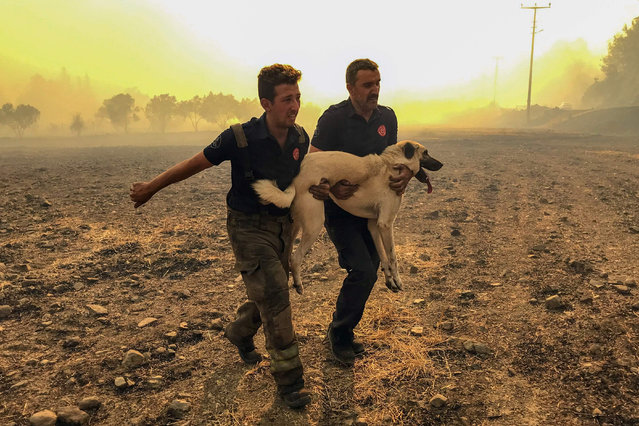
Emergency workers save a shepherd dog from a beach during a forest fire on August 2, 2021 in Mugla, a Marmaris' district, as Turkey struggles against its deadliest wildfires in decades. A roaring blaze raced toward a Turkish thermal power plant and farmers herded panicked cattle toward the sea as wildfires that have killed eight people raged on for a seventh day. The nation of 84 million has been transfixed in horror as the most destructive wildfires in generations erase pristine forests and rich farmland across swaths of Turkey's Mediterranean and Aegean coasts. (Photo by AFP Photo/Stringer)

Emergency workers save a shepherd dog from a beach during a forest fire on August 2, 2021 in Mugla, a Marmaris' district, as Turkey struggles against its deadliest wildfires in decades. A roaring blaze raced toward a Turkish thermal power plant and farmers herded panicked cattle toward the sea as wildfires that have killed eight people raged on for a seventh day. The nation of 84 million has been transfixed in horror as the most destructive wildfires in generations erase pristine forests and rich farmland across swaths of Turkey's Mediterranean and Aegean coasts. (Photo by AFP Photo/Stringer)
Details
05 Aug 2021 08:36:00
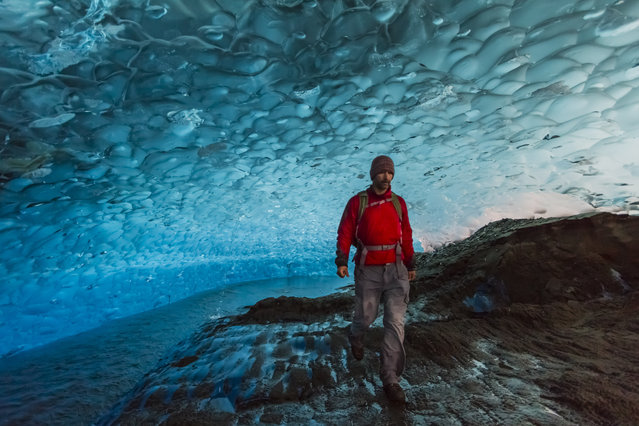
Daniel Fox inside the Mendenhall Glacier, in September 2014, in Juneau, Alaska. Driving in an open-roofed jeep is no longer the fashionable way to see wildlife – as this adventurer shows. (Photo by Daniel Fox/Barcroft Media)

Daniel Fox inside the Mendenhall Glacier, in September 2014, in Juneau, Alaska. Driving in an open-roofed jeep is no longer the fashionable way to see wildlife – as this adventurer shows. A keen wildlife photographer has circled islands in the south of Alaska, the United States, in a kayak to see spectacular scenery and animals. Daniel Fox, 40, from San Francisco spent three months travelling around the islands by kayak, meeting sea lions and brown bears along the way. (Photo by Daniel Fox/Barcroft Media)
Details
14 Sep 2014 10:46:00
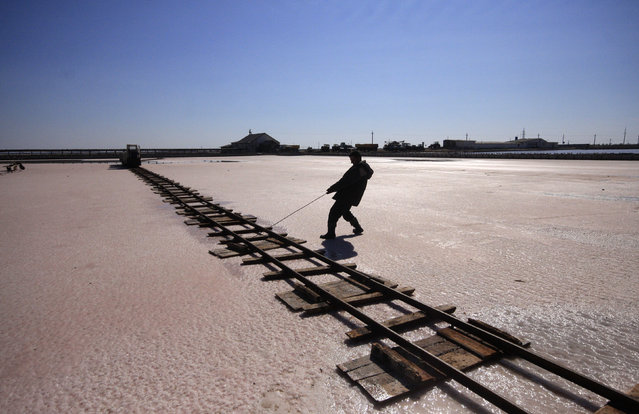
A worker lays rails across the bed of a drained area of a lake used for the production of salt at the Sasyk-Sivash lake near the city of Yevpatoria in Crimea, October 5, 2014. (Photo by Pavel Rebrov/Reuters)

A worker lays rails across the bed of a drained area of a lake used for the production of salt at the Sasyk-Sivash lake near the city of Yevpatoria in Crimea, October 5, 2014. The area has a long tradition of salt production, prepared from salt flats flooded with water from the Black Sea. (Photo by Pavel Rebrov/Reuters)
Details
07 Oct 2014 11:24:00
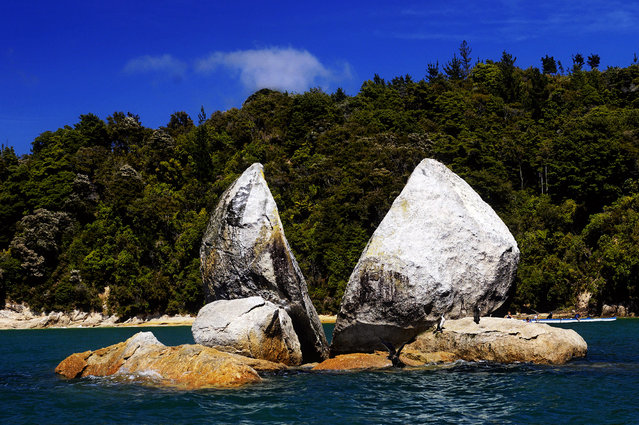
Split Apple Rock

Split Apple Rock is a geological rock formation in The Tasman Bay off the northern coast of the South Island of New Zealand. Made of granite, it is in the shape of an apple which has been cut in half. It is a popular tourist attraction in the waters of the Tasman Sea approximately 50 metres off the coast between Kaiteriteri and Marahau. The rock sits in shallow water at low tide and is accessible by wading. It is also a point of interest for the many tourist boats and pleasure craft which operate along the shores of the Abel Tasman National Park. The cleft to produce two sides of the 'apple' was a natural occurrence. It is unknown when this happened and therefore the cleaving of the rock has attracted mythological explanations.
Details
19 Oct 2013 10:58:00