Loading...
Done
This image is NGC 6543 known as the Cat's Eye Nebula as it appears to the Chandra X-Ray Observatory and Hubble Telescope. A planetary nebula is a phase of stellar evolution that the sun should experience several billion years from now, when it expands to become a red giant and then sheds most of its outer layers, leaving behind a hot core that contracts to form a dense white dwarf star. This image was released October 10, 2012. (Photo by J. Kastner/NASA/CXC/RIT)

This image is NGC 6543 known as the Cat's Eye Nebula as it appears to the Chandra X-Ray Observatory and Hubble Telescope. A planetary nebula is a phase of stellar evolution that the sun should experience several billion years from now, when it expands to become a red giant and then sheds most of its outer layers, leaving behind a hot core that contracts to form a dense white dwarf star. This image was released October 10, 2012. (Photo by J. Kastner/NASA/CXC/RIT)
Details
15 Apr 2013 10:09:00
The spinning vortex of Saturn's north polar storm resembles a deep red rose of giant proportions surrounded by green foliage in this false-color image from NASA's Cassini spacecraft. (Photo by NASA/JPL-Caltech/SSI)

NASA's Cassini spacecraft has provided scientists the first close-up, visible-light views of a behemoth hurricane swirling around Saturn's north pole. In high-resolution pictures and video, scientists see the hurricane's eye is about 1,250 miles (2,000 kilometers) wide, 20 times larger than the average hurricane eye on Earth. Thin, bright clouds at the outer edge of the hurricane are traveling 330 mph(150 meters per second). The hurricane swirls inside a large, mysterious, six-sided weather pattern known as the hexagon. Photo: The spinning vortex of Saturn's north polar storm resembles a deep red rose of giant proportions surrounded by green foliage in this false-color image from NASA's Cassini spacecraft. (Photo by NASA/JPL-Caltech/SSI)
Details
31 May 2015 09:11:00
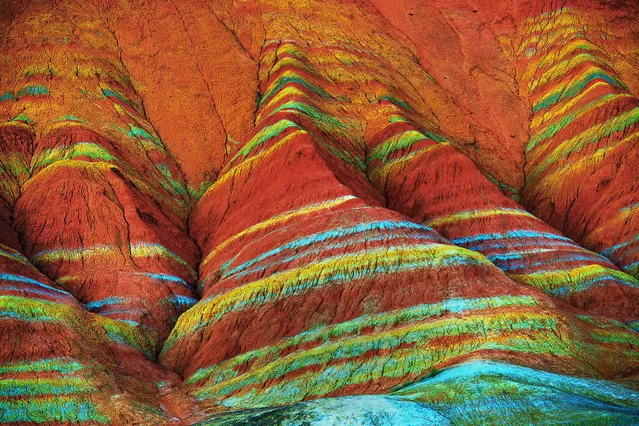
View of colourful rock formations at the Zhangye Danxia Landform Geological Park in Gansu Province, China. The Zhangye Danxia Landform Geological Park is 40km from Zhangye city. The park spans more than 400 square kilometers in Gansu. The unusual terrain is the result of red sandstone and mineral deposits carved over the years by natural forces. A number of boardwalks have been built to encourage visitors to explore the rock formations. (Photo by ImagineChina/The Grosby Group)

View of colourful rock formations at the Zhangye Danxia Landform Geological Park in Gansu Province, China. The Zhangye Danxia Landform Geological Park is 40km from Zhangye city. The park spans more than 400 square kilometers in Gansu. The unusual terrain is the result of red sandstone and mineral deposits carved over the years by natural forces. (Photo by ImagineChina/The Grosby Group)
Details
02 Dec 2013 09:12:00
Revellers hit the town on Saturday, February 19, 2022 for a pub crawl despite the snow in Leeds, United Kingdom. The UK capital was placed under its first ever “red” weather warning, meaning there is “danger to life”. The same level of alert was in place across southern England and South Wales, where schools were closed and transport paralysed. (Photo by Nb press ltd)

Revellers hit the town on Saturday, February 19, 2022 for a pub crawl despite the snow in Leeds, United Kingdom. The UK capital was placed under its first ever “red” weather warning, meaning there is “danger to life”. The same level of alert was in place across southern England and South Wales, where schools were closed and transport paralysed. (Photo by Nb press ltd)
Details
26 Apr 2023 03:11:00
Pinot noir vineyards in the famed Sta. Rita Hills AVA turn a vivid red, orange, and yellow, signaling the end of the grape harvest and approach of winter as viewed on November 26, 2023, near Buellton, California. Following the notoriety from the Academy Award-winning film Sideways, this buccolic farming region north of Santa Barbara has become a popular Wine Country stop for global and domestic tourists traveling between San Francisco and Los Angeles. (Photo by George Rose/Getty Images)

Pinot noir vineyards in the famed Sta. Rita Hills AVA turn a vivid red, orange, and yellow, signaling the end of the grape harvest and approach of winter as viewed on November 26, 2023, near Buellton, California. Following the notoriety from the Academy Award-winning film Sideways, this buccolic farming region north of Santa Barbara has become a popular Wine Country stop for global and domestic tourists traveling between San Francisco and Los Angeles. (Photo by George Rose/Getty Images)
Details
01 Feb 2025 03:30:00


A deer forages for food in the early morning sun as cooler temperatures bring on the autumn season at Dunham Massey on on October 11, 2010 in Lymm, England. Shortening daylight hours and cooler weather brings on the rutting season for Red and Fallow deer herds and Autumn foliage colours across Britain. (Photo by Christopher Furlong/Getty Images)
Details
02 Jul 2011 13:25:00
Autumn Deer

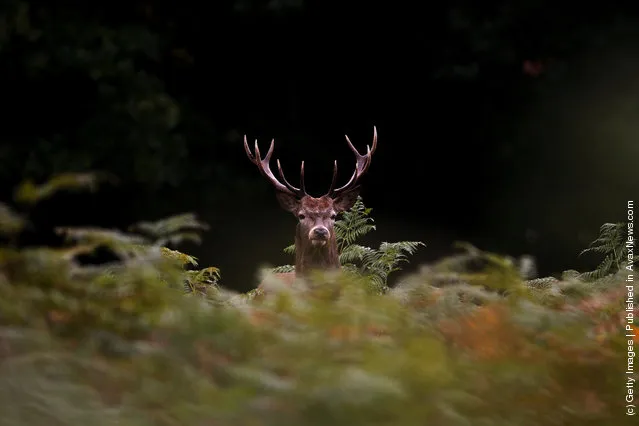
A red deer stag watches from the cover of a bracken thicket during the autumn rutting season at Richmond Park on October 10, 2011 in London, England. Autumn sees the start of the “Rutting” season where the stags and bucks bellow in an attempt to attract female does and hinds. (Photo by Dan Istitene/Getty Images)
Details
11 Oct 2011 07:19:00
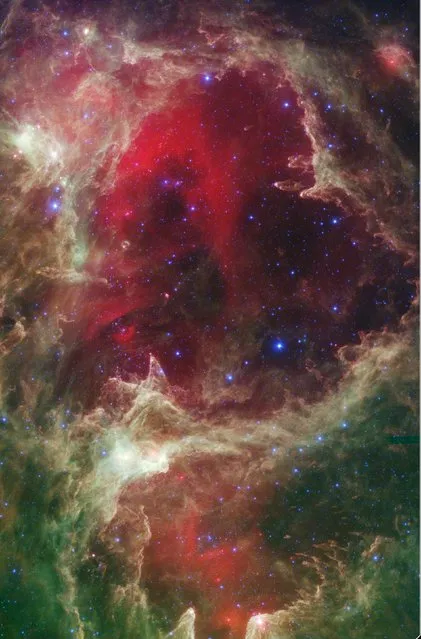
An infrared portrait from NASA's Spitzer Space Telescope which shows generations of stars is seen in this undated NASA handout image released February 14, 2013. In this wispy star-forming region, called W5, the oldest stars can be seen as blue dots in the centers of the two hollow cavities (other blue dots are background and foreground stars not associated with the region). Red shows heated dust that pervades the region's cavities, while green highlights dense clouds. (Photo by NASA/Reuters/JPL-Caltech/Harvard-Smithsonian/Handout)

An infrared portrait from NASA's Spitzer Space Telescope which shows generations of stars is seen in this undated NASA handout image released February 14, 2013. In this wispy star-forming region, called W5, the oldest stars can be seen as blue dots in the centers of the two hollow cavities (other blue dots are background and foreground stars not associated with the region). Red shows heated dust that pervades the region's cavities, while green highlights dense clouds. (Photo by NASA/Reuters/JPL-Caltech/Harvard-Smithsonian/Handout)
Details
03 Mar 2013 08:44:00