Loading...
Done
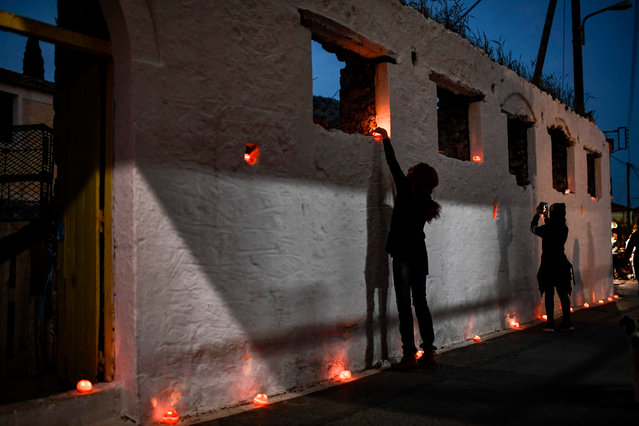
People decorate a street with candles inside oranges during the Epitaph ceremony during Good Friday's “Apokathelosis”, the Descent of Christ's dead body from the Cross, which forms a key part of Orthodox Easter, in the southern city of Leonidio, at the Peloponnese peninsula on April 26, 2019. Millions of Greeks flock to churches around the country this week to celebrate Easter, the country's foremost religious celebration. (Photo by Aris Messinis/AFP Photo)

People decorate a street with candles inside oranges during the Epitaph ceremony during Good Friday's “Apokathelosis”, the Descent of Christ's dead body from the Cross, which forms a key part of Orthodox Easter, in the southern city of Leonidio, at the Peloponnese peninsula on April 26, 2019. Millions of Greeks flock to churches around the country this week to celebrate Easter, the country's foremost religious celebration. (Photo by Aris Messinis/AFP Photo)
Details
15 May 2019 00:05:00
A history enthusiast, dressed as a soldier, marches before the re-enactment of Napoleon's famous battle of Austerlitz near the southern Moravian town of Slavkov u Brna, Czech Republic December 3, 2016. (Photo by David W. Cerny/Reuters)

A history enthusiast, dressed as a soldier, marches before the re-enactment of Napoleon's famous battle of Austerlitz near the southern Moravian town of Slavkov u Brna, Czech Republic December 3, 2016. (Photo by David W. Cerny/Reuters)
Details
04 Dec 2016 10:10:00
Members of the LSU Golden Girls dance team sit spaced apart wearing masks, under COVID-19 restrictions, requiring social distancing and masks, before an NCAA college football game between the LSU and the Mississippi State in Baton Rouge, La., Saturday, September 26, 2020. (Photo by Gerald Herbert/AP Photo)

Members of the LSU Golden Girls dance team sit spaced apart wearing masks, under COVID-19 restrictions, requiring social distancing and masks, before an NCAA college football game between the LSU and the Mississippi State in Baton Rouge, La., Saturday, September 26, 2020. (Photo by Gerald Herbert/AP Photo)
Details
28 Sep 2020 00:03:00
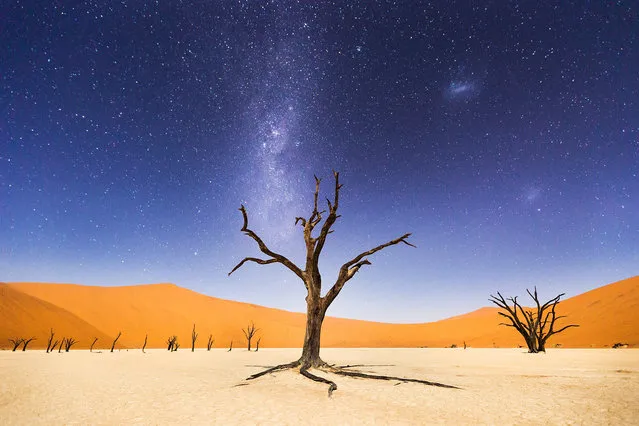
Merit: A Night at Deadvlei. The night before returning to Windhoek, we spent several hours at Deadveli. The moon was bright enough to illuminate the sand dunes in the distance, but the skies were still dark enough to clearly see the milky way and magellanic clouds. Deadveli means “dead marsh. (Photo and caption by Beth McCarley/National Geographic Traveler Photo Contest)

Merit: A Night at Deadvlei. The night before returning to Windhoek, we spent several hours at Deadveli. The moon was bright enough to illuminate the sand dunes in the distance, but the skies were still dark enough to clearly see the milky way and magellanic clouds. Deadveli means “dead marsh. The camelthorn trees are believed to be about 900 years old, but have not decomposed because the environment is so dry. (Photo and caption by Beth McCarley/National Geographic Traveler Photo Contest)
Details
04 Aug 2015 11:50:00
England goalkeeper Mary Earps saves a penalty from Jennifer Hermoso of Spain during the FIFA Women's World Cup Australia & New Zealand 2023 Final match between Spain and England at Stadium Australia on August 20, 2023 in Sydney, Australia. (Photo by Charlotte Wilson/Offside/Offside via Getty Images)

England goalkeeper Mary Earps saves a penalty from Jennifer Hermoso of Spain during the FIFA Women's World Cup Australia & New Zealand 2023 Final match between Spain and England at Stadium Australia on August 20, 2023 in Sydney, Australia. (Photo by Charlotte Wilson/Offside/Offside via Getty Images)
Details
15 Dec 2025 06:33:00
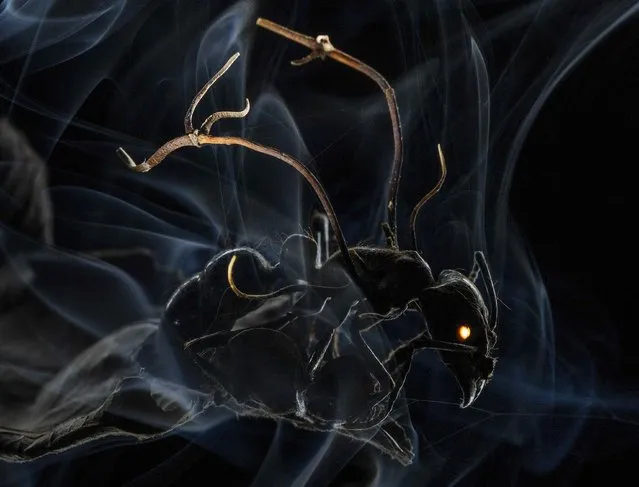
Anand Varma, a U.S. photographer working for the National Geographic, won the First Prize in the Nature Category, Stories, of the 2015 World Press Photo contest with his series of pictures, which includes this one of spores of a fungus landing on an ant, penetrating its exoskeleton and entering its brain, compelling the host to leave its normal habitat on the forest floor and scale a nearby tree, in this picture taken January 22, 2014 and released by the World Press Photo on February 12, 2015. (Photo by Anand Varma/Reuters/National Geographic/World Press Photo)

Anand Varma, a U.S. photographer working for the National Geographic, won the First Prize in the Nature Category, Stories, of the 2015 World Press Photo contest with his series of pictures, which includes this one of spores of a fungus landing on an ant, penetrating its exoskeleton and entering its brain, compelling the host to leave its normal habitat on the forest floor and scale a nearby tree, in this picture taken January 22, 2014 and released by the World Press Photo on February 12, 2015. (Photo by Anand Varma/Reuters/National Geographic/World Press Photo)
Details
15 Feb 2015 15:21:00
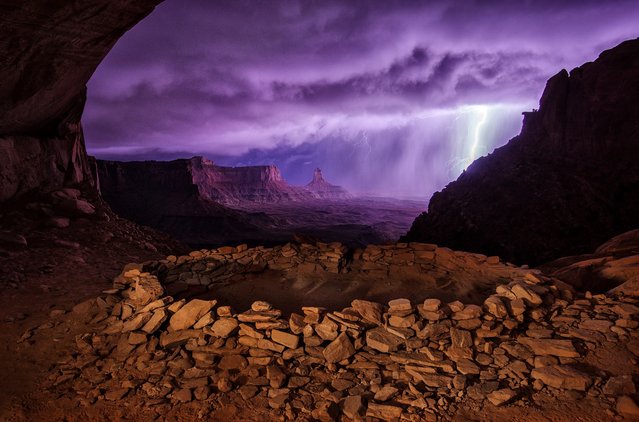
Second Place Winner: “Thunderstorm at False Kiva”. I hiked out to these ruins at night hoping to photograph them with the Milky Way, but instead a thunderstorm rolled through, creating this dramatic image. – Max Seigal. (Photo and caption by Max Seigal/National Geographic Traveler Photo Contest)

Second Place Winner: “Thunderstorm at False Kiva”. I hiked out to these ruins at night hoping to photograph them with the Milky Way, but instead a thunderstorm rolled through, creating this dramatic image. – Max Seigal. National Geographic Traveler Director of Photography Dan Westergren, one of this year's judges, shares his thoughts on the second place winner: “This photo combines two different scenes into one: the small kiva in a cliff dwelling and the grand vista of Canyonlands National Park across the valley. I really like the two different color palettes – warm inside and purple outside. This two-for-one scene was caused by the lightning storm outside the dwelling, which lit up the landscape like it was a huge electronic flash. Looking at this picture I can imagine what a wonderful sight it must have been for the ancient people who lived here. It doesn't seem too amazing now in our modern world, but might have been mind-blowing for the prehistoric residents”. Location: Utah. (Photo and caption by Max Seigal/National Geographic Traveler Photo Contest)
Details
02 Aug 2013 06:16:00
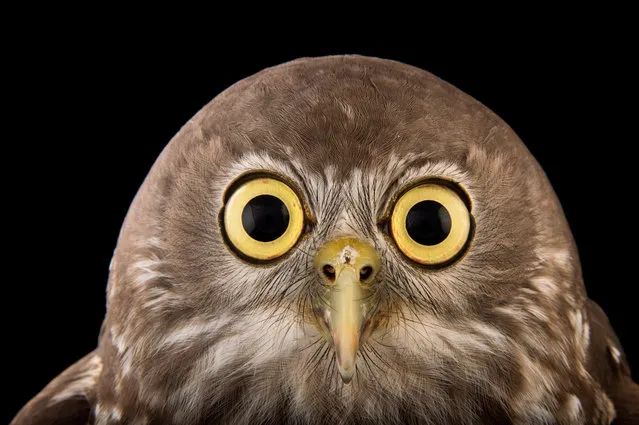
The National Geographic Photo Ark is a travelling exhibition of photographer Joel Sartore’s quest to create a photo archive of biodiversity around the world. So far, Sartore has captured studio portraits of more than 6,000 species – a number that he hopes to double. On 1 July, the ark will open at Melbourne zoo – the first time it has been exhibited in the southern hemisphere. More than 50 portraits will be on display, including many of Australian endangered animals being protected by programs at the zoo itself. These captions have been edited from text supplied by Melbourne zoo. Here: Barking owl. So-named because its call sounds like a barking dog, these birds are native to Australia, Indonesia and Papua New Guinea. In Victoria they are listed as an endangered species, and in 2003 there were estimated to be fewer than 50 breeding pairs. The main threat to the species in Victoria is loss of habitat, especially large trees with hollows in which they can nest and on which many of their prey depend. Apart from a bark, they may utter a chilling scream when they feel threatened. (Photo by Joel Sartore/National Geographic Photo Ark/The Guardian)

The National Geographic Photo Ark is a travelling exhibition of photographer Joel Sartore’s quest to create a photo archive of biodiversity around the world. So far, Sartore has captured studio portraits of more than 6,000 species – a number that he hopes to double. On 1 July, the ark will open at Melbourne zoo – the first time it has been exhibited in the southern hemisphere. More than 50 portraits will be on display, including many of Australian endangered animals being protected by programs at the zoo itself. These captions have been edited from text supplied by Melbourne zoo. Here: Barking owl. (Photo by Joel Sartore/National Geographic Photo Ark/The Guardian)
Details
01 Jul 2017 07:45:00