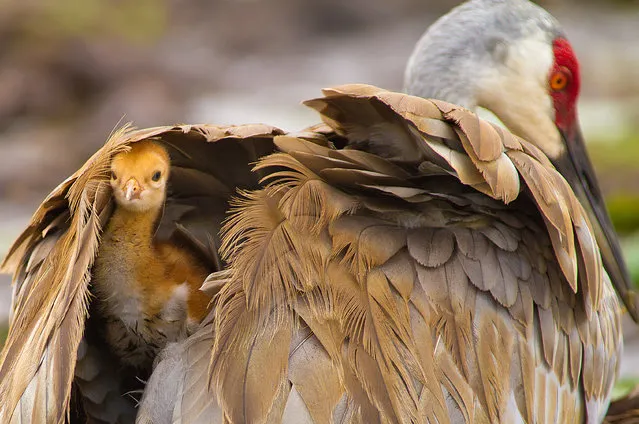
“Hiding In The Shadows”. This Baby Sandhill taking refuge under Moms wings while sitting on her second egg. I witnessed this baby being born earlier that day,and the next morning saw the other one hatch,what a sight to see. Photo location: Deland, Florida. (Photo and caption by Scott Helfrich/National Geographic Photo Contest)
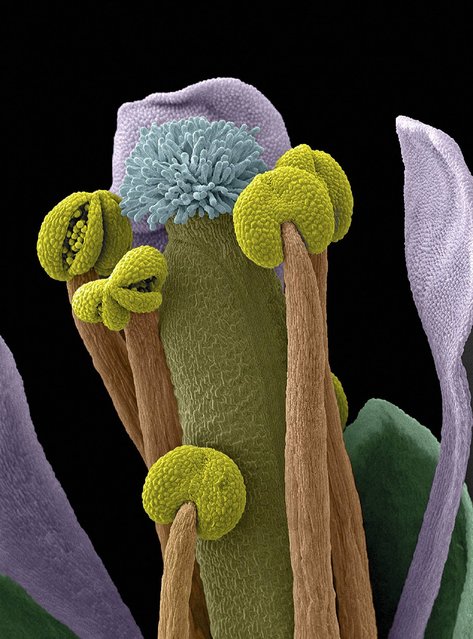
Beautiful, strange and occasionally alarming pictures from the shortlist for this year’s Wellcome image awards – which celebrate the very best in science photography and imaging – from an x-ray of a bat to a micrograph of a kidney stone. The exhibition opens on 12 March at three science centres and the Museum of Science and Industry in Manchester. Photo: Scanning electron micrograph (SEM) of an Arabidopsis thaliana flower, also commonly known as thale cress. Some of the anthers are open, revealing pollen grains ready for dispersal. Arabidopsis was the first plant to have its entire genome sequenced and is widely used as a model organism in molecular and plant biology. Horizontal width of image is 1200 microns. Magnification 100x. (Photo by Stefan Eberhard/Wellcome Images)
In this May 8, 2015 photo, sisters Zoraida Infante, left, and Graciela Trujillo pray on Fishermen's Beach before therapeutic swimming in the Pacific Ocean in Lima, Peru. Under overcast skies, the bathers practice thalassotherapy, which derives from the Greek “thalasso”, for “sea”, and draws on the ocean's healing properties. (Photo by Rodrigo Abd/AP Photo)
Revelers march in the Lower Ninth Ward during a second line parade marking the 10th anniversary of Hurricane Katrina on August 29, 2015 in New Orleans, Louisiana. (Photo by Mario Tama/Getty Images)
Brazilian Marcelo Medeiros of Yamaha team in an accident during the fifith stage of the Rally Dakar 2016 between Jujuy, Argentina, and Uyuni, Bolivia, 07 January 2016. (Photo by Felipe Trueba/EPA)
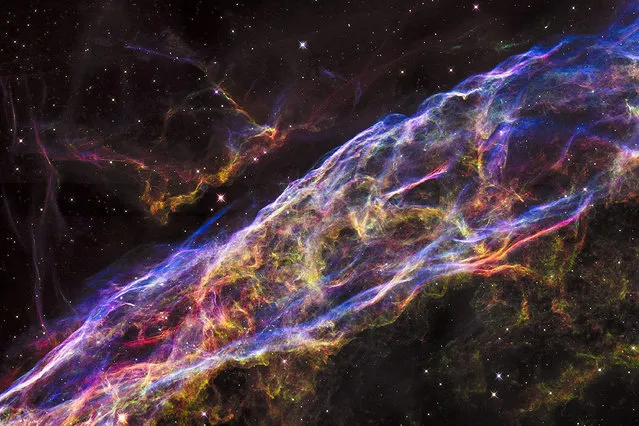
A small section of the expanding remains of the Veil Nebula, a massive star that exploded about 8,000 years ago. The entire nebula is 110 light-years across, covering six full moons on the sky as seen from Earth, and resides about 2,100 light-years away in the constellation Cygnus, the Swan. (Photo by Reuters/NASA/ESA/Hubble)