Loading...
Done
“Locusts & Men”. Oppression, interaction, collaboration. In the life cycle of nature nothing is lost, but the coexistence of different species is sometimes difficult. In Madagascar periodically returns the archaic antagonism between man and the migratory locust, in a circle of life where the two species are looking for space and food for their survival. Photo location: Madagascar, 2013. (Photo and caption by Michele Martinelli/National Geographic Photo Contest)

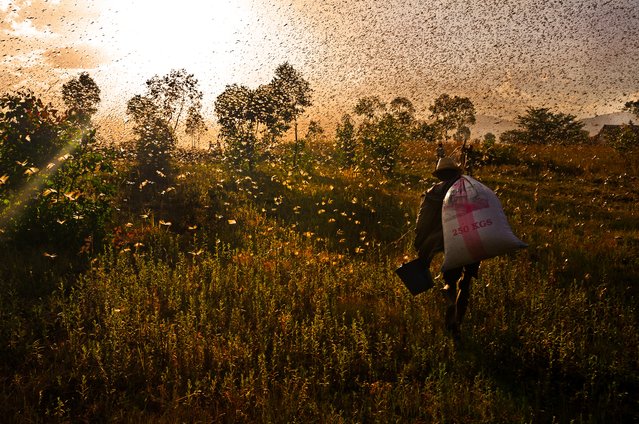
“Locusts & Men”. Oppression, interaction, collaboration. In the life cycle of nature nothing is lost, but the coexistence of different species is sometimes difficult. In Madagascar periodically returns the archaic antagonism between man and the migratory locust, in a circle of life where the two species are looking for space and food for their survival. At the end of the day a man walks home carrying on his shoulders the heavy bag which contains the locusts captured during the day. The insects provide nutritious meals for the man and his family. Photo location: Madagascar, 2013. (Photo and caption by Michele Martinelli/National Geographic Photo Contest)

ATTENTION! All pictures are presented in high resolution. To see Hi-Res images – just TWICE click on any picture. In other words, click small picture – opens the BIG picture. Click BIG picture – opens VERY BIG picture.
Details
03 Dec 2013 10:59:00
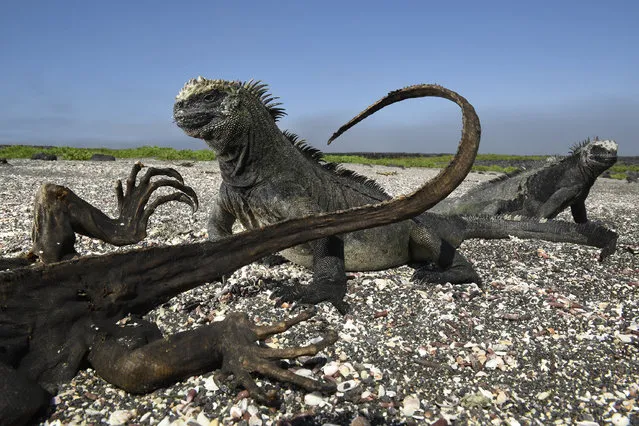
Galapagos – Rocking the Cradle: Four major ocean currents converge along the Galapagos archipelago, creating the conditions for an extraordinary diversity of animal life, April 25, 2016. The islands are home to at least 7,000 flora and fauna species, of which 97 percent of the reptiles, 80 percent of the land birds, 50 percent of the insects and 30 percent of the plants are endemic. The local ecosystem is highly sensitive to the changes in temperature, rainfall and ocean currents that characterize the climatic events known as El Niño and La Niña. These changes cause marked fluctuations in weather and food availability. Many scientists expect the frequency of El Niño and La Niña to increase as a result of climate change, making the Galapagos a possible early-warning location for its effects. (Photo by Thomas P. Peschak for National Geographic/World Press Photo)

Galapagos – Rocking the Cradle: Four major ocean currents converge along the Galapagos archipelago, creating the conditions for an extraordinary diversity of animal life, April 25, 2016. The islands are home to at least 7,000 flora and fauna species, of which 97 percent of the reptiles, 80 percent of the land birds, 50 percent of the insects and 30 percent of the plants are endemic. (Photo by Thomas P. Peschak for National Geographic/World Press Photo)
Details
16 Apr 2018 00:01:00
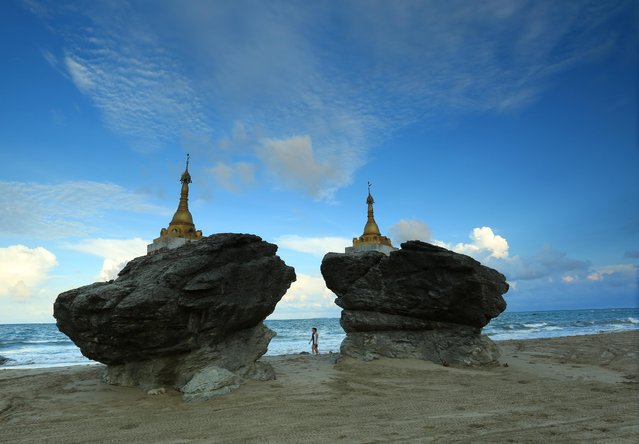
In this May 17, 2015, photo, two men walk past pagodas at Ngwe Saung beach, Pathein township, about 145 miles from Yangon, Myanmar. (Photo by Khin Maung Win/AP Photo)

In this May 17, 2015, photo, two men walk past pagodas at Ngwe Saung beach, Pathein township, about 145 miles from Yangon, Myanmar. (Photo by Khin Maung Win/AP Photo)
Details
22 May 2015 12:10:00
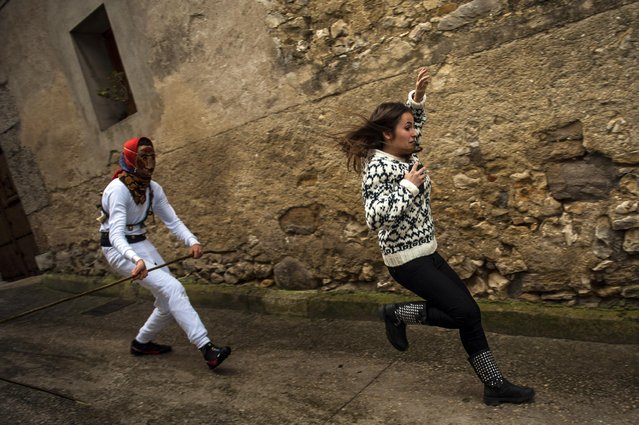
In this photo taken on Sunday, February 15, 2015 a girl runs away from a “Mamuxarro” during the carnival, in the small town of Unanu, northern Spain. While Rio de Janeiro may boast the world’s most famous carnival, the festive period of masquerades and wild and colorful costumes that precedes the Christian religious season of Lent is also a permanent and popular fixture for celebration in Spain and Portugal, with each country having its own strange and unique way of doing it. (Photo by Alvaro Barrientos/AP Photo)

In this photo taken on Sunday, February 15, 2015 a girl runs away from a “Mamuxarro” during the carnival, in the small town of Unanu, northern Spain. In the northern Spanish ancient village of Unamu, people dress up as “Mamuxarro”, folkloric figures in white with a red sash and a metal mask to cover their faces as they pursue townsfolk with sticks. According to custom, their “victims” (usually young women) must kneel and kiss the mamuxarro’s knee after he makes the sign of the cross on their forehead. (Photo by Alvaro Barrientos/AP Photo)
Details
22 Feb 2015 10:51:00
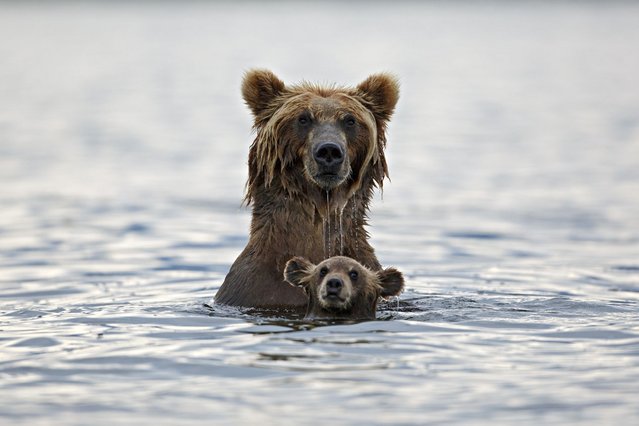
These little grizzly bear cubs had fun making a real splash when their mum took them for a dip to learn how to fish. Kamchatka, Russia. (Photo by Marco Mattiussi/Solent News & Photo Agency)

These little grizzly bear cubs had fun making a real splash when their mum took them for a dip to learn how to fish. Kamchatka, Russia. (Photo by Marco Mattiussi/Solent News & Photo Agency)
Details
11 Jan 2014 13:24:00
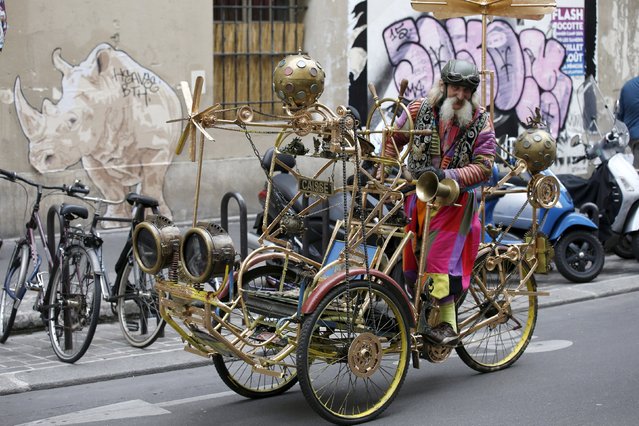
French artist Gino rides the “Celestial Cyclo” tricycle built by him in Le Marais neighbourhood in Paris, France, August 15, 2015. (Photo by Pascal Rossignol/Reuters)

French artist Gino rides the “Celestial Cyclo” tricycle built by him in Le Marais neighbourhood in Paris, France, August 15, 2015. (Photo by Pascal Rossignol/Reuters)
Details
16 Aug 2015 13:57:00
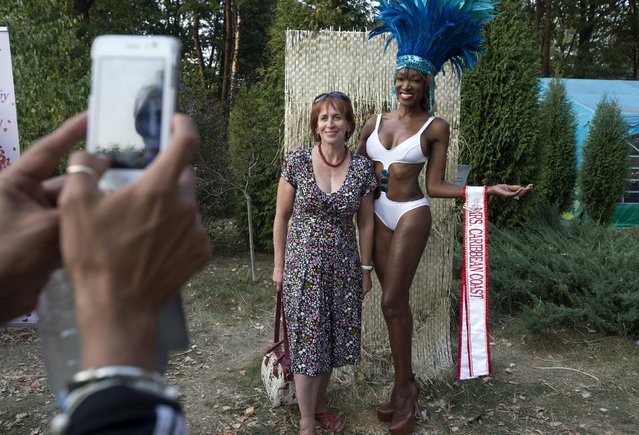
A participant of the “Mrs Universe 2015” contest from Caribbean Coast, Mayra Joli poses for a photo with a woman during their visit in central botanical garden in Minsk, Belarus, August 25, 2015. (Photo by Vasily Fedosenko/Reuters)

A participant of the “Mrs Universe 2015” contest from Caribbean Coast, Mayra Joli poses for a photo with a woman during their visit in central botanical garden in Minsk, Belarus, August 25, 2015. (Photo by Vasily Fedosenko/Reuters)
Details
26 Aug 2015 10:35:00
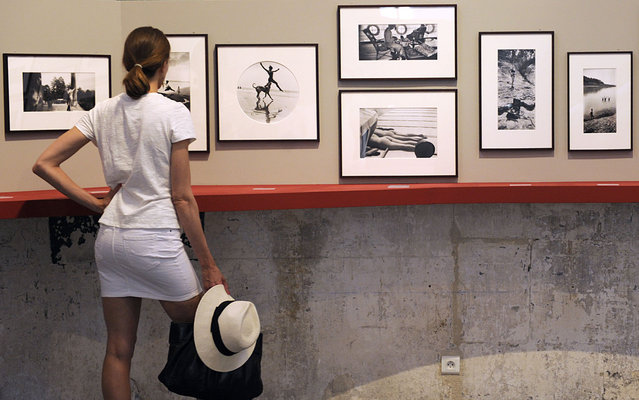
A visitor looks at pictures of French photographer Jacques-Henri Lartigue (1894-1986), on July 1, 2013 during the 44thd annual Rencontres d'Arles photography festival in Arles, southern France. The event runs until September 22. (Photo by Boris Horvat/AFP Photo)

A visitor looks at pictures of French photographer Jacques-Henri Lartigue (1894-1986), on July 1, 2013 during the 44thd annual Rencontres d'Arles photography festival in Arles, southern France. The event runs until September 22. (Photo by Boris Horvat/AFP Photo)
Details
06 Jul 2013 11:34:00