Loading...
Done
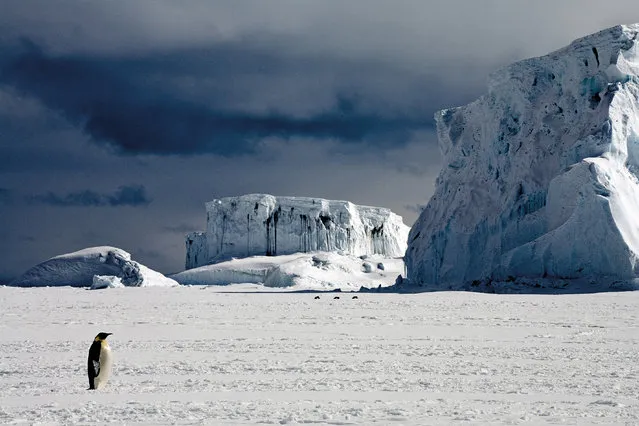
Image from Camille Seamans new book, “Melting Away”. (Photo by Camille Seaman/Barcroft Media)

Documenting the effects of climate change first hand over the past eight years, Camille Seaman fears we may be on the road to the last iceberg. Photographing the enormous frozen floats at both poles for the past eight years, the Californian adventurer has seen the receding ice shelves and experienced the changing warmer weather. Feeling that her intimate and emotional work documents a snapshot of history, Camille presents her series “The Last Iceberg” as a study of what she sees as the personality of each huge iceberg. Drawing parallels with the famous novel, “The Last of the Mohicans”, Camille, 42, wonders whether these unique, almost alien natural features will become a thing of the past or part of nature's renewal process. (Photo by Camille Seaman/Barcroft Media)
Details
02 Dec 2014 12:10:00
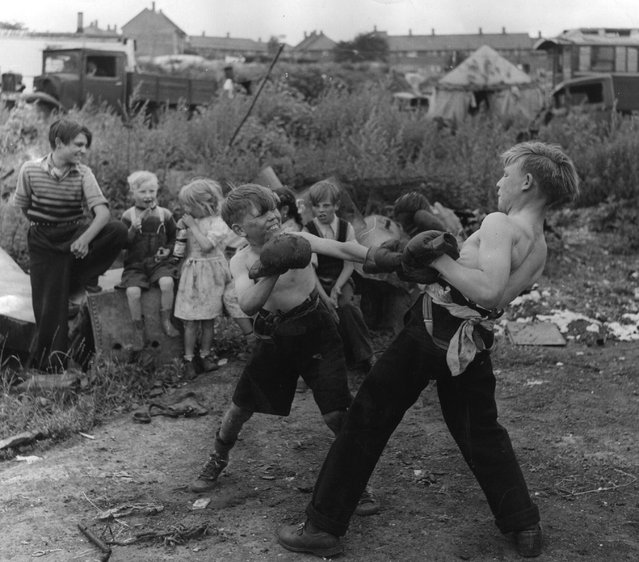
The unromantic gypsies. Children boxing in a gypsy camp in Kent, England on July 1, 1951. Like all boys these gypsy lads like to try their hand at boxing. Encouraged by their friends they fight it out on Corke's Meadow. Few Romanies now live a life of wandering romance. Most are like the three hundred squatters of Corke's Meadow, Kent, which is part of a “gypsy problem” that involves about 100,000 today. Of those about 25,000 can be rightly called gypsies, the rest are Mumpers and Posh-rats and Hobos. Corke's Meadow has both kinds. “Picture Post” cameraman Bert Hardy photographs the Corke's Meadow gypsies in their encampment. (Photo by Hulton-Deutsch Collection/Corbis via Getty Images)

The unromantic gypsies. Children boxing in a gypsy camp in Kent, England on July 1, 1951. Like all boys these gypsy lads like to try their hand at boxing. Encouraged by their friends they fight it out on Corke's Meadow. Few Romanies now live a life of wandering romance. Most are like the three hundred squatters of Corke's Meadow, Kent, which is part of a “gypsy problem” that involves about 100,000 today. Of those about 25,000 can be rightly called gypsies, the rest are Mumpers and Posh-rats and Hobos. Corke's Meadow has both kinds. “Picture Post” cameraman Bert Hardy photographs the Corke's Meadow gypsies in their encampment. (Photo by Hulton-Deutsch Collection/Corbis via Getty Images)
Details
12 Mar 2017 00:01:00
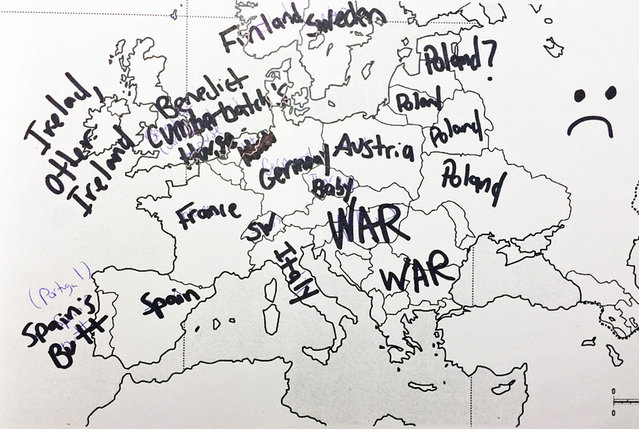
Americans Try To Place European Countries On A Map Part 1

How sure are you of your geographical knowledge? Buzzfeed recently put Americans’ geographical knowledge to the test with a survey in which participants had to write in countries’ names on a blank European political map. Unfortunately, they didn’t fare too well, but some of their responses are hilarious (or hilariously mis-informed). But don’t be so quick to judge Americans – when Buzzfeed posted a similar survey testing Brits’ knowledge of the 50 United States, they also came up short. On the one hand, knowing a country’s states is different from knowing independent countries, but on the other, some U.S. states are larger than some European nations, and some U.S. states have larger economies than some European nations.
Details
02 Dec 2013 11:24:00


“The Greek Civil War was fought from 1945 to 1949 between the Greek governmental army, backed by the United Kingdom and United States, and the Democratic Army of Greece (ΔΣΕ) (Greek initials DSE), the military branch of the Greek Communist Party (KKE), backed by Bulgaria, Yugoslavia and Albania. It was the result of a highly polarized struggle between leftists and rightists which started in 1943 and targeted the power vacuum that the German-Italian occupation during World War II had created. One of the first conflicts of the Cold War, according to some analysts it represents the first example of a postwar Western interference in the internal politics of a foreign country, and for others, marked the first serious test of the theory of the so-called Churchill-Stalin percentages agreement. The first signs of the civil war occurred in 1942–1944, during the Occupation”. – Wikipedia

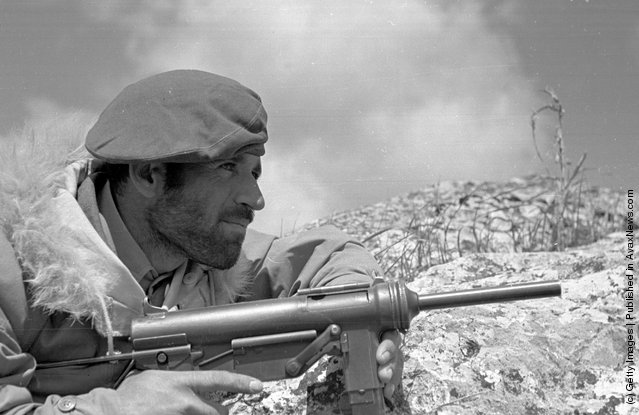
Photo: A Greek commando soldier, wearing a fur-collared jacket supplied by the Americans, waits for a guerrilla target to emerge during the Greek Civil War. (Photo by Bert Hardy/Picture Post/Getty Images). 22nd May 1948
Details
15 Aug 2013 15:47:00
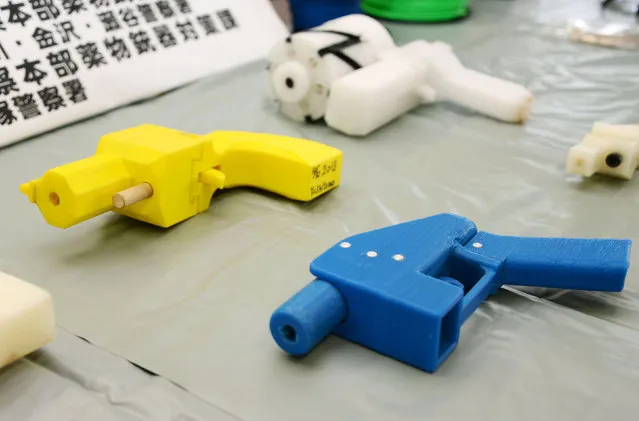
Seized plastic handguns which were created using 3D printing technology are displayed at Kanagawa police station in Yokohama, south of Tokyo, in this photo taken by Kyodo May 8, 2014. (Photo by Reuters/Kyodo)

Seized plastic handguns which were created using 3D printing technology are displayed at Kanagawa police station in Yokohama, south of Tokyo, in this photo taken by Kyodo May 8, 2014. Yoshimoto Imura became the first man to be arrested in Japan for illegal possession of two guns he created himself using 3D printing technology, Japanese media said on Thursday. The 27-year-old, a college employee in the city of Kawasaki, was arrested after police found video online posted by Imura claiming to have produced his own guns. Gun possession is strictly regulated in Japan. Police raided Imura's home and found five guns, two of which could fire real bullets, Japanese media said. (Photo by Reuters/Kyodo)
Details
12 May 2014 10:46:00
Mario Huettenhofer, chief of the German company 3D Fab, presents his own face as 3d print during the international fairs FabCon 3.D and Rapid.Tech in Erfurt, Germany, Thursday, May 15, 2014. 130 exhibitors from all over the world present the entire world of 3D printing. (Photo by Jens Meyer/AP Photo)

Mario Huettenhofer, chief of the German company 3D Fab, presents his own face as 3d print during the international fairs FabCon 3.D and Rapid.Tech in Erfurt, Germany, Thursday, May 15, 2014. 130 exhibitors from all over the world present the entire world of 3D printing. The trade fairs are accompanied by specialist programs featuring 80 scientists, practitioners and trend analysts from ten countries, who will explain the latest findings, trends and applications for additive processes in industry and for 3D printing in the private sector to newcomers, experts and consumers alike. (Photo by Jens Meyer/AP Photo)
Details
17 May 2014 13:06:00
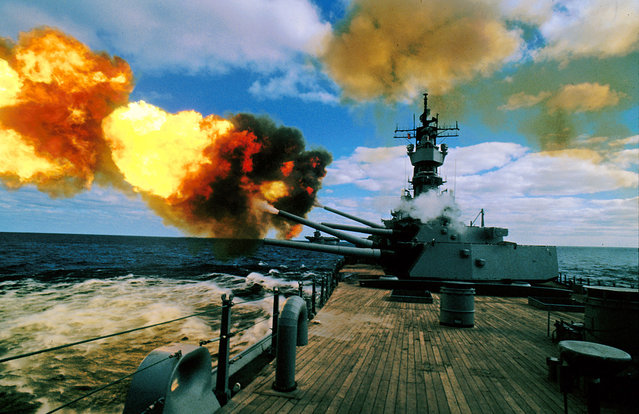
The battleship USS Iowa fires its 16-inch guns during duty in the Persian Gulf on December 16, 1987. In 1943, the Iowa ferried President Franklin Roosevelt home from the Teheran Conference, where post-WW II leaders divided up the world. The ship fought battles from the South Pacific to Korea and escorted convoys through the Persian Gulf. Forty-seven sailors died atop its deck when an explosion ripped through a gun turret. Now, the new port for the retired USS Iowa just might be the home of California's annual asparagus festival, the gritty agriculture port town of Stockton on the San Joaquin River, about 80 miles inland from San Francisco. (Photo by Eric Risberg/AP Photo)

The battleship USS Iowa fires its 16-inch guns during duty in the Persian Gulf on December 16, 1987. In 1943, the Iowa ferried President Franklin Roosevelt home from the Teheran Conference, where post-WW II leaders divided up the world. The ship fought battles from the South Pacific to Korea and escorted convoys through the Persian Gulf. Forty-seven sailors died atop its deck when an explosion ripped through a gun turret. Now, the new port for the retired USS Iowa just might be the home of California's annual asparagus festival, the gritty agriculture port town of Stockton on the San Joaquin River, about 80 miles inland from San Francisco. (Photo by Eric Risberg/AP Photo)
Details
12 Apr 2018 00:05:00
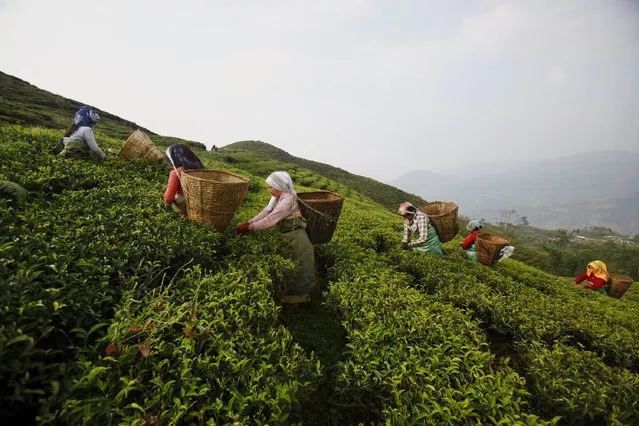
In this Sunday, November 16, 2014 photo, Nepalese women pick tea at a tea garden of Kanyam in Illam district, around 500 kilometers (310 miles) from Katmandu, Nepal. Illam is a hilly district of tea gardens and estates in eastern Nepal's Himalayan region with one of its largest and most productive tea estate being Kanyam estates. (Photo by Niranjan Shrestha/AP Photo)

In this Sunday, November 16, 2014 photo, Nepalese women pick tea at a tea garden of Kanyam in Illam district, around 500 kilometers (310 miles) from Katmandu, Nepal. Illam is a hilly district of tea gardens and estates in eastern Nepal's Himalayan region with one of its largest and most productive tea estate being Kanyam estates. The district produces orthodox tea, hand-processed or machine rolled, which is generally exported to international markets, specially Europe and the United States. Most of the tea pickers here are paid 186 Nepalese Rupees (US $ 2) for 8 hours of work everyday. (Photo by Niranjan Shrestha/AP Photo)
Details
19 Nov 2014 14:28:00