Loading...
Done
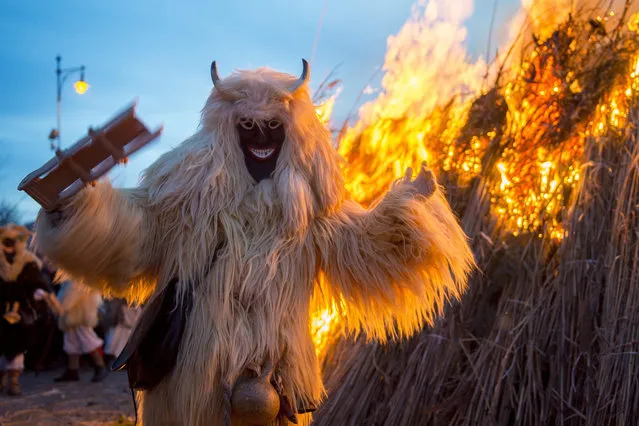
A reveler wearing sheepfur costume is seen in front of a bonfire on which they burn a coffin symbolizing winter during the closing ceremony of the traditional carnival parade in Mohacs, 189 kms south of Budapest, Hungary, 07 February 2016. (Photo by Tamas Soki/EPA)

A reveler wearing sheepfur costume is seen in front of a bonfire on which they burn a coffin symbolizing winter during the closing ceremony of the traditional carnival parade in Mohacs, 189 kms south of Budapest, Hungary, 07 February 2016. The carnival parade of people, the so-called busos, dressed in such costumes and frightening wooden masks, using various noisy wooden rattlers is traditionally held on the seventh weekend before Easter to drive away winter, and is a revival of a legend, which says that ethnic Croats ambushed the Osmanli Turkish troops, who escaped in panic seeing the terrifying figures during the Turkish occupation of Hungary. (Photo by Tamas Soki/EPA)
Details
09 Feb 2016 14:02:00
A woman aims a World War II machine gun at a military show during celebration of the Defenders of the Fatherland Day in St.Petersburg, Russia, Tuesday, February 23, 2016. The day, celebrated in Russia on February 23, honors the nation's military and is a nationwide holiday. (Photo by Dmitri Lovetsky/AP Photo)

A woman aims a World War II machine gun at a military show during celebration of the Defenders of the Fatherland Day in St.Petersburg, Russia, Tuesday, February 23, 2016. The day, celebrated in Russia on February 23, honors the nation's military and is a nationwide holiday. (Photo by Dmitri Lovetsky/AP Photo)
Details
24 Feb 2016 13:30:00
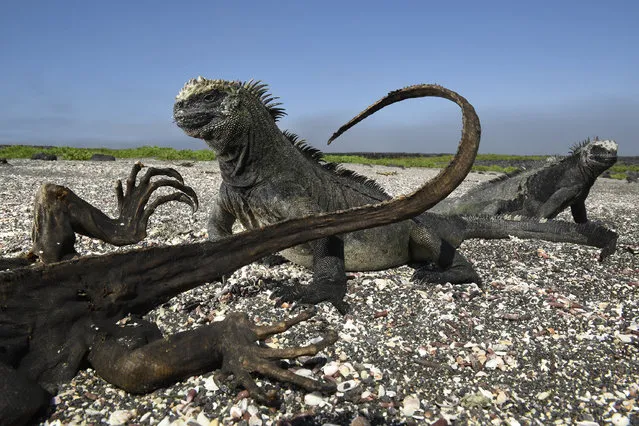
Galapagos – Rocking the Cradle: Four major ocean currents converge along the Galapagos archipelago, creating the conditions for an extraordinary diversity of animal life, April 25, 2016. The islands are home to at least 7,000 flora and fauna species, of which 97 percent of the reptiles, 80 percent of the land birds, 50 percent of the insects and 30 percent of the plants are endemic. The local ecosystem is highly sensitive to the changes in temperature, rainfall and ocean currents that characterize the climatic events known as El Niño and La Niña. These changes cause marked fluctuations in weather and food availability. Many scientists expect the frequency of El Niño and La Niña to increase as a result of climate change, making the Galapagos a possible early-warning location for its effects. (Photo by Thomas P. Peschak for National Geographic/World Press Photo)

Galapagos – Rocking the Cradle: Four major ocean currents converge along the Galapagos archipelago, creating the conditions for an extraordinary diversity of animal life, April 25, 2016. The islands are home to at least 7,000 flora and fauna species, of which 97 percent of the reptiles, 80 percent of the land birds, 50 percent of the insects and 30 percent of the plants are endemic. (Photo by Thomas P. Peschak for National Geographic/World Press Photo)
Details
16 Apr 2018 00:01:00